
Sleeping on the ground is only as good as the mat beneath you, and the right self-inflating model can turn a restless backcountry night into actual recovery. Whether the goal is shaving grams from a thru-hike kit, building a car-camping sleep system, or fitting a custom shape into a Model Y, foam-and-air hybrid pads fill a specific niche. This lineup spans ultralight summer designs, four-season foam workhorses, and Tesla-tailored geometry, so the strengths line up clearly with real use cases.
The Main Contenders
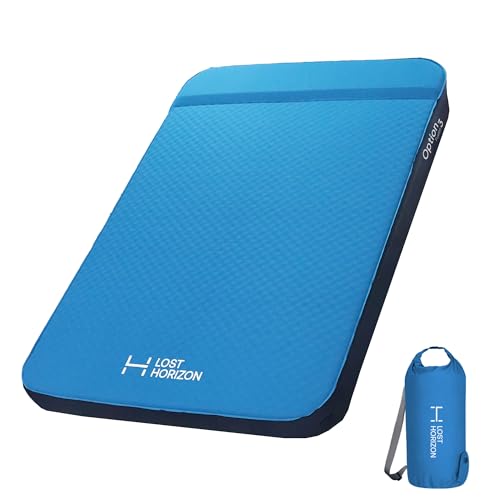
Lost Horizon Self-Inflating Foam Camping Mattress, Full, 3″ Thick

Lost Horizon Self-Inflating Foam Camping Mattress for Model Y

Exped Ultra Ultralight Inflatable Backpacking Sleeping Pad

Self Inflating Sleeping Pad with Electric Pump, 4″ Thick

Lost Horizon Option3 Self-Inflating Foam Camping Mattress, Full, 4.5″

Lost Horizon Option3 Self-Inflating Foam Camping Mattress, Slim Single, 3″
More Details On Our Top Picks
The Full-size 3″ Lost Horizon lands squarely in car-camping territory, where pack size matters less than a flat, cushioned sleep. The 10-pound foam fill absorbs the lumps that air-only pads let through, which matters on a tent floor with a thin footprint. A 400-pound capacity broadens who can sleep comfortably without bottoming out.
For campers driving to a site and unloading once, this mat handles two-season shoulder use well. Compared with the Exped Ultra below, it’s heavier and bulkier, but the foam core compensates on rocky ground where air mats can feel bouncy. The trade-off shows up on the trail: at 10 pounds, it isn’t really a backpacking pad.
What It Does Well
- 3-inch foam core cushions pressure points for side sleepers tossing on a tent floor
- 400-pound weight capacity handles two adults sprawled across a full-size layout
- Self-inflating design saves the lung power that air-only pads demand
- Full dimensions spread across a wide tent or SUV cargo area without gaps
Things To Consider
- 10-pound carry weight rules out long-distance hiking trips
- Foam absorbs moisture in damp conditions, so a dry storage routine matters
Made For
Weekend car campers and basecamp setups who want foam comfort without the bulk of a thicker pad.
Consider Something Else When
Long-distance backpackers should reach for the Exped Ultra Ultralight Inflatable Backpacking Sleeping Pad, which sheds serious weight.
This mat solves a very specific problem: sleeping in a 2-row Tesla Model Y without wrestling ill-fitting rectangles around seat brackets. The custom geometry fills the cargo area with 4.5 inches of foam fill, which is thicker than the standard Full 3″ model above. A 440-pound capacity broadens who can use it.
The real upside is the fit, since foam pads that don’t match the cargo floor leave gaps that shift around at night. Tesla owners running camping mode get a flat surface designed for the trunk, with enough loft to feel like a real bed. Anyone without a 2-row Model Y should skip this and look at a more general-purpose shape.
The Helpful Details
- Custom-cut dimensions eliminate the gap problem that generic mats leave in a Model Y
- 4.5-inch foam thickness puts a meaningful buffer between sleepers and the metal floor
- 9-pound foam core inflates on its own, with top-off breaths fine-tuning firmness
- 440-pound capacity supports two adults sharing the back of the vehicle
Trade Offs
- Fit is restricted to 2-row Model Y layouts, so it doubles as a poor backyard pad
- Storage size is large enough that it stays in the car rather than riding in a pack
Who Should Grab It
2-row Tesla Model Y owners who camp out of the cargo area on weekends and want a pad that actually fits the geometry.
Where Another Pick Suits Better
Tent campers who want the same 4.5-inch foam profile should look at the Lost Horizon Option3 Full, 4.5″ pad below.
The Exped Ultra lives in a different weight class than everything else here, and that’s the point. Its AIRMAT technology runs air-insulated chambers head-to-toe for a 3-inch sleep surface that comes in at under a pound, built for fast-and-light trips where every gram is accounted for. Summer thru-hikers and bikepackers gain rest without the bulk penalty that foam pads carry.
On the trail, the stability of head-to-toe chambers matters more than people expect, because air-only pads without that structure feel floaty under the hips. The Exped keeps a flat sleeping platform that holds a sleeping bag in place. The honest read is that this is a three-season design, so shoulder-season trips into frost demand the foam options below.
Real Benefits
- Sub-1-pound carry weight disappears into a pack’s side pocket
- AIRMAT head-to-toe chambers reduce the bouncy, unstable feel of flat air mats
- 3 inches of loft provides real pressure relief for side sleepers on hard ground
- Compact packed size leaves room for shared shelter and cooking gear
Worth Noting
- Air-only construction needs lung power or a pump to inflate at altitude
- Summer-focused design runs cold on frost nights without supplemental insulation
- Thin fabric demands careful site selection to avoid abrasion on rocky ground
Key Specs
Who Will Love This
Fastpackers, thru-hikers, and bikepackers who count ounces and stick to three-season trips.
Look Elsewhere When
Cold-weather campers should consider the LLUAII Self Inflating Sleeping Pad with Electric Pump for higher insulation and four-season usability.
Most self-inflating pads still demand lung-driven top-off breaths, but the LLUAII integrates an electric pump that automates the whole cycle, with one-touch inflation and deflation that runs on its own power. The 4-inch foam fill delivers generous loft, and the built-in pillow removes one more piece of sleep kit from the packing list. A 9.5 R-value (a measure of insulation, where higher numbers block more cold from the ground) puts this firmly in four-season territory for campers who brave shoulder-season frost.
For car campers, truck-bed sleepers, and anyone setting up in a cabin, the electric pump pays off in setup speed. Compared with the Lost Horizon Option3 below, this one inflates without breath, but the foam core is 0.5 inches thinner. The trade-off is weight: a built-in pump and battery add bulk, so this isn’t a backcountry piece.
A Few Highlights
- One-touch electric pump inflates and deflates without manual effort
- 4-inch foam loft cushions side sleepers on hard truck or cot platforms
- 9.5 R-value extends usability into late-fall and early-spring nights
- Built-in pillow removes one accessory from the sleep kit
Points To Keep In Mind
- Vacuum packaging requires a full first-use inflation with a 30-minute rest before sleeping
- Battery-dependent pump adds weight compared with pump-free foam pads
Best Suited To
Truck campers, cot sleepers, and four-season car campers who prioritize quick setup over pack weight.
A Better Fit Elsewhere
Backpackers should skip this and pick the Exped Ultra Ultralight Inflatable Backpacking Sleeping Pad instead.
The Option3 Full delivers the thickest foam profile in the lineup, with 4.5 inches of loft and a 12-pound foam core that absorbs pressure points more aggressively than the 3-inch model. Side sleepers tend to feel the difference most, since shoulders and hips compress thinner pads down to ground level. A 440-pound capacity opens the pad to a wider range of body types sharing the surface.
This is a heavyweight mat by backpacking standards, but in a family tent or car-camping setup, the extra foam matters. Compared with the LLUAII above, this one skips the electric pump in favor of pure foam construction, which trades convenience for simpler long-term durability. The honest read: it’s overkill for summer car camping, and exactly right for someone who wants a bed-like surface in the woods.
Features That Help
- 4.5-inch foam thickness keeps side sleepers’ hips and shoulders off the ground
- 12-pound foam fill dampens the lumps that thinner pads telegraph upward
- Full-size layout spans two campers or one sprawled sleeper without seams
- 440-pound weight capacity handles adults, kids, and gear on top
Some Limits To Know
- 12-pound foam core is heavy for any distance beyond the parking lot
- Larger packed size demands a vehicle or large gear tote for transport
- Foam-only design requires manual top-off breaths for personal firmness
Quick Facts
Right Fit For
Side sleepers and cold-night car campers who want the thickest foam pad in the Lost Horizon range.
Skip It When
Anyone hauling gear into a backcountry site should grab the Exped Ultra Ultralight Inflatable Backpacking Sleeping Pad instead.
When the sleeping platform is a narrow tent vestibule, a truck-bed rail, or a vehicle footwell, the Slim Single 3″ solves a geometry problem that full-size pads can’t. Its narrow footprint fits spaces where wider mats buckle or fold, while keeping 3 inches of foam loft for pressure relief. Lightweight enough to toss in a trunk without rearranging the whole cargo area.
Compared with the Option3 Full above, this sacrifices width for packability, so anyone who rolls at night needs to gauge whether the slim width stays under them. The honest read: this is a specialty shape for confined spaces, not a primary family pad. Storage stays simple, since the foam rolls tight and the rolled cylinder fits behind a seat.
Useful Touches
- Narrow profile fits tight truck beds, footwells, and small solo tents
- 3-inch foam loft cushions pressure points despite the slim shape
- Lightweight construction loads and unloads from a vehicle without effort
- Self-inflating foam expands on its own once the valve opens
Honest Caveats
- Slim width may not contain restless sleepers who roll at night
- 3-inch profile leaves less insulation than the 4.5″ Option3 above
Perfect Match For
Solo campers working with narrow sleeping platforms in truck beds, compact tents, or vehicle interiors.
Another Choice May Suit
Campers who want the same 3-inch foam in a more standard size should consider the Lost Horizon Self-Inflating Foam Camping Mattress Full 3″ instead.
What To Weigh Before Picking a Self-Inflating Pad
Three attributes drive most of the comfort difference between self-inflating pads, and each one shifts the use case significantly. Thickness controls how well the pad absorbs pressure points and ground texture, with 3 inches suiting back sleepers and 4.5 inches and up giving side sleepers the hip and shoulder relief they actually need. R-value (the standardized measure of a pad’s resistance to heat flow, where higher numbers mean warmer sleep) determines season range, with summer pads sitting below 2 and four-season workhorses climbing past 6. Pack weight decides whether the pad belongs in a vehicle or on a trail.
The right mat depends on how the trip actually unfolds. Backpackers counting every gram should prioritize weight and packed size over thickness, which is why an ultralight air-focused mat like the Exped makes sense for thru-hikers even though it sacrifices some cushioning. Car campers and basecamp sleepers gain a lot by going thicker, since the vehicle absorbs the weight penalty. Cold-weather sleepers need to match R-value to expected ground temperatures, not air temperatures, since the ground pulls heat faster than the air around the tent.
Build details matter once a mat gets used hard. Foam density affects how well the pad rebounds after a season of rolling, and heavier foam cores typically outlast lighter ones when stored compressed. Valve quality influences long-term sealing, since foam pads with poorly seated valves slowly lose firmness overnight. Cover fabric, when listed, signals abrasion resistance for rocky sites.
What Separates Premium From Basic
Hidden Buying Traps
The most common slip-up is choosing thickness over insulation, since a thick summer-rated pad still leaves a sleeper cold on frost nights. R-value is the better guide for shoulder-season trips, regardless of how lofty the foam feels in the store. Another trap is ignoring packed size: a 4.5-inch foam pad eats trunk space, and shoppers who underestimate that end up leaving the mat at home.
Sizing errors run the other direction. A full-size mat that overlaps a tent’s seams creates a draft channel, while a slim pad that doesn’t reach shoulder-width lets restless sleepers slide off. Matching pad dimensions to the actual sleeping platform, whether that’s a tent floor, truck bed, or vehicle cargo area, prevents both problems.
Where The Extra Money Goes
Higher-tier foam pads tend to buy denser foam that rebounds better after compression, which matters for anyone who stores the mat rolled for months between trips. Premium builds also add better valves, more abrasion-resistant covers, and shaped geometry that fits specific sleeping platforms. For backpackers, premium pricing buys lighter materials and smarter construction that holds up to trail abuse.
The honest case for spending up shows up over years, not weekends. A denser foam core stays supportive after multiple seasons, while a budget pad compresses permanently and feels flat by the second summer. For occasional summer camping, a value-tier pad handles the job. For regular use or cold-weather trips, the upgrade earns its place in comfort and durability.
Closing Thoughts
Self-inflating sleeping mats split into three camps, and the right one depends entirely on where the mat lives. Backpackers want the Exped Ultra’s sub-1-pound carry, car campers and side sleepers want the Option3’s 4.5-inch foam, and Tesla owners get a custom fit from the Model Y-specific pad. Match the mat to the platform and the season, and the rest takes care of itself.