
City and campground water pressure swings harder than most RVers expect. A regulator sits between the spigot and the hose, trimming incoming pressure to a safe band so fittings, PEX lines, and water heaters stop taking punishment. Anyone connecting to unfamiliar taps, especially during travel through mixed municipal systems, gains peace of mind from a solid brass regulator paired with a quality hose and inline filter. The picks below cover the dependable preset workhorses, adjustable models for tricky hookups, and the supporting hose and filter that round out a complete freshwater setup.
A Fast Comparison Of The Options

Camco Brass Marine/RV Water Pressure Regulator

Hourleey Brass RV Water Pressure Regulator with Filter Screen

2PK NSF Certified Inline RV Drinking Water Filter & Hose Protector
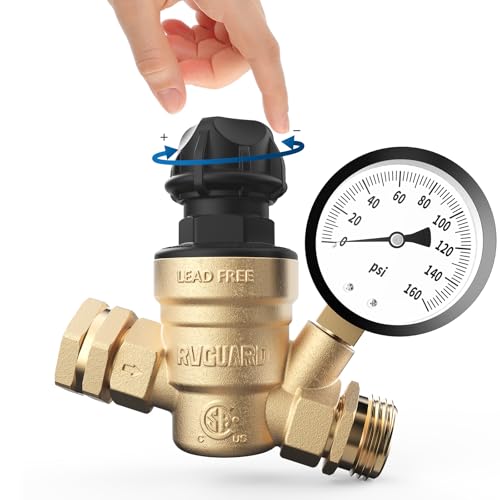
RVGUARD RV Water Pressure Regulator Valve With Adjustable Knob

OULEME 25FT RV Drinking Water Hose, Anti-Kink Flexible

LIULO TOOL RV Water Pressure Regulator with Gauge and Mesh Filter

OULEME Adjustable RV Water Pressure Regulator Valve
Meet The Standout Selections
The Camco preset regulator has earned its place in countless freshwater bays for one simple reason: it does the basic job without fuss. Constructed from lead-free brass, it steps incoming pressure down to a safe level the moment water reaches the hose. For someone plugging into a new campground every weekend, that set-and-forget behavior removes one more decision from setup day.
Unlike the Hourleey screened model reviewed next, this unit keeps the design minimal with no internal filter element. Most owners who already run a separate inline filter appreciate that simplicity. The trade-off shows up at sites with truly erratic pressure where adjustability would be useful.
What Works In Its Favor
- Solid lead-free brass body handles repeated hookups without corrosion concerns
- Pre-set output removes guesswork for owners who do not want to dial in a number
- Compact profile fits inside most wet bay compartments with the hose attached
- Broad thread compatibility with standard 3/4-inch garden hose fittings
Things To Consider
- No built-in screen means sediment-heavy taps can clog downstream fixtures without a separate pre-filter
- Fixed pressure leaves no flexibility when a specific appliance benefits from a lower or higher setting
Feature Snapshot
Right Fit For
Weekend travellers who plug in at familiar parks and want a regulator they never need to think about again.
Swap It Out When
Full-timers bouncing between municipal systems with wild pressure swings should reach for the RVGUARD adjustable regulator instead.
The Hourleey regulator targets first-time owners who want brass construction plus a basic debris screen without committing to a premium tier. The internal stainless filter catches sediment before it reaches the campground hose, which protects aerators and washing machine solenoids over the long run. For a setup where a single regulator needs to do double duty as a basic pre-filter, it earns its place.
Compared with the LIULO TOOL pick reviewed later, the Hourleey keeps things simple with a fixed 40-50 PSI output. Owners who already use a high-quality inline carbon filter, such as the OULEME 2-pack bundled below, gain an extra layer of protection without spending on a fully adjustable brass body.
What It Does Well
- Brass body holds up to repeated pressure cycles without cracking
- Integrated stainless screen reduces sediment reaching faucets and tanks
- Universal 3/4-inch threading matches standard RV hoses
- Output band of 40-50 PSI covers most residential fixtures safely
Worth Noting
- Screen needs periodic rinsing; owners with hard-water sources report faster clogging
- No pressure gauge means blind operation at unfamiliar hookups
- Fixed output cannot be tuned for specialty appliances that prefer lower flow
Built With In Mind
New RVers on a tight budget who want reliable brass plus a basic filter in a single fitting.
Not Your Match When
Anyone wanting real-time pressure visibility should pick up the LIULO TOOL regulator with gauge instead.
This two-pack of inline filters slots between the regulator and the coach, tackling chlorine taste, odor, and sediment that brass alone cannot fix. Owners travelling through older municipal supplies or natural water sources appreciate the upgrade in flavor and the visible reduction in faucet residue. Each cartridge delivers several months of service before needing a swap.
Unlike the brass regulators above, this is a consumable filter rather than a permanent fixture. Pairing it with the OULEME hose covered later rounds out a clean-water setup that protects both plumbing and palates on long trips.
The Value In It
- NSF certification adds confidence in the filtration claims
- Six-stage media tackles chlorine, sediment, and odor in one pass
- Two-cartridge pack keeps a spare ready mid-trip without reordering
- Flexible hose protector section absorbs stress at the connection point
Trade Offs
- Cartridges require replacement every few months depending on usage volume
- Flow rate drops slightly compared with a plain hose connection
Quick Facts
Whose Shelf It Belongs On
Travellers sensitive to chlorine or anyone pulling water from wells and natural sources on long routes.
A Better Fit Elsewhere
Full-timers prioritising pressure control over taste should centre their setup around the LIULO TOOL regulator and skip consumable filters.
The RVGUARD adjustable regulator addresses the most common frustration with fixed regulators: pressure that is too high for a delicate fixture or too low for a shower. A hand-operated knob, clockwise to raise, counterclockwise to lower, lets owners dial in the sweet spot without tools. The 45 PSI factory default is a sensible starting point that most people never need to leave.
Compared with the Camco preset model reviewed earlier, this one trades simplicity for flexibility. Same story with the OULEME adjustable regulator further down the list, though RVGUARD keeps the body lighter and the price friendlier for newcomers testing the waters of adjustable control.
Where It Excels
- Tool-free knob makes live adjustments possible mid-shower without a wrench
- Factory preset of 45 PSI handles most residential hookups correctly out of the box
- Compact brass body fits inside small wet bay doors
- Clockwise increase, counterclockwise decrease logic is intuitive
Room For Improvement
- No pressure gauge means tuning happens blind, which can frustrate first-time users
- Plastic knob can wear after heavy season use, so handle gently at extremes
Feature Card
Perfect Match For
RVers who split time between city water and variable campground pressure and want a single regulator that adapts.
Reach For A Different Pick When
Anyone wanting visual confirmation of the actual number should choose the LIULO TOOL regulator with its built-in gauge.
A regulator is only as good as the hose feeding it, and the OULEME 25-foot hose handles that role without complaint. Lead-free and BPA-free construction keeps drinking water safe, while a hybrid polymer body with a braided middle layer resists the kinking that plagues cheap hoses on cold mornings. The included storage bag makes tear-down at the end of a trip quicker than wrestling a tangled coil.
Unlike the brass regulators and filters above, this entry rounds out the freshwater kit rather than controlling flow. Pair it with the Camco preset regulator for a simple setup, or slot it behind the OULEME adjustable valve reviewed last for full control and clean conveyance.
Noteworthy Benefits
- Lead-free and BPA-free materials keep potable water safe for the family
- Anti-kink design maintains steady flow even on sharp turns toward the spigot
- Standard 3/4-inch aluminum fittings connect to any regulator in this roundup
- Storage bag prevents dirt transfer during compartment transport
Small Caveats
- 25-foot length may fall short at long pull-through sites requiring extra reach
- Hybrid polymer can stiffen in sub-freezing conditions, so winter travellers should drain promptly
Made For
RVers who move sites often and want a hose that coils neatly without fighting back each setup.
Consider Something Else When
Owners needing a longer run for big rig hookups should look for a 50-foot option rather than stretching this one.
The LIULO TOOL regulator is the closest thing on this list to a command centre. Lead-free brass construction handles the safety side, while a clear precision gauge shows the actual number at a glance. The ergonomic adjustable handle tunes pressure smoothly without tools, and a built-in mesh filter catches debris before it reaches the coach.
Compared with the RVGUARD knob-only model reviewed earlier, this unit adds visual feedback and filtration in one body. Where the Camco preset relies on blind trust, LIULO TOOL lets owners see what is happening and react.
Positive Points
- Food-grade lead-free brass resists corrosion across seasons of mixed water sources
- Pressure gauge removes the guesswork from adjustable regulators entirely
- Built-in mesh filter handles light sediment without a separate inline stage
- Ergonomic handle allows one-handed pressure changes mid-use
A Few Limitations
- Higher cost than fixed regulators, which may deter weekend-only RVers
- Mesh filter requires occasional cleaning, especially at sediment-heavy taps
Spec Overview
Best Suited To
Detail-oriented full-timers who treat water pressure as something to monitor and tune rather than ignore.
Look Elsewhere When
Casual weekend campers may find the RVGUARD adjustable valve plenty for their needs at a friendlier price.
OULEME’s adjustable regulator closes the roundup with a sensible middle-ground option for owners who want flexibility without paying for a premium gauge. The tool-free handle turns smoothly, the lead-free brass body handles corrosion, and a silicone-oil-filled gauge keeps the reading stable under vibration. Factory setting sits around 45 PSI, matching the rest of the field.
Compared with the LIULO TOOL model reviewed above, OULEME skips the mesh filter and the food-grade brass marketing in favour of a simpler, lighter package. Owners who already run a separate inline filter, like the NSF certified 2-pack covered earlier, lose nothing by choosing this regulator.
Where It Helps
- Tool-free handle simplifies adjustment for owners who dislike wrenching fittings
- Lead-free brass construction keeps potable water safe
- Silicone-oil gauge resists vibration and stays readable across rough roads
- Handles pressures up to 160 PSI on the inlet side without damage
Points To Note
- No built-in debris screen, so a separate filter is recommended for sediment-heavy sources
- Gauge reads output only; inlet pressure must be inferred from experience
Who Should Grab It
RVers who want adjustable output with gauge feedback but do not need a built-in debris screen.
Where Another Pick Suits Better
Anyone wanting mesh filtration built into the regulator should step up to the LIULO TOOL model instead.
Choosing Rv Pressure Regulators That Actually Protect Your Plumbing
The first decision is material. Lead-free brass has become the standard because it resists corrosion, tolerates temperature swings, and keeps drinking water free from contamination. Plastic regulators exist, but they tend to crack under repeated high-pressure exposure and rarely inspire long-term confidence at busy campsites.
The second decision is fixed versus adjustable output. Fixed regulators ship pre-set around 40-50 PSI, which covers most residential fixtures safely. Adjustable models, like the RVGUARD and OULEME valves above, give owners a knob for tweaking output on the fly when a specific campground pushes too hard or arrives barely above trickle. For travellers who move between known and unknown hookups, that flexibility pays off quickly.
Gauges matter more than most first-time buyers expect. A regulator without a gauge forces blind tuning, which means trusting the factory setting regardless of what the spigot is actually delivering. Models with built-in dials, like the LIULO TOOL regulator, show the number and let owners respond in real time. The trade-off is cost and a slightly larger body.
Filtration deserves a separate look. Brass regulators with built-in mesh screens catch large debris but not chlorine or fine sediment. Owners chasing clean drinking water should plan on adding an inline filter cartridge, such as the NSF certified 2-pack covered above, downstream of the regulator. That pairing handles pressure control and taste in two stages without complicated plumbing.
Finally, fittings and hose quality tie the system together. A regulator with standard 3/4-inch threading accepts any typical RV drinking water hose, including the flexible anti-kink OULEME model reviewed earlier. Cheap hoses kink and starve the regulator of flow, which can make a healthy regulator look underwhelming. Treating the hose as part of the kit, rather than an afterthought, solves that frustration for good.
Key Considerations Across These Picks
Common Shopping Slip Ups
Skipping the regulator because the campground pressure “feels fine” is the most common misstep. Municipal systems regularly exceed 80 PSI, and many RV plumbing components are rated for far less. Owners also forget to budget for a quality hose and inline filter, treating the regulator as a complete solution when it really only manages pressure. Finally, ignoring thread compatibility leads to adapters piled on adapters, each one a potential leak point under sustained pressure.
Where The Extra Money Goes
Premium regulators earn their higher cost through better materials, integrated gauges, and built-in filtration that cheaper models skip. Lead-free brass at food-grade purity costs more to source and machine, while silicone-filled gauges resist vibration that destroys cheaper dials on rough roads. For full-timers and frequent travellers, those upgrades translate into fewer replacements and fewer surprises. Weekend RVers who rarely stray from friendly parks can stay with a solid preset model and pocket the difference.
Closing Remarks
A dependable regulator is one of those quiet upgrades that fades into the background once installed, which is exactly the point. Match the body material, adjustability, gauge, and filter to the kind of trips actually planned, and the freshwater system stops being something to worry about. The picks above cover the common combinations, from set-and-forget brass to fully gauged premium models, so any of them rewards the right owner with years of quiet service.