
Finding the right RV jack isn’t about grabbing the heaviest model on the shelf. It’s about matching lifting capacity, height range, and base footprint to the trailer you actually tow. Weekend campers running a lightweight rig have very different needs than full-time travelers hauling a fifth wheel into soft ground.
The right setup also depends on how you stabilize once parked. Scissor jacks push the trailer frame up from below; tongue jacks lift the front coupler; jack blocks add clearance under soft ground or uneven campsites. Some setups use a combination of all three. The picks below cover each approach, from scissor pairs for travel trailers to drill-compatible tongue jacks that save your back at the hitch.
A Closer Look At The Lineup
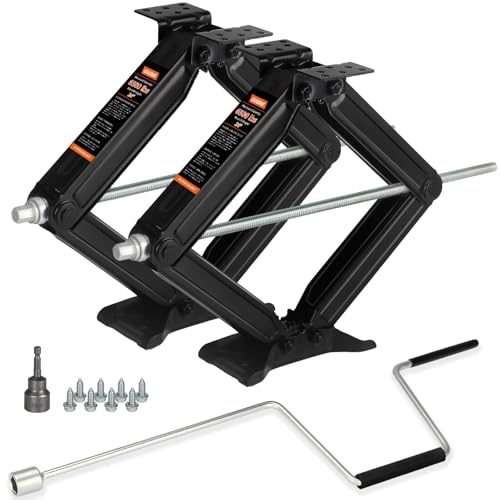
OULEME 6500 lbs RV Camper Scissor Jack 2PK

Andersen Hitches Magnetic Trailer Jack Block

OULEME 6500 lbs RV Camper Scissor Jack 4PK

Hyfico Trailer Jack Block with Bag

CARPEAK 2000 lbs Drill-Compatible Trailer Jack

Kohree 5000 lbs A-Frame Trailer Jack
A Deeper Look At The Lineup
Pair-style scissor jacks handle the most common stabilization job on a travel trailer: pinning the two front corners so the camper stops rocking when someone walks to the back. The OULEME set ships with one manual crank and a drill socket, so setup time stays low even on the first trip out.
For most two-axle travel trailers in the 5,000-lb range, a pair on the front corners handles the heavy lifting. The 6,500-lb capacity per jack leaves headroom for heavier rigs, and the wide base plate keeps each jack planted on asphalt, gravel, or packed dirt.
The Good Stuff
- Wide height range from 4 inches collapsed to 24 inches extended covers most uneven sites
- Wide steel base plate spreads load across soft ground without sinking
- Drill socket adapter speeds up repeated setup at every stop
- Complete kit includes crank handle and mounting hardware out of the box
Points To Note
- Two-pack covers front corners only; larger rigs will need a second set for the rear
- Manual cranking takes effort on the first setup until the drill socket is in play
- Welds and paint commonly need a quick inspection after a winter of storage
Whose Trailer It Belongs On
Travel trailer owners running a single-axle to mid-weight dual-axle rig who want front-corner stabilization without buying four jacks.
A Better Fit Elsewhere
Full-time travelers with long, heavy trailers should reach for the OULEME 4PK instead for full-corner coverage.
Where the OULEME scissor jacks push the trailer up from inside the frame, jack blocks work the other direction. They sit under the jack foot and give it a taller, wider platform to land on, especially helpful at campsites where the ground tilts or turns soft after rain.
The Andersen block leans on a built-in magnet on top to lock onto a round jack pad. The block stays put as the jack lowers onto it, so the usual dance of readjusting by hand drops away. The wide 12-inch base spreads load across grass, gravel, or asphalt.
What Stands Out
- Magnetic top locks to round jack pads without slipping
- 8-inch profile adds real clearance over a steeply sloped site
- Wide 12-inch base resists tipping on soft or uneven ground
- Side finger holes let you grab and reposition without bending into the dirt
Trade Offs
- One block helps one jack; multi-jack rigs need more than one
- Magnet only grips round metal pads, not square footplates
- Stacking two blocks drops capacity sharply, so height is finite
Key Product Details
Right Fit For
RVers who camp on uneven terrain or soft ground and want a quick, no-slip base under a single round jack foot.
Skip It When
Trailer owners with square jack feet should look at the Hyfico Trailer Jack Block, which fits a wider range of foot shapes.
The four-pack version of the OULEME scissor jack covers all four corners of a typical travel trailer in one purchase. Two jacks handle the front corners near the A-frame; the other two stabilize the rear, where rocking tends to be the worst.
Compared to the two-pack covered above, the four-pack just adds two more jacks to the same hardware kit, including extra mounting screws and the same crank and drill socket. The extra pieces mean a complete stabilization setup on day one.
A Few Strong Suits
- Full-corner coverage stops rocking from both front and rear
- Same 6,500-lb capacity per jack as the smaller set
- Drill socket speeds up lifting and lowering at every camp
- Wide base plates keep each jack planted on varied surfaces
Worth Bearing In Mind
- Four jacks means four points to crank on each setup
- Heavier to ship and store than the two-pack
- More mounting points to drill into the trailer frame
Built With In Mind
Long, heavy travel trailer owners who want full-corner stability without buying two separate two-packs.
Another Choice May Suit
Smaller trailer owners who only need front-corner work should save money with the OULEME 2PK.
Where the Andersen block leans on a magnet and a round pad, the Hyfico block goes for universal compatibility. It works under wheels, square jack feet, tongue jacks, and stabilizer feet alike, which makes it useful for anyone running multiple trailer types or lending gear to friends.
The redesigned profile channels water away instead of pooling on top, and the included storage bag keeps the block clean on the way to the site. For shop owners or full-time RVers with one block per trailer, that bag matters more than it sounds.
What Works In Its Favor
- Universal fit works with wheels, tongue jacks, and stabilizers
- Side finger holes simplify pickup and placement
- Stackable design adds height when one block isn’t enough
- Storage bag keeps the block from getting muddy in transit
Small Caveats
- No magnetic top means it can shift on a slick jack foot
- Single block capacity is fine for most rigs but worth checking against heavier fifth wheels
Quick Facts
Who Should Grab It
Multi-trailer households and RVers who want a single block that works under wheels and jacks of every shape.
Consider Something Else When
Anyone who camps often on round-jack setups and wants hands-free placement will appreciate the Andersen Magnetic block more.
Where the OULEME scissor jacks and the Hyfico and Andersen blocks all work at the camper body, the CARPEAK handles the front of the trailer at the coupler. It’s a tongue jack, and the key feature is that it accepts any 20 to 24-volt cordless drill on the top socket, so the lifting work happens at the speed of the drill trigger.
For boat trailers and small utility rigs under 2,000 lbs, hand-cranking a tongue jack gets old fast. The dual-wheel design spreads load at the foot, and the 12-inch lift range covers most drop heights from a standard tow vehicle hitch.
The Practical Payoff
- Drill-compatible top turns hours of cranking into minutes
- Swivel mount folds up out of the way when towing
- Solid steel construction handles repeated seasonal use
- Dual-wheel foot spreads load across softer ground
Some Limits To Know
- 2,000-lb rating rules out heavier campers and most fifth wheels
- Requires a 20 to 24-volt drill on hand, not included
- Not a replacement for scissor jacks at the trailer body
Best Suited To
Boat and utility trailer owners who currently crank a tongue jack by hand and want to speed up every hitch and unhitch.
Look Elsewhere When
Anyone running a heavier travel trailer should consider the Kohree A-Frame jack for more lifting capacity and a galvanized finish.
Like the CARPEAK, the Kohree is a tongue jack that lifts the trailer coupler. The difference is in the load class. Where the CARPEAK tops out at 2,000 lbs, the Kohree handles 5,000 lbs and pairs it with a galvanized coating that shrugs off rain, road salt, and storage humidity.
The adjustable drop leg adds another level of height range beyond the main screw, which matters on A-frame trailers that sit higher than standard bumper-pull hitches. The non-slip side handle keeps cranking comfortable even with cold or wet hands.
Noteworthy Benefits
- 5,000-lb capacity covers most travel trailers and small fifth wheels
- Galvanized steel resists corrosion through wet seasons
- Drop leg extends reach for taller A-frame couplers
- Detachable side handle gives better cranking leverage
Practical Considerations
- Heavier than plastic-bodied jacks, which matters for very light rigs
- Hand-crank only, no drill socket included
- Drop leg adds bulk that needs storage planning
Spec Overview
Made For
A-frame travel trailer owners who store or camp in wet conditions and need corrosion resistance alongside higher lift capacity.
Where Another Pick Suits Better
Boat and utility trailer owners with lighter rigs will find the CARPEAK drill-compatible jack easier on the back.
Matching RV Jacks To The Trailer And The Trip
Capacity, Height, And Ground Type
A jack’s load rating matters most when the trailer sits at the upper edge of its class. A 5,000-lb travel trailer needs jacks that sum to more than 5,000 lbs across the load points. Lift height is the next filter: a jack that maxes out at 18 inches won’t reach a lifted truck hitch. Soft ground, gravel, and tilted sites all demand wider base plates or a jack block layered underneath.
Trailer Type Shapes The Choice
A-frame trailers pair naturally with tongue jacks like the Kohree or CARPEAK, which lift at the coupler. Travel trailers with flat frames along the body want scissor jacks at the corners, such as the OULEME 2PK or 4PK. Anyone running on soft ground or uneven terrain will benefit from adding jack blocks, either the magnetic Andersen or the universal-fit Hyfico.
Drive Speed Versus Hand Cranking
Cordless-drill-compatible jacks save real time when hitching and unhitching repeatedly. Hand-crank models work fine for occasional use, especially on smaller rigs, but anyone unhitching more than a few times per season will feel the difference. Drill compatibility adds convenience at the cost of needing the drill on hand.
Key Considerations Across These Picks
Where Shoppers Go Wrong
The most common mistake is matching jack capacity to trailer dry weight rather than loaded weight, which can run 20 to 30 percent higher. Another is buying short on height range, then discovering the jack can’t reach the tow vehicle hitch on a lifted truck. Skipping base-plate width on soft ground leads to sinking jacks and unstable trailers. Picking a jack by style alone, ignoring whether it’s a tongue jack or a stabilizer jack, is the third trap.
Where The Extra Money Goes
Higher-capacity jacks tend to add thicker steel, galvanized coatings, and better seals against road grime. In the jack-block category, the upgrade typically buys a magnetic top or a universal-fit design, both of which save setup time. For tongue jacks, the premium often pays for drill compatibility, drop legs, and stronger gearing, all of which shorten setup time and extend service life on heavier rigs.
Wrap Up
The right RV jack setup depends less on brand and more on trailer type, loaded weight, and campsite conditions. A two-pack of scissor jacks covers most front-corner work, while a four-pack handles larger rigs. Jack blocks add clearance on soft ground, and a quality tongue jack makes hitching faster. Match the specs to the trailer and the trip, and the rest falls into place.