
A parked travel trailer takes a beating from sun, pollen, tree sap, and surprise hailstorms. Owners who use their rigs seasonally know that a quality cover pays for itself in fewer resealing jobs and a cleaner interior when spring rolls around. The right fit depends on rig length, storage location, and how much wind the cover needs to handle.
The Essentials At A Glance

WanDwel RV Electric Tongue Jack Cover

Safoner Travel Trailer Electric Tongue Jack Cover (Gray)
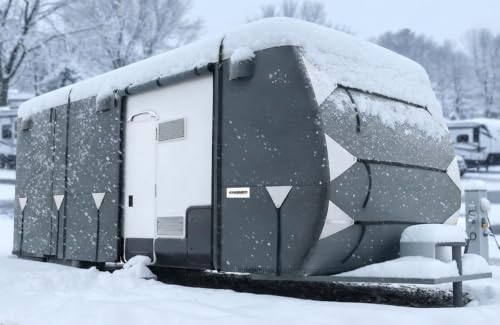
KING BIRD Enhanced RV Cover, 22-24ft

RVMasking Travel Trailer RV Cover, 24-26ft
RVMasking Travel Trailer RV Cover, 31-34ft
RVMasking Travel Trailer RV Cover, 26-28ft
A Breakdown Of The Leading Choices
Electric tongue jacks sit low and exposed, so corrosion at the motor and switch terminals is one of the most common cold-weather failures. This cover from WanDwel wraps that vulnerable hardware in a two-material shell: a PVC coated mesh (a vinyl layer bonded to a woven mesh for tear resistance) paired with Oxford cloth (a tightly woven polyester often used in bags) for shape. For owners who park outdoors year-round and dread the post-storage diagnostic visit, the targeted protection pays for itself the first time a storm rolls through.
Unlike the full-body covers below, this piece only guards the jack assembly, so it pairs well with any rig already using a larger cover. The fit is specific to electric jacks, so verify the jack head dimensions before ordering.
Where It Helps
- PVC mesh blocks rain and snow from reaching the motor housing
- Oxford cloth panels add shape retention during windy weeks
- Shields the wiring harness, a frequent corrosion hotspot
- Reduces UV fading on plastic switch caps and housings
- Lightweight enough to slip on and off without a ladder
Things To Consider
- Covers the jack only, not the full trailer, so it complements rather than replaces a body cover
- Mesh can trap fine grit over a long winter, so a quick brush-off before removal helps the finish last
Made For
Owners storing electric-jack-equipped trailers outside in wet or snowy climates.
Reach For A Different Pick When
Full-body protection is the priority, in which case the RVMasking Travel Trailer RV Cover, 26-28ft is the closer match.
Safoner takes a similar approach to the WanDwel pick, layering heavy-duty PVC with Oxford cloth, then adds a small but useful detail: a chain hook sewn into the cover. That hook lets owners tether the cover down for extra security in gusty storage lots. The gray tone also blends better against darker trailer skirting than lighter alternatives.
This is the pick for someone who wants the same kind of targeted jack protection as the WanDwel model but prefers a neutral color that hides road grime between cleanings.
Advantages To Know
- Chain hook adds a tie-down point beyond the elastic hem
- Gray finish masks dust between maintenance washes
- Heavy-duty PVC top panel resists pooling water
- Compatible with most electric tongue jack shapes
Worth Noting
- Limited size data published, so measuring the jack head before ordering is wise
- The chain hook is helpful in storms but can snag on brush when off-road
The Right Fit
Travel trailer owners who want quick-install jack protection that visually disappears against the trailer frame.
Skip It When
Full-coverage weather sealing matters more, in which case the KING BIRD Enhanced RV Cover, 22-24ft covers the whole rig instead.
KING BIRD targets the popular 22 to 24 ft range, a sweet spot for couples’ trailers and lightweight bunkhouses. The build centers on a rip-stop top panel with double-stitched seams (stitches that overlap at the end of a seam to prevent unraveling under stress) and reinforced stress points around the corners. Gray side panels pair with a white multi-layer roof to bounce UV while shedding water. It’s a thoughtful material split for rigs that bake in summer sun.
For most owners storing a mid-length trailer under trees or beside a fence, this cover offers a step up in tear resistance compared with entry-level all-polyester covers.
Points In Its Favor
- Rip-stop top panel resists small punctures from falling branches
- White roof reflects sunlight, lowering interior heat buildup
- Double-stitched corners handle repeated install cycles
- Two advertised size tiers (18-20 ft and 20-22 ft) bracket the 22-24 ft option for shorter rigs
Honest Caveats
- Zipper access panels vary by production run, so check the listing before assuming easy entry
- Not suited to high-wind open lots without extra under-body straps
Quick Facts
Right Fit For
Mid-length travel trailer owners who want rip-stop reinforcement without stepping into a 30+ ft cover profile.
A Better Fit Elsewhere
Rigs sitting on exposed, windy lots are better served by the RVMasking Travel Trailer RV Cover, 24-26ft with its extra wind straps.
RVMasking’s 24-26 ft cover is the first in this lineup built for high-wind storage. The manufacturer specs an extra-long horizontal strap that wraps beneath the trailer to lock the bottom edge flat. Pair that with two roof straps, an elastic hem, and front-and-rear tension panels, and the cover resists billowing (the ballooning that happens when wind gets under loose fabric) far better than basic covers with only top straps.
The “9-layer” top panel suggests a laminated construction, where multiple thin sheets are bonded together, balancing waterproofing and breathability so trapped moisture can escape.
What Helps Most
- Under-body strap prevents wind from getting under the cover
- Elastic hem keeps the perimeter snug against the trailer base
- 9-layer top panel balances water shedding with vapor escape
- Tension panels at front and rear reduce flapping at the most exposed edges
Potential Drawbacks
- Installation takes longer with the extra straps, so plan a calm-weather afternoon
- Multiple anchor adjusters mean more pieces to keep track of between seasons
Feature Snapshot
Best Suited To
Trailer owners in coastal or plains regions where steady wind makes basic covers flap themselves apart.
Consider Something Else When
The rig runs 30 ft or longer, in which case the RVMasking Travel Trailer RV Cover, 31-34ft fits the longer frame.
At 31 to 34 ft, this is the largest cover on the list and the right call for fifth wheels, toy haulers, and extended-stay rigs. The same 9-layer top and wind-management strap system from the 24-26 ft sibling carry over, which matters more on longer trailers because they catch more crosswind. Measuring carefully is critical at this length: an extra inch of slack at the front becomes three feet of flapping fabric at the rear.
For seasonal owners at long-term storage facilities, the time spent measuring pays off in fewer mid-season adjustment trips.
Everyday Perks
- Largest fit range covers most fifth wheels and toy haulers
- Inherited strap system handles the extra wind load of a longer body
- 9-layer top panel matches the brand’s storm-ready siblings
- Compatible with common rooftop accessories like AC shrouds when properly measured
Soft Spots
- Bigger cover means heavier folded weight, so storage space matters during the travel season
- Longer fabric panels can pool water if the roof isn’t pitched evenly
Who Should Grab It
Owners of long fifth wheels or toy haulers parked on open ground through the off-season.
Swap It Out When
The trailer falls under 28 ft, where the RVMasking Travel Trailer RV Cover, 26-28ft provides a closer fit with less excess fabric.
This is the most popular size band in the RVMasking line because it fits the bulk of bunkhouse family trailers. The 26-28 ft range is where many buyers find themselves: long enough for slide-outs and outdoor kitchens, short enough that a single person can wrestle the cover over the roof. The shared 9-layer top and multi-strap system keeps it consistent with the rest of the family.
For most family-sized rigs parked outside through more than one season, this is the safest middle-of-the-road choice.
A Favorable Mix
- 26-28 ft range covers common bunkhouse layouts
- 9-layer top balances waterproofing and breathability
- Multi-point strap system matches the brand’s storm-ready siblings
- Elastic hem supports a cleaner install on moderately sized rigs
Points To Keep In Mind
- Verify slide-out dimensions before ordering; an extended slide can stretch the fit range
- Some roof accessories may need temporary removal for a flush fit
At A Glance
Whose Shelf It Belongs On
Family trailer owners who want brand-consistent wind protection in a versatile mid-length size.
Not Your Match When
The rig runs under 24 ft or over 30 ft, where the KING BIRD Enhanced RV Cover, 22-24ft or the RVMasking Travel Trailer RV Cover, 31-34ft fit better.
Matching A Cover To Your Storage Conditions
Cover choice starts with the measurement, not the brand. Measure the trailer from the front cap to the rear bumper, including any spare tire or hitch accessory that adds length. Add the rooftop accessories that need accommodation: air conditioners, antennas, satellite dishes. A cover that’s an inch short leaves a gap that funnel water straight to the roof seam, and a cover that’s a foot long turns into a sail in any breeze.
Match the cover to the storage location. Tree-shaded driveways need puncture-resistant top panels but rarely face serious wind. Open-lot storage facilities need multi-point anchoring, especially any under-body strap that prevents billowing. Coastal owners should look for laminated top panels that release trapped vapor, since salt air plus trapped moisture accelerates metal corrosion faster than rain alone.
Material Layers And Why They Matter
A single-layer polyester cover keeps rain off but traps condensation underneath, which can fog gel-coat finishes and feed mildew on rubber roof membranes. Multi-layer builds sandwich a breathable membrane between an outer water-shedder and an inner soft liner. The middle layer is what separates a budget cover from one that protects for five seasons instead of two.
Strap Systems And Wind Behavior
Top-strap-only covers rely on gravity and friction to stay put. Add an under-body strap plus elastic hem, and the cover behaves like a fitted sheet instead of a tablecloth. Tension panels at the front and rear cap, where wind hits hardest, reduce the slow stretching that turns a snug cover into a loose bag after a few months.
Component Covers Versus Full-Body Covers
Component covers, such as the WanDwel and Safoner tongue jack options, solve one problem well. They’re useful for owners who already have a full-body cover or who store indoors and only need targeted weather sealing on vulnerable hardware. Full-body covers handle everything else but rarely include jack-specific protection, so the two categories complement each other rather than overlap.
Reading The Size Tier Listings
Manufacturers often list the same cover under several fit ranges. Check whether the model offers a size bracket that includes your measured length, and confirm the listed dimensions in the listing details before ordering. Two inches of measurement error at 30 ft is a small percentage, but a cover that misses by even a few inches at either end will leak at the seams.
Key Differences Worth Knowing
Where Shoppers Go Wrong
The most common slip-up is ordering by trailer class instead of measured length. A “26 ft” trailer class often refers to the floor length, not the total length including the hitch and bumper. Measure end to end and add any rooftop accessories that protrude above the roofline.
Another frequent miss is skipping the under-body strap on long covers. Top straps alone handle a calm weekend, but a single storm can leave the cover wrapped around a fence post a hundred feet away. Owners in wind-prone regions should treat the under-body strap as standard, not optional.
Where The Extra Money Goes
Higher-tier covers tend to spend the budget on three upgrades: laminated waterproofing instead of single-layer coatings, rip-stop top fabric instead of plain weaves, and multi-point anchoring instead of basic top straps. Each upgrade costs real money but pays back across multiple seasons.
Premium pricing also tends to include better zipper access, which matters more than it sounds. Zipper doors save the hassle of fully removing the cover every time someone needs into the rig, and they’re worth the upgrade for any trailer that’s accessed during storage.
Wrap Up
Start with a tape measure and a clear view of the storage site. Pick the fit range that matches the measured length, then add the anchoring and material features the location demands. The right cover turns seasonal storage from a constant worry into a set-and-forget routine.