
Lawn maintenance doesn’t have to eat into Saturday mornings anymore. For homeowners with mobility concerns, busy schedules, or simply a desire to reclaim their weekends, remote control and robotic mowers offer a genuinely different ownership experience. The four models below span everything from hillside workhorses to small-lawn specialists, each with a distinct approach to keeping grass in check without a person behind the wheel.
A Side-By-Side Look
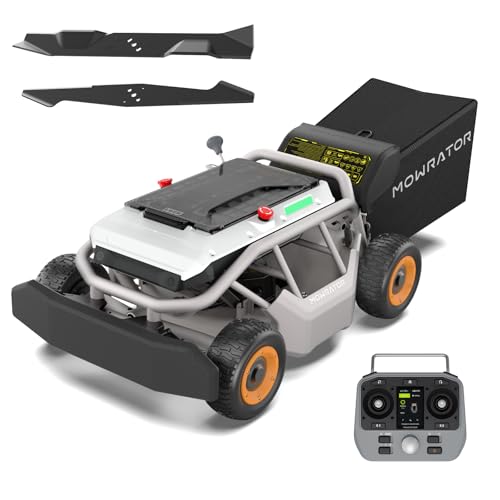
Mowrator S1 4WD Remote Control Lawn Mower 21-Inch

LEBOSBO V3 AI Vision Robotic Lawn Mower
YARDCARE V100 Robot Lawn Mower HD Vision

YARDCARE M800Plus GPS & 3D Vision Robot Mower
What Each Pick Brings To The Table
Where the rest of this list leans toward compact robotic mowers that quietly disappear into hedges, the Mowrator S1 takes a different road entirely. This is a genuinely remote-controlled unit, operated with a handheld transmitter rather than left to wander on its own schedule. The 21-inch cutting deck and four-wheel-drive layout position it closer to a traditional riding mower in capability, while the wireless control lets the operator stay off the seat entirely.
That makes it a strong fit for properties the other three picks simply can’t handle. Steep grades up to 37 degrees, rough terrain, and larger parcels all fall within its wheelhouse. Compared to the LEBOSBO V3 and YARDCARE siblings, this one trades silent autonomy for active, joystick-style guidance and serious traction. Homeowners managing acreage, sloped lots, or simply wanting a mower that responds like a drone on the ground will find its purpose refreshingly direct.
Everyday Advantages
- All-wheel-drive traction handles slopes that stop conventional robotic units in their tracks.
- 21-inch deck reduces total cutting time on larger properties.
- Handheld remote lets the operator stand at a safe distance from slopes and uneven ground.
- 18Ah battery capacity supports extended sessions before recharging.
Trade-Offs To Consider
- Larger physical footprint means tighter storage requirements in a standard garage.
- Active remote operation still requires the user’s attention, unlike set-and-forget robotic alternatives.
- Commonly reported terrain performance suggests very wet grass may reduce grip on steeper sections.
Key Product Details
Built With In Mind
Homeowners with sloped, uneven, or larger-than-average lawns who want active control rather than autonomous scheduling.
Consider Something Else When
Those with small, flat lawns under 1,600 square feet will get more value from the LEBOSBO V3’s autonomous setup.
The LEBOSBO V3 is built for the kind of lawn most suburban homes actually have: small, fenced, and full of garden beds the mower needs to avoid. AI vision (camera-based obstacle detection, rather than buried boundary wires) gives it a sense of what’s grass and what’s not, while a 32-foot magnetic strip lets owners define no-go zones without digging up the yard. That’s a meaningful upgrade in convenience for anyone who’s installed a traditional perimeter wire before.
Coverage tops out at 1,600 square feet, which positions the V3 firmly in the compact-yard category. It runs quieter and lighter than the Mowrator S1, and the setup is closer to plug-and-play than to weekend project. Compared to the YARDCARE V100 reviewed below, the LEBOSBO V3 leans harder into AI-based pathing, while the V100 emphasizes straightforward camera navigation. Most urban homeowners with modest lots will find the V3’s footprint and feature balance well-judged.
The Case For It
- AI vision lets the mower distinguish grass from non-grass areas, reducing wasted passes on pavement.
- Magnetic strip no-go zones install in minutes without digging trenches.
- Compact footprint suits narrow side yards and tight storage spaces.
Points To Keep In Mind
- 1,600-square-foot coverage leaves larger properties out of reach.
- Camera-based navigation may struggle in low-light dawn or dusk runs without adequate ambient light.
- Magnetic strips require occasional repositioning as landscaping changes.
Whose Shelf It Belongs On
City and suburban homeowners with lawns up to roughly 1,600 square feet and a few garden features to protect.
Reach For A Different Pick When
Owners managing half an acre or more should consider the YARDCARE M800Plus, which covers significantly more ground with GPS mapping.
The YARDCARE V100 occupies a useful spot in the lineup: a vision-guided robotic mower aimed squarely at first-timers. HD visual sensing pairs with bumper detection, and the AI layer reportedly distinguishes up to 150 different obstacle types. For someone who has never owned a robot mower and wants the gentlest possible entry point, that combination reads as reassuringly thorough.
Coverage is rated for small lawns up to 1,600 square feet, which places it in the same general territory as the LEBOSBO V3. The practical difference comes down to navigation philosophy: where the LEBOSBO leans on no-go magnetic strips, the V100 puts more weight on visual scene recognition. Owners who want a mower that simply figures things out from a camera feed, rather than relying on physical barriers, will appreciate the design. It’s also a sensible match for households with curious pets or frequently moved garden decor.
Practical Advantages
- HD vision system can recognize a wide range of obstacles without boundary wires.
- Bumper sensor handles blind-spot collisions gracefully, automatically adjusting the path.
- Simple initial setup makes it approachable for first-time robotic mower owners.
Where It Is Less Suited
- Coverage tops out around 1,600 square feet, so larger suburban lots will need a different unit.
- Camera-based navigation can lose accuracy in heavy shade or after dark without supplemental lighting.
- Reported behavior suggests obstacle detection improves after the mower learns the lawn’s layout.
Right Fit For
First-time robotic mower owners with small, well-defined lawns who value a gentle learning curve over advanced features.
Skip It When
Households needing to cover more than a modest yard should look at the YARDCARE M800Plus, which handles over five times the area.
The M800Plus stretches what robotic mowing can reasonably cover. With GPS mapping and 3D vision working together, it handles lawns up to roughly 8,611 square feet without the perimeter wire that older robot mowers demanded. That’s a meaningful step up from the V100 and LEBOSBO V3, both capped near 1,600 square feet, and it puts this unit in reach of mid-size suburban lots rather than just postage-stamp yards.
The 32.8-foot magnetic stripe keeps no-go zone control in the user’s hands, while app-based scheduling and auto-charging handle the day-to-day operation. Bow-shaped mowing paths add a layer of efficiency on more open lawns, and obstacle avoidance draws on both the camera system and physical sensing. For shoppers comparing the M800Plus to the Mowrator S1 earlier in this list, the divide comes down to autonomy versus active control: this one does the work itself once configured, while the S1 stays under operator command.
What Pays Off
- GPS and 3D vision together enable cordless setup without buried boundary wires.
- 8,611-square-foot coverage supports mid-size lots that overwhelm smaller robotic units.
- App control and auto-charging keep daily operation genuinely hands-off.
- Bow-shaped path planning improves efficiency on wider, open lawn sections.
Worth Bearing In Mind
- Owners with grass over 2.6 inches tall may need to do an initial manual trim for clean baseline cutting.
- GPS-assisted navigation depends on a relatively clear sky view, so dense tree canopy can affect accuracy.
- Magnetic stripe no-go zones require repositioning whenever the garden layout shifts.
Feature Snapshot
Who Should Grab It
Suburban homeowners with mid-size lawns up to roughly a fifth of an acre who want full autonomous operation with smart mapping.
A Better Fit Elsewhere
Those with steep, rough terrain will get more from the Mowrator S1’s active remote-control setup and four-wheel-drive traction.
Picking The Right Robotic Mower For Your Yard
Lawn size sets the first boundary. Units like the LEBOSBO V3 and YARDCARE V100 are built for compact lots around 1,600 square feet, while the M800Plus opens up mid-size properties, and the Mowrator S1 tackles terrain that defies smaller units entirely. Measure the actual mowable area, excluding house footprint, garden beds, and patios, before getting attached to a coverage number.
Slope and terrain matter just as much as flat square footage. Most robotic mowers handle gentle grades comfortably, but anything over 20 degrees typically calls for four-wheel-drive or active remote control. The Mowrator S1 climbs to 37 degrees, which puts it in a category most autonomous units cannot touch.
Navigation style shapes daily experience. Boundary-wire systems require installation work upfront but tend to be predictable. Camera-based and GPS-assisted models skip the digging but depend on lighting, sky view, and a learning period. Magnetic no-go strips offer a middle ground: physical, repositionable, and quick to install.
For most suburban shoppers, a robot mower pays off when weekly time savings outweigh the upfront cost and the small bit of seasonal maintenance, like blade replacement and dock cleaning, that comes with ownership. Larger properties and steep terrain shift the calculus toward remote-control or heavy-duty options, where capability matters more than full autonomy.
Key Considerations Across These Picks
Pitfalls Shoppers Hit
A common slip is matching a mower to total property size rather than actual grass area. Houses, driveways, and garden beds eat into that number fast, and undersizing leaves the unit running constant recharge cycles. Another trap is ignoring tree canopy: GPS-assisted mowers like the M800Plus rely on reasonable sky visibility, so heavily shaded lawns can throw off their accuracy. Buyers also tend to skip planning for the dock’s location, which needs a flat, accessible spot near a power outlet and out of pooling water.
Where The Extra Money Goes
Higher-tier models in this category buy three meaningful upgrades: stronger navigation (GPS plus 3D vision versus a single camera), far larger coverage areas, and traction systems for tougher terrain. The Mowrator S1’s four-wheel-drive layout and the M800Plus’s GPS mapping both justify their step up for shoppers who actually need them. For a small, flat lawn, that spending rarely translates into better results; for sloped or larger properties, it’s the difference between a useful tool and a frustrating one.
Final Verdict
The right remote control lawn mower depends on lawn size, terrain, and how hands-on the owner wants to be. The Mowrator S1 leads for steep or rough ground, the LEBOSBO V3 and YARDCARE V100 serve compact lots well, and the M800Plus brings GPS-level autonomy to mid-size yards. Matching the unit to the property, rather than chasing features, tends to deliver the cleanest result.