
Compressed air cans have been the default dusting tool for years, but they run dry, cost a small fortune over time, and leave the planet with another empty metal cylinder to recycle. Portable air blowers solve that loop with a rechargeable motor, swappable nozzles, and enough thrust to handle keyboards, camera gear, car interiors, and even workshop corners. This roundup focuses on compact cordless models that genuinely replace disposable cans for everyday cleaning, with attention to airflow strength, runtime, ergonomics, and accessory kits.
Your Options, Compared
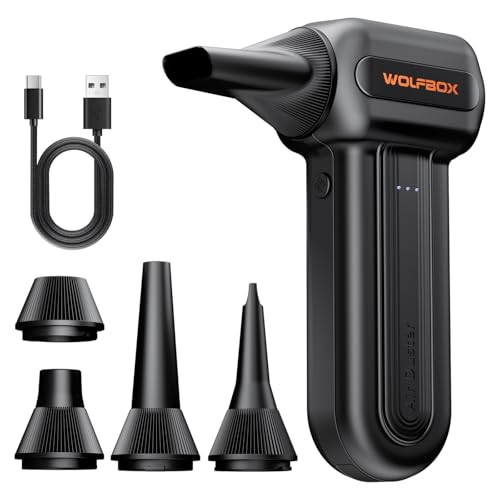
WOLFBOX MF60 Compressed Air Duster, 3-Speed Adjustable, Electric, Cordless

WOLFBOX MF70 Compressed Air Duster, 3-Speed Adjustable, Electric, Cordless

WOLFBOX MF100 Compressed Air Duster, 150000RPM Turbo Fan, 45 m/s Airflow

WOLFBOX MF200-2PK Compressed Air Duster, 2 Swappable Batteries & Case

WOLFBOX MegaFlow 50 Compressed Air Duster, 110,000 RPM, 3-Gear Adjustable

WOLFBOX MF200 Compressed Air Duster, Removable Battery, Car Cleaning, Home

Compressed Air Duster & Vacuum Cleaner, 2-in-1 130000RPM Cordless Air Blower
The Strengths Of Each Pick
The MF60 sits in that useful middle ground where the motor has enough muscle to clear a sticky keyboard or a dusty radiator fin, but the body still slips into a desk drawer or a laptop bag without complaint. At roughly half a pound, it’s the kind of tool that ends up living on a workstation rather than buried in a closet. For most daily cleaning, three speed settings cover the spread from delicate camera sensors to a quick blast across a fan grill.
Compared with the heavier MF70 below, this one trades a bit of top-end thrust for portability, and that swap usually works out in its favor for routine household chores. Owners with multiple PCs, gaming rigs, or a small home office tend to get the most out of it.
Why It Works Well
- Three speed settings match the task, from gentle puffs on optics to heavier bursts in crevices.
- Weighs around 0.5 lb, so wrist fatigue stays low during longer dusting sessions.
- Cordless design means no outlet hunting mid-cleanup.
- Rechargeable battery replaces disposable cans, trimming ongoing cost.
Things To Consider
- Top gear drains the battery faster than lower settings, so longer jobs may need a recharge break.
- The compact body can feel small in larger hands; the grip works best with a pinch hold.
Who Should Grab It
Remote workers and casual PC owners who want a reliable daily cleaner without paying for workshop-grade hardware.
Skip It When
The WOLFBOX MF100 makes more sense for those regularly clearing thick dust from radiators or large PC cases.
The MF70 nudges upward from the MF60 with a similar three-speed architecture, aimed squarely at anyone who wants finer control over how hard the air hits a surface. Stepped RPM settings let users dial in a softer puff for camera gear or a firmer push for vents and grills. In a busy workspace where different jobs happen back-to-back, that level of precision saves time and nerves.
It’s a sensible pick for PC builders and tinkerers, since the same tool can clean a freshly assembled motherboard and then move on to a dusty case interior without swapping equipment. The trade-off shows up in size: this is a slightly larger unit than the MF60, so it doesn’t disappear into a bag quite as easily.
The Upside
- Three distinct speed modes give measurable control for different materials and surfaces.
- Cordless operation means the work happens wherever the mess is.
- Rechargeable battery keeps recurring costs low versus disposable cans.
Points To Note
- A larger chassis may feel bulky during long, overhead cleaning angles.
- Top speed is identical to the MF60, so shoppers chasing maximum airflow should look at the MF100 instead.
- No swappable battery here, so marathon sessions require a recharge wait.
Made For
PC builders, hobbyists, and home techs who want measured speed control rather than a single fixed blast.
Where Another Pick Suits Better
The WOLFBOX MF200-2PK suits detailers who need uninterrupted runtime through a swappable battery setup.
Where the MF60 and MF70 stop, the MF100 keeps pushing. A 150,000 RPM turbo fan and 45 m/s wind speed put this model into territory once reserved for shop-grade electric dusters. Stubborn dust wedged between radiator fins, pet hair caught in HVAC vents, or crumbs lodged under car seat rails all bow to that kind of thrust.
For users who clean less often but more thoroughly, the extra airflow is the difference between wiping a surface and actually clearing it. The catch shows up in the hand: the motor pulls more current, so runtime on top gear is shorter than on smaller units.
A Favorable Mix
- Top-tier airflow at 45 m/s clears compacted dust that lower-RPM models leave behind.
- Three adjustable speeds handle both heavy jobs and delicate surfaces.
- Bundled nozzles and brushes reach tight crevices and intricate components.
Trade Offs
- Top-speed runtime is shorter than the MF60 and MF70, so big jobs may need pacing.
- The motor’s thrust can scatter lightweight debris if the nozzle sits too close.
Feature Snapshot
Who It Suits Best
Workshop tinkerers, PC enthusiasts with large cases, and car owners clearing vents and trim.
Look Elsewhere When
The WOLFBOX MegaFlow 50 makes more sense for travelers who want something lighter than the MF100.
The MF200-2PK is built around a simple promise: never run out of power mid-job. Two swappable batteries and a hardshell case turn this kit into a portable workstation, especially for techs who clean gear in the field or detailers working through multiple vehicles in a day. The included case keeps nozzles, brushes, and batteries organized, which sounds small until a third job rolls in.
Compared with the single-battery MF200 listed later, the bundle’s value is uptime, not raw power. That orientation makes it a natural fit for professional routines where downtime matters.
Noteworthy Benefits
- Two batteries eliminate the recharge pause between long cleaning sessions.
- Hardshell case protects the tool and accessories during transport.
- Built on the MF200 platform for strong airflow in professional scenarios.
- Swappable design extends the kit’s working life as batteries age.
- Useful for mobile detailers who clean on-site rather than in a fixed shop.
Points To Keep In Mind
- Bundled kit costs more than single-battery alternatives.
- Spare batteries add some bulk to the carry setup.
Right Fit For
Mobile detailers, IT professionals, and serious hobbyists who can’t afford a recharge break in the middle of a job.
Swap It Out When
Casual at-home cleaning is better served by the lighter WOLFBOX MF60, which keeps cost and size down.
The MegaFlow 50 is the smallest member of the WOLFBOX family, weighing just 0.45 lb and slipping into a jacket pocket or camera bag without protest. The three gears hit 110,000 RPM at the top end, which is plenty for travel touchups, quick keyboard blasts, and clearing crumbs from a car cup holder. For someone who cleans as a side effect of moving around, the size matters more than peak thrust.
It also serves as an easy entry point into the cordless duster category. The included nozzles cover most everyday jobs, and the fast-charging battery means short top-ups between trips.
Features That Help
- 0.45 lb body keeps the tool barely noticeable in a bag.
- Three gears cover gentle and firmer cleaning modes.
- Four included nozzles handle common tasks straight out of the box.
- Fast charging reduces downtime between sessions.
Soft Spots
- Smaller battery means shorter continuous runtime than larger siblings.
- Not built for heavy workshop dust loads.
Best Suited To
Frequent travelers, photographers, and minimalists who want a grab-and-go cleaner for small jobs.
Where Another Pick Suits Better
The WOLFBOX MF100 fits better when cleaning depth outweighs portability in a typical session.
The single-battery MF200 brings workshop-style endurance to a cordless frame. A 22.2Wh removable battery delivers up to 100 minutes of operation at the lowest speed setting, and Type-C charging tops the cell up in roughly 2.5 hours either inside the tool or on its own. For a deep clean of a sedan interior or a long pass over a dusty PC cluster, that runtime removes the usual cordless anxiety.
It’s the natural pick between the lighter MF60 and the dual-battery MF200-2PK bundle. Owners who want long sessions but don’t need a second battery in their bag land here.
Where It Excels
- Removable battery supports continuous cleaning with a charged spare on standby.
- Up to 100 minutes of low-speed runtime covers extended jobs.
- Type-C charging works with common cables and chargers.
- Strong enough airflow for car interiors and home surfaces alike.
A Few Limitations
- Highest-speed runtime is much shorter than the low-speed figure.
- Single-battery design means a wait if no spare is charged.
The Right Fit
Car owners, serious home users, and small-shop techs with extended cleaning sessions on the calendar.
A Better Fit Elsewhere
Shoppers who already want two batteries in the box should step up to the WOLFBOX MF200-2PK instead.
The Glowsky 2-in-1 breaks from the single-purpose crowd by combining an air blower with a small vacuum in one shell. A 130,000 RPM brushless motor drives both functions, so users can blow dust off a keyboard and then suck up the crumbs without swapping tools. Workspaces that generate loose debris, like a 3D printing station or a craft corner, get particular value from that dual approach.
It’s a refreshing change of pace in a category where most models only blow. The honest read is that vacuum suction in this format is meant for small particles rather than full floor cleanup, so users expecting shop-vac performance should temper expectations.
Everyday Perks
- Dual blower and vacuum functions cut down on tool-swapping during cleaning.
- 130,000 RPM brushless motor provides strong airflow in a compact body.
- Cordless design supports quick grab-and-go use in any room.
- Reusable design sidesteps disposable-can waste and recurring cost.
Honest Caveats
- Vacuum mode is sized for small debris, not large cleanups.
- Switching between blow and vacuum takes a moment of setup.
- Suction power is modest compared with dedicated handheld vacuums.
Who Will Love This
Hobbyists with 3D printers, crafters, and small-office users who want to capture debris as they blow it loose.
Not Your Match When
Pure blowing strength matters more than vacuum capability, in which case the WOLFBOX MF100 is the stronger pick.
What To Weigh Before Choosing A Portable Air Blower
Airflow And Speed Control
Raw RPM numbers grab attention, but real cleaning depends on airflow at the nozzle, the unit m/s figure, and whether the tool offers stepped speed modes. Lower gears protect delicate optics and screens; higher gears lift embedded dust from vents and radiator fins. A model with three speeds covers most scenarios without needing add-on regulators.
Brushless motors (motors with no physical carbon brushes to wear out) tend to run cooler and last longer than brushed equivalents. For shoppers who run a duster weekly rather than monthly, brushless is worth prioritizing.
Battery Design And Runtime
Runtime claims usually reference the lowest speed setting, so anyone planning real work on top gear should plan for shorter sessions. Removable or swappable batteries solve that problem cleanly, especially for mobile detailers and workshop users. Type-C charging has become the norm, which keeps cable clutter low.
Fast charging matters more than people expect. A 2 to 2.5 hour top-up from a common cable turns the duster into a daily-carry tool rather than a once-a-week ritual.
Accessories And Ergonomics
Nozzles and brushes decide how versatile the tool feels in practice. Five nozzles and two brushes is a generous kit; four nozzles is the typical baseline. Weight plays into fatigue during overhead cleaning, so anything under one pound earns its keep in extended sessions.
Hard cases and swappable batteries push a kit toward professional use, while a slim shell and pocketable form factor point to travel and quick touchups. Match the form to the routine.
Key Considerations Across These Picks
Mistakes Worth Dodging
A common trap is chasing the highest RPM figure without checking how the airflow translates at the nozzle. A motor that spins fast but pushes little air at the tip will frustrate users on real messes. Equally, skipping the accessory count leads to buyer’s remorse when a crevice tool or brush turns out to be missing.
Another slip is ignoring weight. A duster that lives at a desk feels fine in short bursts, but a heavier unit used overhead quickly wears out the wrist. Match the form factor to the actual routine.
When Paying More Pays Off
Higher-tier models in this category earn their cost through brushless motors, removable batteries, and accessory breadth. For daily users, those upgrades reduce noise, extend service life, and remove recharge pauses. For occasional users, the basic three-speed cordless dusters already cover the job, and the premium is harder to justify.
The cleanest case for spending up is professional or mobile use, where runtime, swap-ability, and a hard carrying case directly affect productivity.
Bottom Line
The right portable air blower depends on how often it gets used and where. For most desks, the WOLFBOX MF60 hits the everyday sweet spot. For deeper cleans, the MF100 and MF200 bring serious airflow and runtime. Travelers and hobbyists will likely find the MegaFlow 50 or the Glowsky 2-in-1 more useful. Pick based on the cleaning routine already in place, and the rest of the choice tends to fall into line.