
A cold plunge stops being fun once the mercury dips below 70°F. Picking the right heater keeps a backyard pool swim-ready through shoulder seasons and stretches pool time well into fall. The shortlist below covers solar collectors, heat pumps, gas units, and a high-efficiency pump that pairs with any system.
An Overview Of The Picks

SolarPoolSupply DIY Solar Pool Heater Kit (4-4×10 / 1.5″ I.D. Header)

Hayward TriStar VS Variable Speed Pool Pump 1.85 HP

AQUASTRONG Swimming Pool Heat Pump (7,500 Gallons)
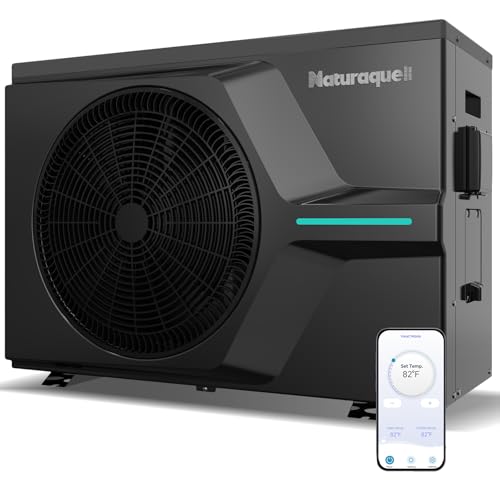
NATURAQUELL Inverter Pool Heat Pump (Up to 16,000 Gallons)

Hayward H-Series Natural Gas Pool Heater 250,000 BTU
Hayward H-Series Propane Gas Pool Heater 250,000 BTU
A Deeper Look At The Lineup
Sun-soaked yards get a quiet, fuel-free path to warm water with this DIY solar collector. The kit is sized 4 panels wide by 10 feet long, with a 1.5″ internal-diameter header (the tube that gathers heated water from each panel) that supports strong flow without bottlenecking the existing pump.
For homeowners with a south-facing roof or a stretch of fence line that sees midday sun, mounting the panels and tying them into the existing filtration loop is genuinely approachable. The trade-off is seasonal: cloud cover and short winter days limit output, so most owners treat this as a spring-through-fall extender rather than a year-round workhorse.
What Earns Its Place
- Operating cost stays near zero once installed, since the sun does the heating
- A 15 to 20-year service life keeps replacement cycles far away
- Roof or rack mounting lets owners reclaim yard space
- The over-molded header design is engineered to maintain strong flow across the array
- Plumbing ties into standard pool equipment without specialty fittings in most setups
Things To Consider
- Cloudy stretches noticeably slow temperature climbs
- Winter performance drops, so a backup heater is wise in colder regions
Key Specs
Who It Suits Best
Homeowners in sunny climates who want a quiet, fuel-free way to extend their swim season and don’t mind a one-time install project.
Where Another Pick Suits Better
For pools that need reliable heat in cold shoulder seasons, the Hayward H-Series Natural Gas Pool Heater 250,000 BTU recovers temperature much faster when sun alone won’t cut it.
The TriStar VS isn’t a heater on its own, but it pairs with one beautifully. As a variable-speed pump (a motor that can run at multiple RPMs rather than a single fixed speed), it dials circulation up or down depending on the task, which trims energy use every single day.
At 1.85 HP, this unit replaces older single- or two-speed pumps up to 1.5 full-rate or 2.0 max-rate horsepower. The permanent-magnet, totally enclosed fan-cooled motor (a sealed design that resists dust and moisture) runs quieter and cooler than older open motors, which matters in equipment pads close to living space. For households already running a heat pump or gas heater, the pump upgrade often pays back fastest on the utility bill.
Useful Touches
- Programmable speeds let owners run low RPMs for filtration and higher speeds only when heating or cleaning
- Quieter operation than older single-speed pumps, helpful for nearby patios
- The sealed motor housing tends to resist humidity and debris on outdoor equipment pads
- Designed as a drop-in replacement for most full-rate pumps up to 1.5 HP
Trade Offs
- Not a heater by itself, so it only pays off when paired with a heat source
- Older wiring may need an electrician to add a proper circuit for variable-speed operation
- Setup of speed programs takes a one-time learning curve for first-time owners
Right Fit For
Owners upgrading an aging single-speed pump who want lower monthly utility costs and smoother integration with a new heat pump or solar system.
Look Elsewhere When
Someone wanting warm water on its own should jump to the NATURAQUELL Inverter Pool Heat Pump, which handles heating and circulation concerns in a single unit.
The AQUASTRONG heat pump targets smaller pools up to about 7,500 gallons, a sweet spot for many suburban backyards. It pulls warmth from outdoor air rather than burning fuel, which makes daily operating cost a fraction of a gas unit.
The dual-function design supports both heating and cooling, which is unusual at this size. Heating spans 47°F to 104°F and cooling runs 47°F to 83°F, so owners can drop water temperature during heat waves too. Compared to the larger NATURAQUELL inverter unit further down the list, this one trades capacity for a more compact footprint and simpler installation.
Reasons It Performs
- Dual heating and cooling widens the comfort window across the calendar
- Compact footprint fits tighter equipment pads where a gas heater won’t
- Air-source heat pump operation avoids fuel-line installation and venting
- Aim it at pools up to 7,500 gallons without oversizing the system
Worth Noting
- Cold-climate performance drops as outdoor air temperature falls below about 50°F
- Not a fit for pools larger than its rated capacity
Feature Snapshot
Made For
Households with modest pools who want year-round temperature flexibility without the fuel logistics of a gas heater.
Consider Something Else When
Larger pools need the higher capacity of the NATURAQUELL Inverter Pool Heat Pump, which targets up to 16,000 gallons with full inverter efficiency.
Full inverter technology (compressors that ramp up and down smoothly rather than cycling on and off at one fixed speed) is the headline here, and it shows up directly on the electric bill. The 55,000 BTU/h output handles pools up to 16,000 gallons, which covers most mid-size residential inground setups.
Heat and cool modes both come standard, with heating operating from 5°F to 104°F outdoor air and cooling from 59°F to 109.4°F. Real-world performance varies with pool size, plumbing layout, and whether a cover stays on overnight, but inverter modulation tends to keep efficiency high across partial loads. Compared to the smaller AQUASTRONG above, this one trades a bit of compactness for noticeably higher capacity and steadier output.
A Few Highlights
- Inverter modulation cuts power draw when full heat isn’t needed
- Heat and cool modes extend comfort into both shoulder seasons and heat waves
- 16,000-gallon capacity handles larger inground pools without supplement heat
- Quieter ramp-up compared to standard on/off compressor cycling
Points To Note
- Outdoor unit placement needs adequate airflow clearance around the housing
- A pool cover makes a meaningful difference in cold-weather performance
- Larger capacity means a heavier unit at delivery
Best Suited To
Mid-size to larger inground pools in mild-to-moderate climates where energy-conscious heating is the priority.
Not Your Match When
Cold-climate pools that need to recover temperature fast on frosty mornings will get faster results from the Hayward H-Series Natural Gas Pool Heater 250,000 BTU.
When warm water can’t wait, natural gas still wins on raw recovery speed. The Hayward H-Series delivers 250,000 BTU (British Thermal Units, a measure of heating energy) and targets pools and spas up to about 750 square feet of surface area, so most residential inground pools fall comfortably inside its range.
The cupro nickel heat exchanger (a copper-nickel alloy tube bundle that transfers heat from the burner to the pool water) holds up well against the corrosive effects of unbalanced water chemistry, which is a common failure point in cheaper headers. Owners commonly pair this unit with a digital controller and rely on it for short, high-demand heat-ups during shoulder seasons or after a cold snap. Compared to the solar option at the top of the list, fuel cost is real, but the speed tradeoff is hard to beat.
Notable Gains
- Heats pools far faster than any heat pump or solar setup
- Cupro nickel heat exchanger resists corrosion from typical pool chemistry swings
- Front control panel keeps service adjustments accessible
- Self-diagnostic display simplifies troubleshooting when issues pop up
- Suitable for both pools and attached spas
Honest Caveats
- Operating cost climbs quickly with heavy use due to gas consumption
- Requires a gas line run and proper venting at install
- Subject to hazardous-materials shipping regulation, so returns are restricted
Who Should Grab It
Homeowners with natural gas service who need fast, reliable heat through cool months and don’t mind higher monthly fuel bills for that responsiveness.
A Better Fit Elsewhere
Anyone prioritizing low operating cost over recovery speed should consider the NATURAQUELL Inverter Pool Heat Pump, which uses ambient air instead of burning fuel.
The propane version of the H-Series delivers the same 250,000 BTU output as the natural gas sibling, but it swaps the fuel source for off-grid homes. Properties without a municipal gas line can still get fast, controllable heat, which is rare in this category.
The intuitive front control panel with LED display keeps setpoint and self-diagnostic information close at hand, and the unit suits both pools and attached spas up to about 750 square feet of surface area. The catch is propane logistics: tank rental, refills, and price swings all factor in. Versus the natural gas model above, fuel planning takes a bit more attention but the heating performance is essentially identical.
Where It Helps
- Brings gas-heater speed to homes without natural gas service
- Digital LED display simplifies temperature setting and status checks
- Same heat exchanger durability as the natural gas sibling
- Self-diagnostic capability speeds up service calls when something’s off
A Few Limitations
- Propane fuel cost can swing noticeably with seasonal supply
- Requires a propane tank and periodic refills scheduled in advance
- Returns are restricted due to hazardous-materials shipping rules
At A Glance
Whose Shelf It Belongs On
Rural or off-grid homeowners who want gas-heater speed without depending on a municipal gas line, and who can manage propane deliveries.
Swap It Out When
Properties with a natural gas line already in place should look at the Hayward H-Series Natural Gas Pool Heater 250,000 BTU, which avoids propane logistics entirely.
What Matters Before Choosing A Pool Heater
Match The System To Your Climate
Pool heaters fall into three broad families, and climate decides which one makes sense. Solar collectors like the SolarPoolSupply kit thrive where the sun shows up reliably, since output drops sharply under heavy cloud cover. Heat pumps (the AQUASTRONG and NATURAQUELL units) pull warmth from outdoor air, which means efficiency climbs as outside temperatures rise and falls as they drop. Gas heaters (the two Hayward H-Series models) ignore weather almost entirely and just burn fuel for fast recovery. A quick gut check: list the average overnight low for the months you actually want to swim, then pick the family that holds up there.
Size To Gallons, Not Square Feet Alone
BTU ratings get tossed around a lot, but pool volume drives the real calculation. A 250,000 BTU gas heater sounds oversized for a 12,000-gallon backyard pool, but that output is what makes a cold-start recovery feel reasonable. Heat pumps sized in BTU-per-hour need closer matching to gallons, since they work steadily rather than in bursts. The NATURAQUELL’s 16,000-gallon rating is a useful ceiling marker: overshoot it and recovery stretches into days rather than hours.
Plan For Operating Cost, Not Just Purchase Cost
The sticker price rarely tells the whole story. Solar runs on sunlight but demands a one-time install project. Heat pumps cost more upfront than gas but use a fraction of the energy per degree of temperature rise. Gas heaters heat fastest but charge for the privilege every month. A useful exercise is to estimate how many degrees of lift, and how often, the pool actually needs through the year. That number usually picks the winner between fuel-free, electric, and gas.
Don’t Forget The Pump Pairing
A heater can only do its job when water flows through it. Variable-speed pumps like the Hayward TriStar VS reduce electrical cost on the circulation side and often interact more efficiently with heat pump thermostats. Pools upgrading both pump and heater in the same project usually see the best combined savings, since each piece of equipment complements the other.
Key Considerations Across These Picks
Where Shoppers Go Wrong
Underestimating pool volume is the classic mistake, and it leaves a heater working overtime to ever reach setpoint. Always cross-check gallons against actual measurements, not rough square-foot estimates. Another slip is ignoring climate: a heat pump that looks efficient on paper stalls in cold air, and a solar kit that seems clever struggles through cloudy weeks. Match the heater family to the local weather, and double-check the BTU-to-gallon math before committing.
What Separates Premium From Basic
Higher-tier pool heaters earn their keep through modulation and material quality. Inverter-driven compressors (like the NATURAQUELL) ramp output up and down to match demand, which trims electrical use during steady-state heating. Cupro nickel heat exchangers (in the Hayward gas models) resist corrosion far better than standard copper, especially in pools with salt or aggressive chemistry. The honest trade-off is upfront cost: premium materials and smarter controls stretch budgets at purchase, but tend to pay back through longer service life and lower monthly bills.