
A backyard pond looks serene on the surface, yet the water below can quietly turn stagnant without oxygen moving through it. Pond aerators solve that problem by pushing air to the bottom or splashing water at the top, and the right one depends on whether a pond is a quiet koi retreat or a half-acre lake with a fountain display in mind. The seven options below cover both ends of that spectrum, from linear diaphragm pumps built for steady subsurface oxygen to floating fountains that double as evening lighting.
How The Shortlist Stacks Up

HIBLOW HP-80 Pond Aerator
HIBLOW HP-60 Pond Aerator

HIBLOW HP-60 Aerator with 100 ft Hose
Goldlife F1 Floating Fountain Aerator

Goldlife F3 Fountain with RGB Lights
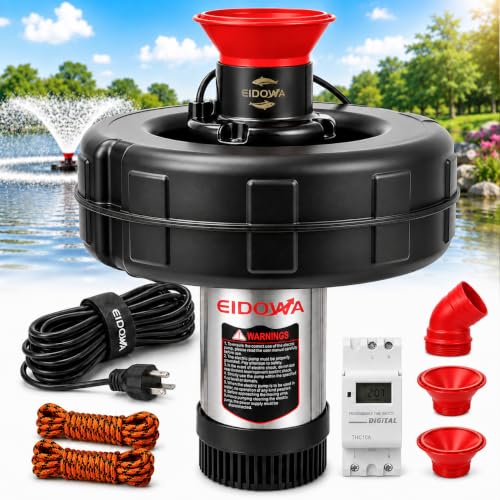
EIDOWA 1HP Floating Fountain Aerator

Goldlife F2 Floating Fountain Aerator
A Breakdown Of The Leading Choices
The HP-80 sits at the upper end of the linear diaphragm family, where airflow matters more than spray patterns. Built around an oil-less piston and electromagnetic drive, it pushes a steady stream of air through buried tubing to one or more diffuser discs at the pond floor. That bottom-up approach keeps the water column turning without disturbing fish or surface plants, which is exactly what larger koi ponds and stocked water gardens need during warm months.
For most ponds above roughly 1,500 gallons, or any setup where subsurface circulation is the priority, this is a logical step up from the smaller HP-60. Owners commonly pair it with weighted diffuser stones or membrane plates and run it on a seasonal timer, letting the unit cycle on and off to conserve power overnight.
Points In Its Favor
- High airflow output suits larger water volumes and dual-diffuser layouts
- Oil-less operation keeps the airstream free of contaminants that could harm fish
- Electromagnetic diaphragm design runs cooler than older rotary vane pumps
- Outdoor-rated housing reduces the need for full weatherproofing
- Automatic pressure limitation protects the motor against hose blockages
Things To Consider
- Higher power draw than the HP-60, so running costs add up across a full season
- Diaphragm replacement becomes routine every couple of years in heavy-use ponds
- No surface spray means the visual effect comes entirely from bubbling, not a fountain plume
Key Specs
Best Suited To
Pond owners running larger koi or game fish ponds who want strong subsurface oxygen without splashing.
Consider Something Else When
Shoppers wanting a decorative spray display should look at the Goldlife F1 instead, since it circulates from the surface rather than through buried tubing.
The HP-60 takes everything that makes the HP-80 dependable and trims the output down to suit a typical backyard pond. Its oil-less diaphragm design delivers clean, low-vibration airflow that can be routed to a single diffuser or split between two shallow ones, which keeps installation flexible. The motor hum stays subtle enough that the unit is comfortable sitting near a patio or under a deck overhang.
Compared with the HP-80 reviewed above, this one draws less current and runs cooler, which makes it a sensible pick for ponds up to roughly a quarter acre. It also pairs easily with a basic GFCI outlet and a simple weatherproof enclosure, so electrical work rarely becomes the hardest part of the install.
Useful Strengths
- Low starting current is gentle on outdoor circuits and extension runs
- Oil-less contamination-free design protects fish and pond plants
- Automatic pressure limitation prevents motor strain if a line clogs
- Compact footprint fits inside most pump vaults or storage benches
- Outdoor rating available on the housing for year-round exposure
Points To Note
- Output tops out well below the HP-80, so very large ponds may run short of oxygen
- Replacement diaphragms are an eventual maintenance item worth budgeting for
- Lacks the bundled diffuser hose that the HP-60 bundle below includes
Who It Suits Best
Backyard koi keepers and water-garden owners with modest-sized ponds who value quiet operation over maximum airflow.
Look Elsewhere When
Shoppers wanting a single-purchase setup with the diffuser hose included should consider the HIBLOW HP-60 bundle with MixAirTech hose instead.
This package pairs the dependable HP-60 pump with a 100-foot run of self-sinking diffuser hose, which removes the most common stumbling block for first-time owners. The MixAirTech hose lays along the pond floor without floating to the surface, so the visual profile of the water stays clean. For ponds up to roughly a quarter acre at shallow depths, that combination circulates oxygen and evens out temperature swings without an extra diffuser disc.
The pump shares the same oil-less diaphragm and outdoor-rated housing as the standalone HP-60 above, which means installation is mostly a matter of routing the weighted hose and plugging in. Owners who want a tidy look with no exposed airline running across the yard appreciate how the self-sinking feature hides the plumbing underwater.
Everyday Perks
- Self-sinking hose avoids floating loops that disrupt the pond surface
- Single purchase covers pump and diffuser plumbing for new installations
- Energy-efficient operation keeps electrical demand on par with a small appliance
- Oil-free output protects fish from residue in the airstream
- Suited to ponds at 10 feet or less in depth, a common residential range
Honest Caveats
- 100 feet of hose is generous for some layouts and excessive for tight ponds
- Still requires a diffuser end-cap or stone to terminate the line properly
Feature Snapshot
Made For
First-time pond owners who want a complete pump-and-hose kit without sourcing parts separately.
Skip It When
Anyone running the higher-output HP-80 will want to upgrade to a heavier diffuser plate instead, which the Orb-3 hose in this bundle cannot match.
The F1 is a floating surface aerator, not a buried-line diaphragm pump, so its purpose is different from the Hiblow picks earlier in this list. A 1-horsepower motor drives roughly 15,000 gallons per hour through a low-profile float, throwing water into a tall plume while pushing oxygen into the pond from above. That makes it a strong fit for open lakes and decorative ponds where the fountain itself is part of the appeal.
The motor housing sits above the waterline, so routine inspection is straightforward, and the floating design means installation is mostly anchoring the unit and running the power cord. Compared with the HP-80, the F1 exchanges subsurface circulation for surface-driven oxygen transfer, which can be more visible and faster-acting in shallow ponds.
Why It Works Well
- 15,000 GPH flow rate circulates large volumes of surface water quickly
- Fountain plume removes debris and adds visual interest
- Low-profile float keeps the unit balanced in upright position
- 750W motor balances power draw with serious water movement
- Increases dissolved oxygen balance in heavily stocked ponds
Some Limits To Know
- 110V power requirement means routing a heavy-duty outdoor cable to the pond edge
- Surface agitation can disturb water-lily beds and shallow-rooted plants
- Larger spray plume may overspray onto nearby walkways if positioned too close to shore
Key Attributes
Who Should Grab It
Owners of mid-to-large open ponds who want both circulation and a visible fountain plume in one unit.
Reach For A Different Pick When
Shoppers wanting built-in lighting for evening displays will find the Goldlife F3 a closer match, since it adds RGB lighting to a similar flow profile.
The F3 takes the F1’s surface-aeration concept and layers in four RGB lights, turning the fountain plume into an evening focal point. The 1-horsepower motor still moves roughly 15,000 gallons per hour, so oxygen transfer stays at the same useful level, but the addition of interchangeable nozzle heads allows two distinct spray patterns. Owners can run a tall v-shaped column during the day and switch to a wider parabola for softer evenings.
The 100-foot power cord gives flexibility for placing the unit away from the shoreline, which matters when the pond is wide. The black octagon float design blends into shadowed water when the lights are off, so the visual profile stays clean until dusk.
A Favorable Mix
- RGB lighting adds atmosphere without needing separate landscape fixtures
- Two interchangeable nozzles create different spray shapes for varied moods
- Stainless steel hardware resists corrosion in constant water contact
- 100-foot power cord simplifies placement in larger ponds
- V-shaped and parabola patterns both agitate water for healthy aeration
Trade Offs
- Lighting adds wiring complexity compared with a plain floating fountain
- Spray height on the v-pattern may overshoot the intended area in tight ponds
- Larger housing footprint takes up more visual space when lights are off
Quick Facts
Whose Shelf It Belongs On
Decorative pond owners who entertain outdoors after dark and want the fountain to pull double duty as a light feature.
Swap It Out When
Pond keepers prioritizing automated on-off scheduling should consider the EIDOWA 1HP Floating Fountain Aerator, which adds a programmable LCD timer.
EIDOWA enters the floating-fountain category with the same 1-horsepower, 15,000 GPH profile as the Goldlife F1 reviewed above, but its standout feature is the programmable LCD timer. The display lets owners set automatic run cycles so the fountain shifts into evening mode without anyone flipping a switch. For ponds where the goal is hands-off operation across an entire season, that scheduling layer changes the ownership experience.
The copper motor is built for sustained output, and the red float housing gives the unit a different visual signature from the black Goldlife models. Beyond aesthetics, the timer cuts wasted run-time during cool nights when oxygen transfer matters less, which can shave meaningful kilowatt-hours across a long summer.
Useful Touches
- Programmable LCD timer automates daily on-off cycles
- Copper motor supports continuous high-output operation
- 15,000 GPH flow rate matches the heavy-duty Goldlife units
- Red float housing offers a distinct look on the water
- Surface agitation increases dissolved oxygen in stagnant pockets
Things To Weigh
- Timer programming has a learning curve for first-time users
- No built-in lighting, so the evening effect is less dramatic than the F3
- Heavy 750W motor still demands a dedicated outdoor circuit
Perfect Match For
Set-and-forget pond owners who want the fountain to switch itself on and off without manual intervention each day.
Another Choice May Suit
Shoppers wanting lighting plus a timer would need to layer the Goldlife F3 with an external timer, which is a heavier install than this all-in-one unit.
The F2 sits between the F1 and F3 in the Goldlife floating-fountain lineup, offering the same 1-horsepower, 15,000 GPH flow profile with two interchangeable nozzle heads. The v-shaped and parabola patterns give owners visual variety without adding the cost of RGB lighting. For pond keepers who care more about aeration than aesthetics, this is the most direct path to high-volume surface circulation.
It draws on the same low-profile floating platform used across the Goldlife range, which keeps the unit stable in wind and easy to anchor. Compared with the EIDOWA unit reviewed just above, the F2 trades the LCD timer for a simpler plug-and-run experience, which works well for owners who prefer a basic on-off schedule through an external outlet timer.
What Stands Out
- Two spray patterns included for visual variety on the water
- 15,000 GPH matches the higher-end Goldlife models
- Floating platform design stays balanced in moderate wind
- Surface agitation clears debris while oxygenating the water
- Agitates water column to reduce stagnant pockets
Possible Compromises
- No built-in lighting, so evening visual impact is limited
- No onboard timer, requiring an external plug-in schedule for automation
- Standard outdoor circuit still needed for the 750W motor
The Right Fit
General-purpose pond owners who want a reliable floating aerator with spray-pattern flexibility but no lighting or timer extras.
A Better Fit Elsewhere
Shoppers wanting scheduled automation should consider the EIDOWA 1HP Floating Fountain Aerator, which integrates the timer into the unit itself.
What Matters Most Before Choosing Pond Aerators
Pond Size And Depth
The single biggest decision driver is the surface area and depth of the water. Linear diaphragm pumps like the HIBLOW HP-60 and HP-80 push air through tubing to diffusers at the pond floor, which makes them efficient for ponds up to roughly a quarter acre or any depth beyond a few feet. Floating fountains rely on surface splash to move oxygen, which works faster in shallow, open ponds but loses effectiveness in deep or heavily planted water.
For most backyards under 2,000 square feet with average depth, either approach gets the job done. The choice becomes more important as pond size grows, since undersized diaphragm pumps struggle to push air to far diffusers and undersized fountains cannot move enough surface water to matter.
Noise And Placement
Diaphragm pumps hum quietly and can sit under a bench or inside a faux rock, which suits installations close to outdoor living space. Floating fountains are louder by nature, especially in tall v-spray mode, so positioning them away from bedroom windows and seating areas makes sense. Pond owners near property lines should also weigh whether the sound travels into neighboring yards.
Power And Installation
A 110V outdoor GFCI outlet within reach of the pond edge is the minimum requirement for floating fountains, and heavier units benefit from dedicated circuits. Diaphragm pumps draw less current and often run on shared outdoor outlets, but they still need protection from direct rainfall. Routing the power cord cleanly, anchoring floats with proper mooring, and burying diffuser lines where applicable all affect the long-term satisfaction with any setup.
Key Considerations Across These Picks
Pitfalls Shoppers Hit
The most common mistake is sizing a diaphragm pump by horsepower alone rather than by airflow at operating pressure, since real-world output drops as diffuser depth increases. Another trap is pairing a strong fountain with a small pond, where over-agitation stresses fish and damages shallow-rooted plants. Buying a pump without a plan for the diffuser end, or skipping the diffuser altogether, leaves the system pushing air into a dead-ended hose.
Where The Extra Money Goes
Higher-tier floating fountains add features like RGB lighting, programmable timers, and stainless steel hardware that resist corrosion across multiple seasons. Linear diaphragm pumps at the top of the range deliver more airflow per watt and often include automatic pressure relief that protects the motor during line blockages. For ponds used year-round or in coastal climates where salt air attacks finishes, the upgrade usually pays for itself in extended service life and reduced maintenance visits.
Bottom Line
The right pond aerator depends on whether the goal is invisible subsurface oxygen or a visible surface display. Quiet diaphragm pumps suit fish-heavy ponds and small gardens, while floating fountains turn the pond itself into a feature. Match the unit to pond size, depth, and how much sound or spray the surrounding yard can absorb, and the rest of the ownership experience tends to fall into place.