
Reaching up into a tall oak or a stubborn fruit tree with a ladder feels risky, and hauling out a chainsaw for a few stray branches feels like overkill. A purpose-built pole pruner solves both problems at once, and the right one depends on whether the goal is quick cleanup, heavy limbs, or routine hedge work without the hassle of cords.
The Shortlist At A Glance
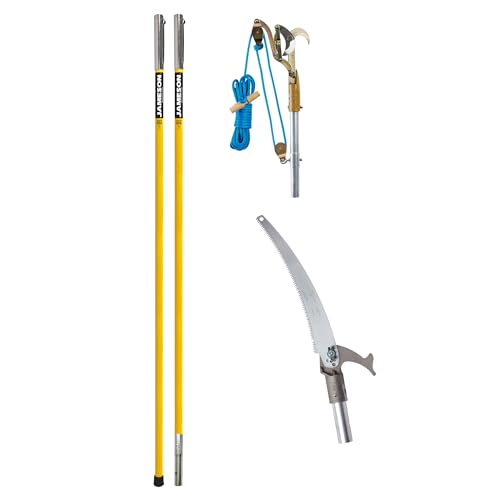
Jameson FG-6PKG-7 Manual Pole Saw and Tree Pruner

WORX WG261 20V Cordless Hedge Trimmer 22″

TRUPER TR-82M-A Tree Pruner w/ Extendable Pole

Buyplus 26FT Reach Pole Saw 5-20FT Telescoping
WORX WG252 20V Cordless Pole Hedge Trimmer 20″
WORX WG801.9 20V Cordless Grass Shear & Shrub Trimmer
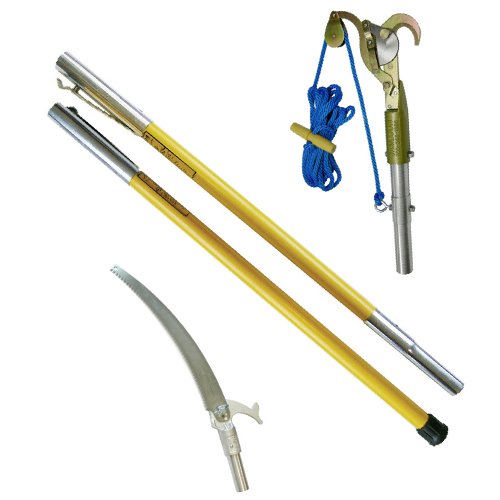
Jameson FG-6PKG-1 FG-Series Manual Pole Saw and Tree Pruner
More On The Choices That Made The List
The Jameson FG-6PKG-7 arrives as a serious tool, not a backyard novelty. Two six-foot fiberglass poles thread together for a twelve-foot reach, and the base pole alone handles lower work without dragging out the full kit. For anyone clearing storm damage or thinning a tall canopy, that modularity pays off in setup speed and storage.
What separates it from cheaper imports is the build philosophy. Fiberglass poles are dielectric, meaning they resist electrical current, which matters for utility-line clearing or any overhead work near wires. The Barracuda-style tri-cut saw blade (a tooth pattern that scores on the pull stroke, push stroke, and neutral) cuts faster and stays sharper longer, and the double-pulley pruner head (a rope-and-pulley mechanism using two wheels to halve the pulling force) needs less arm strength to slice through a one-and-a-quarter-inch branch. Compared to the manual pole saw from Buyplus later on this list, Jameson trades raw reach for durability.
Points In Its Favor
- Twelve-foot assembled reach covers most residential canopies without a ladder.
- Dielectric fiberglass construction makes overhead work safer near wiring.
- Tri-cut saw blade design reduces binding and speeds through dense limbs.
- Double-pulley pruner head lightens the pull, helpful during long sessions.
- Modular poles store compactly and travel well in a truck bed or garage.
Things To Consider
- Fully manual operation means more physical effort than cordless pole pruners like the WORX WG252.
- Fiberglass can splinter if knocked against hard surfaces, so a storage sleeve is worth buying.
Feature Snapshot
Right Fit For
Arborists, utility crews, and serious homeowners managing tall hardwoods or storm cleanup where ladder-free work matters most.
A Better Fit Elsewhere
Casual gardeners trimming small ornamentals may prefer the lighter Buyplus pole saw for its simpler setup and lower cost.
The WORX WG261 is a hedge trimmer, not a true pole pruner, but it earns a spot because most homeowners asking about pole pruners really want versatile trimmer capability for shrubs and small branches. At roughly five and a half pounds with a D-grip front handle, it stays comfortable through a full yard session. Twenty-two inches of dual-action hardened steel blades (two blades moving in opposite directions simultaneously, which cancels vibration) glide through twiggy growth without shaking the user’s arms numb.
The cordless 20V platform (battery voltage) shares across the WORX PowerShare family, so an existing 20V battery stash keeps the tool running without buying extras. For someone whose real chore is tidying privet hedges and shaping boxwoods rather than felling limbs, this trimmer delivers. Where the Jameson FG-6PKG-7 targets overhead limb removal, the WG261 owns waist-to-shoulder-height shaping work.
Features That Help
- D-grip front handle lets the user hold the trimmer at any angle without wrist strain.
- Dual-action blades cut smoothly and dampen vibration compared to single-action designs.
- Shares batteries with other WORX 20V tools, lowering the long-term cost for an existing WORX household.
Worth Noting
- Not designed for overhead tree work, so it cannot replace a true extending pole pruner.
- Battery and charger often sell separately depending on the kit configuration.
- Hardened steel blades need occasional lubrication to prevent sap buildup during heavy hedge seasons.
Who It Suits Best
Homeowners maintaining hedges, foundation plantings, and ornamental shrubs who want a lightweight cordless trimmer without investing in gas-powered gear.
Skip It When
Anyone needing overhead limb removal should reach for the Jameson FG-6PKG-7 or the Buyplus pole saw instead.
The TRUPER TR-82M-A brings genuine steel to the budget tier. SK5 steel, a high-carbon Japanese-grade alloy used widely in professional cutting tools, gives the fourteen-inch curved blade a noticeably harder edge than stamped blades on cheap competitors. Triple-ground teeth (each tooth sharpened on three angles) bite aggressively into green wood, and the carbon-steel step blade handles the actual cutting work without flexing.
For an orchard owner pruning pear or apple trees each winter, this combination delivers clean cuts that heal quickly. The telescoping aluminum handle extends to roughly 2.4 meters, or about eight feet, putting most fruit-tree branches within easy reach. It costs less than half of a fiberglass pro setup, yet the blade quality holds its own. The trade-off shows up in handle stiffness and weight distribution at full extension.
The Good Stuff
- SK5 steel blade holds an edge far longer than typical stamped-steel cutters.
- Cutting capacity around one-and-a-quarter inches handles typical fruit-tree limbs.
- Telescoping aluminum handle reaches roughly eight feet without a ladder.
- Lightweight enough for older gardeners to manage comfortably.
Honest Caveats
- Aluminum is conductive, so overhead work near power lines is genuinely unsafe with this tool.
- Blade coating can wear after a season, and sharpening requires a proper round file.
Quick Facts
Made For
Backyard orchard keepers and budget-conscious homeowners pruning deciduous fruit trees and ornamentals up to about eight feet high.
Reach For A Different Pick When
Reaching past twelve feet or working near electrical lines makes the Jameson FG-6PKG-7 the safer, longer-reaching option.
The Buyplus pole saw is the reach champion on this list. Telescoping from five feet up to roughly twenty feet gives a working height around twenty-six feet when adding the user’s arm span, enough for most two-story rooflines and mature hardwoods without hiring a tree service. Four flip-lock clamps (small levers that snap closed to lock pole sections in place) hold each section rigid, and the aluminum construction keeps total weight manageable despite the length.
The detachable twenty-four-inch saw blade tackles limbs the pruner head cannot grab. For palm trees, tall ornamental shrubs, and neglected yard trees that grew past easy reach, this kit replaces a ladder in many situations. Setup takes longer than a fixed-length fiberglass pole because every extension demands a clamp check, but the trade-off is reach nobody else on this list matches. The non-slip handle section helps when the saw is fully extended and leverage loads the grip.
Everyday Perks
- Reaches roughly twenty feet, far past any fixed-length pruner on the market.
- Four flip-lock clamps keep telescoping sections secure during cuts.
- Detachable saw blade swaps out for easier sharpening and replacement.
- Aluminum build stays light enough for one person to handle at full extension.
Minor Gripes
- At full extension, slight flex shows up in the pole during heavier cuts.
- Aluminum conducts electricity, so this tool is not safe near overhead wires.
- Flip-lock clamps occasionally loosen, so a periodic check mid-job is wise.
Feature Card
Best Suited To
Homeowners with tall trees, palm groves, or multi-story hedges who need maximum reach and are willing to spend a few extra minutes on setup.
Consider Something Else When
Anyone pruning near electrical lines should select the Jameson FG-6PKG-7 for its dielectric fiberglass poles instead.
The WORX WG252 is the tool to reach for when the chore is tall hedges, not trees. A telescoping pole stretches to about twelve feet of reach, and the cutting head pivots through ten positions, so trimming the top of a six-foot privet becomes a ground-level job. The head angle adjusts with a button press rather than a wrench, which speeds up real-world sessions where the user constantly shifts between flat tops and sloped sides.
For tall hedge owners who dreaded balancing on a step stool every spring, the WG252 earns its price. Compared to the WORX WG261 covered earlier, this model trades blade length for reach and angle adjustability. The 20V PowerShare battery platform remains consistent, so an existing WORX battery works here too. Where a manual pole pruner like the Buyplus handles woody limb removal, the WG252 owns soft green growth in hedges and ornamental shrubs.
Notable Upsides
- Ten-position pivoting head handles overhead tops, vertical sides, and awkward angles.
- Twelve-foot reach eliminates ladders for most residential hedge heights.
- Button-press angle adjustment beats tools that require tools to reposition.
- 20V PowerShare compatibility lowers cost for households already invested in WORX tools.
A Few Limitations
- Not designed for thick woody limbs, so it complements rather than replaces a pole saw.
- Battery life under heavy use may demand a second pack for larger properties.
At A Glance
Whose Shelf It Belongs On
Homeowners with tall hedges or overgrown shrubs who want cordless convenience and the ability to switch cutting angles on the fly.
Not Your Match When
Anyone tackling thick tree limbs should look at the Buyplus pole saw or Jameson FG-6PKG-7 for the right tool.
The WORX WG801.9 is the lightest tool on this list, barely tipping the scale at two pounds. It swaps between a four-inch grass shear blade and an eight-inch shrub trimmer blade with a quick-release mechanism. For tidying the edge of a flower bed, cleaning up around a mailbox post, or shaping a small ornamental, it accomplishes in minutes what a full-size hedge trimmer would overcomplicate. This is not a pole pruner by any stretch, but for homeowners whose real need is detail cleanup rather than canopy work, it fills the gap.
The 20V PowerShare battery keeps the weight down while still providing enough runtime for typical touch-up jobs around a yard. The catch is its size. Anything beyond finger-thickness branches stops this tool cold, so expectations need to match its scale. Where the Buyplus pole saw reaches for the sky, the WG801.9 stays close to the ground for precise finish work.
Standout Benefits
- Two-pound weight means anyone, including older gardeners, can use it without fatigue.
- Interchangeable blades cover grass edging and shrub shaping in one tool.
- Quick-swap blade mechanism beats tools that need a hex wrench for changes.
- Same 20V PowerShare battery platform as larger WORX tools simplifies charging.
Practical Considerations
- Cannot handle anything beyond thin twigs, so it complements rather than replaces larger tools.
- Battery life runs short under continuous use, particularly with the shrub trimmer blade engaged.
Perfect Match For
Apartment dwellers, small-yard homeowners, and detail-oriented gardeners who want a grab-and-go tool for finishing touches around beds and borders.
Swap It Out When
Anyone needing to reach overhead branches or cut limbs thicker than a finger should step up to the WORX WG252 or Buyplus pole saw.
The Jameson FG-6PKG-1 shares the same fiberglass DNA as the FG-6PKG-7 covered earlier, but trims a few features for a friendlier price. Two six-foot hollow-core fiberglass poles (tubes with air pockets inside for lighter weight) connect via easy-change aluminum ferrules (the threaded metal collars that join pole sections), reaching twelve feet total. The hollow-core design shaves weight without sacrificing dielectric safety, and the 0.125-inch wall thickness holds up to job-site abuse.
The thirteen-inch saw blade is slightly shorter than the FG-6PKG-7’s sixteen-inch blade, which means a touch more effort on wider limbs. The fixed-pulley pruner head (a single-wheel pulley design) lacks the mechanical advantage of the double-pulley version, so cuts take a harder pull. For a homeowner who values fiberglass safety and modular storage but does not need maximum cutting efficiency, the FG-6PKG-1 makes practical sense. Crews handling daily professional work may still prefer the upgraded FG-6PKG-7 for its stronger cutting geometry.
Where It Delivers
- Dielectric fiberglass poles keep overhead work safer near electrical wiring.
- Modular two-pole setup stores in shorter spaces and assembles quickly.
- Hollow-core construction reduces arm fatigue during long sessions.
- Tri-cut saw blade handles typical branch diameters with clean cuts.
Trade-Offs To Consider
- Single-pulley pruner head requires more pull force than the double-pulley FG-6PKG-7.
- Thirteen-inch saw blade is shorter, so wide limbs need multiple passes.
Technical Reference
Who Should Grab It
Homeowners and part-time landscapers who want dielectric safety and modular storage, and who do not mind slightly higher effort on bigger cuts.
Look Elsewhere When
Daily professional users cutting large volumes of limbs should invest in the Jameson FG-6PKG-7 for its longer blade and double-pulley head.
Picking The Right Pole Pruner For Your Yard
The first decision is reach. Anything under twelve feet handles most single-story homes, while taller canopies or two-story rooflines push shoppers toward telescoping options like the Buyplus pole saw. Material matters too: fiberglass resists electrical current, making it the safer pick for overhead work near wiring, while aluminum stays lighter but conducts electricity.
Cutting capacity is the next filter. Most manual pole pruners slice through one-and-a-quarter-inch branches cleanly, and anything beyond that belongs in chainsaw territory. Cordless models such as the WORX WG252 handle soft green growth but stall on woody limbs, so matching the tool to the typical material in the yard prevents frustration.
For tall hedge work, an articulating head (one that pivots through multiple angles) like the WG252’s saves hours of ladder shuffling. For orchard pruning, blade steel quality and replacement availability matter more than raw reach. Weight affects how long the arms last during a session: a five-pound cordless trimmer feels easy for ten minutes but punishing after an hour, while hollow-core fiberglass balances the long-haul comfort.
Storage and transport often get overlooked. Modular two-piece pole systems fit inside a garage corner or truck bed; telescoping designs collapse to roughly five feet but require clamp checks before every use. Anyone storing tools in a small shed benefits from a kit that breaks down without a fuss. Above all, honest matching of tool to task beats buying the longest pole on the shelf.
Key Considerations Across These Picks
Where Shoppers Go Wrong
The most common mistake is choosing the longest reach available without checking weight at full extension. A twenty-foot aluminum pole feels great until the first cut, when leverage multiplies arm fatigue dramatically. Another trap is ignoring electrical safety: aluminum and steel poles near overhead wires turn a routine prune into an emergency-room visit. Dielectric fiberglass, as found on the Jameson FG-6PKG-7 and FG-6PKG-1, eliminates that risk.
Cordless shoppers often forget to factor battery platform compatibility. Buying a tool from one ecosystem locks future purchases into that battery family, so a household already invested in a 20V PowerShare system gets more value from WORX tools than from a competing brand. Finally, confusing a hedge trimmer with a pole pruner leads to disappointment: shrubs and small twigs are fine, but woody limbs over half an inch need a real saw blade.
What Separates Premium From Basic
Higher-tier pole pruners earn their cost through three upgrades: blade steel, pulley mechanics, and pole construction. SK5 steel and impulse-hardened teeth (a heat-treatment process that strengthens the cutting edge) hold sharpness far longer than stamped blades on budget tools. Double-pulley pruner heads halve the required pull force, which matters during long sessions. Fiberglass poles with thicker walls resist cracking and splintering over years of job-site abuse, where thin-wall poles develop stress fractures after a season or two.
The upgrade makes sense for crews, arborists, and homeowners managing large properties with frequent pruning cycles. A casual gardener pruning two trees a year gains little from premium features and may actually prefer the lighter, simpler budget options. The honest read is to match the tool to the workload, not to the wish list.
Final Verdict
The right pole pruner depends on what the yard actually demands: tall canopy work favors the Jameson FG-6PKG-7 for its pro-grade fiberglass build, while tall hedges call for the articulating WORX WG252. Detail cleanup needs the ultralight WORX WG801.9, and maximum reach belongs to the Buyplus telescoping pole saw. Match the tool to the chore, check the electrical-safety profile, and the rest falls into place.