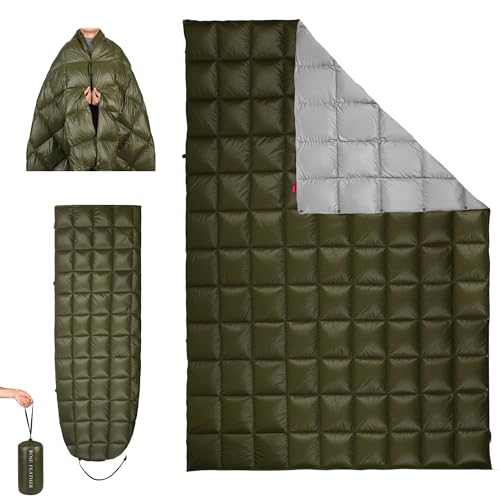
A down camping blanket earns its place in your pack when the temperature drops, the ground is hard, and the fire is just embers. This roundup looks at five blankets built for everything from stadium bleachers to alpine bivvies. Down fill, synthetic fill, and wool each take a different approach to warmth and packability. The honest read: the right pick depends on how far you’re carrying it, how wet it might get, and whether you want it to double as a quilt at camp.
A Fast Comparison Of The Options
PickWhy We Picked ItBest ForAction

Family FriendlyDOWN UNDER OUTDOORS Waterproof Fleece Stadium Blanket
Stadium-ready, hands-free wear
Game days and bleachers
Performance LeaderRumpl Backcountry Puffy Blanket (Moraine)
Built rugged for backcountry
Backpacking and overlanding
Travel ReadyROSE FEATHER Down Camping Blanket 55×79
Genuine goose down warmth
Lightweight backpacking trips |
Solid All-RounderWise Owl Outfitters Packable Puffy Quilt
Synthetic, easy-care insulation
Wet-weather campers |
Built To LastMolithe 100% Wool Blanket 62×48
Wool durability, no synthetics
Vehicle camping and basecamps | Taking A Closer Look At The Options
Game-day bleachers and chilly fall soccer matches were the obvious use case for the DOWN UNDER OUTDOORS stadium blanket, and it leans into that scene with confidence. The 350 GSM fleece (a mid-loft fabric weight that feels substantial without being bulky) brings real warmth, and the waterproof backing keeps damp metal seats from soaking through. A toggle-and-loop design lets it drape over your shoulders cape-style, which matters more than you’d think when you’re trying to clap, snap a photo, or unwrap a snack.
For parents juggling kids and thermoses, the hands-free wear is the real pitch. You get coverage that doesn’t slide off, and the sherpa option adds a plush inner layer for colder venues. It’s not a backcountry blanket, and it won’t stuff into a hydration-pack pocket, but for short-range outdoor seating it earns its keep.
A Strong Showing
- ✓Waterproof backing keeps you dry on wet bleachers and damp grass
- ✓Hands-free cape wear solves the constant readjustment problem
- ✓Sherpa lining option adds layered warmth for cold-weather games
- ✓Generous cut covers two adults seated side by side
Trade Offs
- •Too bulky to pack for hiking or backcountry trips
- •Fleece holds onto moisture longer than synthetic or down fills, so drying it after a rain-soaked game takes planning
Made For
Parents, fans, and anyone spending long evenings in stadium or bleacher seating where a jacket alone isn’t enough.
Look Elsewhere When
Trail users carrying weight over distance will find the Rumpl Backcountry Puffy Blanket far easier to justify in a pack.
The Rumpl Backcountry line is built for folks who treat gear like tools, not accessories. The 50D ripstop liner (a tightly woven fabric rated to resist tearing under stress) and 30D polyester shell stand up to abrasive granite seats and prickly pine duff in ways most consumer blankets can’t. NanoLoft insulation, Rumpl’s proprietary synthetic fill, mimics the loft of down while staying functional when damp.
The 1-person cut covers a single adult sitting or lying flat in a bivy. It’s tighter than the family-sized stadium blanket above, which is exactly the point: every ounce earns its place. If your trips involve rocky campsites, dirt roads, or roof-top tents, this is the right tool for that job.
What Makes Sense
- ✓Engineered for backcountry use with reinforced shell and liner
- ✓Synthetic fill keeps insulating when wet, unlike down
- ✓Compresses small enough for a 25-liter pack
- ✓Durable construction handles rough campsite conditions
Honest Caveats
- •Synthetic fill weighs more per unit of warmth than goose down
- •Single-person sizing won’t suit couples or family lounging
Key Attributes
| | Feature | Specification | Why It Matters |
|---|
| Shell fabric | 30D ripstop polyester | Resists tears and abrasion on rough terrain |
| Liner fabric | SummitShield 50D ripstop | Adds durability where the blanket contacts skin and gear |
| Insulation | Proprietary synthetic NanoLoft | Retains warmth in damp conditions where down would struggle |
| Size | 1-person | Right-sized for solo backcountry use |
Who Should Grab It
Solo backpackers and overlanders who prioritize durability and weather resistance over ultralight pack size.
Consider Something Else When
Couples sharing a campsite will get better value from the Molithe wool blanket’s broader coverage and natural fire resistance.
This is the pick for gram counters. Real goose down at a 90% fill ratio gives the ROSE FEATHER blanket a warmth-to-weight edge the synthetic options can’t match. The 55-by-79-inch cut covers most adults from shoulders to ankles, and it doubles as a quilt over a sleeping pad on mild nights. Compared to the Rumpl above, it’s lighter in the pack but less forgiving in sustained wet weather.
Polyester shell construction keeps the price lower than premium down gear while still shedding light moisture. Treat it as a dry-weather workhorse, and it’ll reward you on trail.
Well-Handled Touches
- ✓90% goose down fill delivers serious warmth for minimal weight
- ✓Compresses into a small stuff sack for travel and hiking
- ✓Generous 55×79 dimensions cover a full adult body
- ✓Functions as a sleeping bag supplement in mild conditions
Points To Keep In Mind
- •Down loses loft when soaked through, so heavy rain demands a pack liner
- •Polyester shell is lighter than nylon but less abrasion-resistant on rough surfaces
- •Requires careful storage, ideally lofted, to maintain fill over the long term
Best Suited To
Lightweight backpackers and travelers prioritizing warmth-to-weight ratios in mostly dry conditions.
A Better Fit Elsewhere
Wet-climate campers should consider the Wise Owl Outfitters synthetic quilt, which handles moisture far better.
The Wise Owl Outfitters quilt lands in the middle of the pack in every meaningful sense. A ripstop nylon shell and water-resistant coating shrug off condensation, wet grass, and the occasional spilled drink at the campsite. Synthetic down-style insulation keeps performing when damp, which is the big practical win for shoulder-season campers and Pacific Northwest trips.
Unfolded to roughly 6.5 by 4.5 feet, it covers a full adult with room to spare. Where the Rumpl above leans technical and the ROSE FEATHER leans ultralight, this one leans practical. You may find it the easiest to justify if you’re not counting grams.
Good Reasons To Consider
- ✓Water-resistant shell handles damp grass and light rain without soaking through
- ✓Synthetic insulation stays warm even when moisture gets in
- ✓Large 6.5×4.5 ft footprint offers full-body coverage
- ✓Ripstop nylon construction resists tears from branches and rough ground
Some Limits To Know
- •Bulkier packed size than down-filled options
- •Lacks premium technical features found on higher-end backcountry blankets
Right Fit For
Car campers, festival-goers, and weekend backpackers who value easy-care synthetic insulation over ultralight performance.
Skip It When
Long-distance thru-hikers chasing ounce savings will prefer the ROSE FEATHER down blanket’s lighter pack profile.
The Molithe wool blanket steps away from the ultralight crowd entirely. At 62 by 48 inches and stuffed with virgin wool at roughly 600 GSM (grams per square meter, indicating heavy, dense fabric), it’s a serious piece of kit that earns its weight through durability and natural fire resistance. Wool keeps insulating even when damp, which is a quiet superpower most synthetic fills can claim but few execute as reliably.
This is the one you keep in the truck, drape over a picnic table, or throw over a cot at basecamp. The trade-off is real: it’s heavy, it takes up space, and it doesn’t compress to jacket-pocket size. But for vehicle camping, emergency kits, and cold-weather lounging, wool has earned its reputation over decades.
Positive Points
- ✓100% virgin wool fill offers natural loft and warmth retention
- ✓Wool naturally resists sparks and embers better than synthetics
- ✓Heavy-duty construction handles years of regular use
- ✓Maintains insulating properties when damp
Practical Considerations
- •Significantly heavier than down or synthetic options, which rules out backpacking use
- •Wool requires air-drying and careful storage to prevent mildew
- •Smaller dimensions than other picks, better suited as a personal layer than a shared blanket
Feature Snapshot
| | Feature | Specification | Why It Matters |
|---|
| Material | 100% virgin wool | Natural fiber with proven long-term durability |
| Dimensions | 62 x 48 inches | Personal-sized coverage for sitting or sleeping |
| Fabric density | ~600 GSM | Heavy, dense weave for serious cold-weather use |
Whose Shelf It Belongs On
Vehicle campers, emergency-preppers, and anyone building a basecamp kit where weight doesn’t matter but durability does.
Swap It Out When
Distance hikers will find the Rumpl Backcountry Puffy Blanket’s technical shell and smaller pack size far more practical for trail use.
What To Weigh Before Choosing A Down Camping Blanket
Fill type sets the ceiling on performance. Goose down delivers the best warmth-to-weight ratio but fails when soaked. Synthetic fills mimic down’s loft while handling damp conditions, though they pack larger. Wool sits outside both categories, trading weight and bulk for natural durability and fire resistance.
Pack size shapes real-world usability. Backpackers should look for blankets that compress to roughly the size of a large water bottle. Stadium use or vehicle camping removes that constraint, opening the door to heavier wool and fleece options.
Shell fabric matters more than it looks. Denier ratings measure fiber thickness; a 30D shell feels light but snags easily, while a 50D ripstop (woven with reinforced threads at regular intervals to stop small tears from spreading) liner adds years of service life. Water-resistant coatings help, but full waterproof membranes are rare on this category.
Size should match your typical use. A 55-by-79-inch blanket works as a personal quilt. Anything smaller covers a lap or a child. Anything bigger becomes hard to manage solo.
Key Considerations Across These Picks
Wrong Turns To Avoid
Picking a blanket by fill weight alone is a common slip. A heavy 600 GSM wool blanket weighs far more than a lighter synthetic with similar warmth. Match the fill to your actual conditions instead of trusting the biggest number on the label.
Another trap: ignoring shell denier ratings. A 20D shell feels luxurious in the hand but tears fast on rocky campsites. For backcountry use, prioritize durability over softness.
Where The Extra Money Goes
Premium pricing on down camping blankets usually buys higher fill power (a measure of how much space one ounce of down occupies, with higher numbers meaning more loft per gram) and responsibly sourced goose down. That translates to genuine warmth savings in the pack, not just marketing copy.
Synthetic premium tiers often mean technical shell fabrics, taped seams, and recycled insulation. These add weight savings and environmental credentials but won’t change the fundamental wet-weather behavior of synthetic fill.
Frequently Asked Questions
QWhat temperature is a down camping blanket rated for?
Most down camping blankets work best above freezing as standalone layers and serve as sleeping bag supplements below that. Manufacturers rarely assign formal temperature ratings the way sleeping bags do.
QCan a down camping blanket replace a sleeping bag?
A down blanket can substitute for a sleeping bag in mild, dry conditions when paired with an insulated sleeping pad. Below freezing or in wet weather, a proper sleeping bag remains the safer choice.
QHow do you wash a down camping blanket?
Down blankets benefit from front-loading machine washes on gentle cycles with down-specific soap, followed by low-heat drying with clean tennis balls to restore loft. Synthetic versions tolerate more aggressive machine care.
QAre synthetic camping blankets warmer than down?
Synthetic fills match down’s warmth at the same weight but lose less performance when damp. Down offers better warmth-to-weight in dry conditions, while synthetics win in wet or humid climates.
QHow should you store a down camping blanket long-term?
Store down blankets uncompressed in a breathable cotton sack so the fill maintains its loft. Compression for weeks or months can permanently reduce insulating performance.
The Takeaway
Pick the blanket that matches your trip, not the one with the most impressive spec sheet. Backpackers chasing warmth-to-weight will favor the ROSE FEATHER down blanket. Campers dealing with damp conditions should look at synthetic options like the Wise Owl Outfitters or Rumpl Backcountry. Anyone building a basecamp kit or emergency setup will appreciate the Molithe wool’s longevity. The right down camping blanket quietly does its job so you can focus on the trip, not the gear.