
Training for climbing between gym sessions used to mean improvising with door frames and towels. A purpose-built hangboard changes that, giving your fingers something honest to pull against, whether you’re warming up on jugs after work or chasing one-arm hang progressions on a rest day. The picks below lean into different needs: renters who can’t drill, wood purists who want long sessions, and climbers who want every pocket depth under the sun. Each one earns its slot for a reason, and the trade-offs matter as much as the strengths.
The Choices Worth Comparing

Two Stones Hangboard Wooden Fingerboard Training Board

YY Vertical SandwichBase + VerticalBoard One No-Drill Set

TWO STONES Door Mounted Fingerboard Training Station

YY Vertical Hangboards for Rock Climbing

TRANGO Rock Prodigy Hangboard – Beech Wood
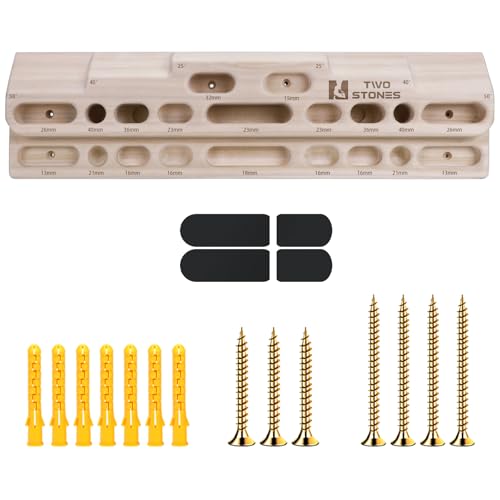
TWO STONES Climbing Hangboard with Jugs and Pockets

YY Vertical Hang Holds Rubberwood Board
The Details Behind The Selections
The TWO STONES CJ-HB2051 is a wooden hangboard aimed squarely at climbers who want a single board that covers a lot of ground. Milled from a single block (no glued seams, no chips), it pairs flat slopes at three angles with one, two, three, and four-finger pockets at three different depths. Compared to the YY Vertical boards later on, this one’s material is less refined, but the hold variety is competitive.
The rubber plate and climbing hanger for difficulty adjustment make it approachable for newer climbers working toward their first one-arm hang. Mounting lives over a door frame, which suits apartment setups where drilling into studs isn’t an option.
Benefits That Matter
- Seven distinct hold types cover warm-ups through max-effort hangs in a single board.
- Solid wood construction from a single block reduces the risk of splits or weak glue joints over years of use.
- Adjustable difficulty via the included hanger and rubber plate lets you scale load without buying add-ons.
- Door-frame mounting means renters avoid wall repairs at move-out.
Points To Note
- Door-frame mounts introduce slight play during dynamic moves; some find it less stable than a stud-mounted board.
- Wood hardness isn’t specified, so long sessions may wear skin faster than denser hardwood alternatives like the TRANGO Rock Prodigy.
Feature Snapshot
Best Suited To
Beginner and intermediate climbers who want a versatile door-frame board without committing to stud-mounted hardware.
Consider Something Else When
Renters with stricter rules about door-frame hardware should look at the YY Vertical SandwichBase set, which uses counter-pressure instead of screws or hangers.
This bundle is the answer for climbers whose lease agreement reads like a contract negotiation. The SandwichBase support uses counter-pressure to lock the board against a door frame, so installation is tool-free and reversible. That alone makes it the most landlord-friendly entry on this list.
The VerticalBoard One hangboard ships with the base and is engineered to stay put during aggressive pull-ups and weighted hangs. For climbers in tight urban apartments, it’s a real alternative to the stud-mounted setups most boards require.
Positive Points
- No drilling, no screws, no wall marks: ideal for renters and dorm rooms.
- Counter-pressure design keeps the board stable during dynamic moves.
- Compact footprint fits narrow hallways and closet door frames.
- Full kit, so there’s no guessing about whether a base will match the board.
Trade Offs
- Counter-pressure systems have a frame-width tolerance; oversized or trimless frames may not clamp securely.
- The base adds storage footprint when not in use, so smaller apartments will feel the squeeze.
Right Fit For
Renters, college students, and anyone whose home gym doubles as a security deposit waiting to happen.
Skip It When
Climbers who already own a stud-mounted setup or prefer door-frame hangers should consider the TWO STONES CJ-HB2051 instead, which leans into traditional door-frame hardware.
The other TWO STONES door-frame option trades some hold variety for a lower entry point. Outer jugs, two slope angles, and pockets at four different depths cover the bread-and-butter of finger training: dead hangs, bent-arm hangs, and offset positions for crimp endurance work.
It’s not as deep as the CJ-HB2051 with its three-angle slopes, but for the climber who only needs a handful of usable grips, the simplification is a feature. It mounts over standard door frames without modifying the wall.
Bright Spots
- Door-frame mounting means no studs, no anchors, no commitment.
- Pocket depths from one to four fingers work for both warm-ups and structured progressions.
- Outer jugs give beginners a usable starting hold to learn proper form.
- Useful for both beginners building base strength and experienced climbers adding volume.
Honest Caveats
- Fewer hold variations than its TWO STONES sibling, which may limit structured progression.
- Door-frame mounts shift slightly under lateral load, so explosive campus-style moves are not ideal.
Feature Snapshot
Made For
Climbers on a tighter budget who still want a proper training surface without committing to a drilled mount.
Look Elsewhere When
Anyone wanting maximum hold variety in a door-frame board should pick the TWO STONES CJ-HB2051 from earlier in this list.
The YY Vertical hangboard line is built around poplar wood, which is gentler on skin than denser tropical hardwoods. Engineered with physiotherapists and coaches, it targets climbers logging serious volume who care about skin wear as much as grip strength.
Where the TWO STONES boards focus on hold count, YY Vertical leans into edge geometry and ergonomics. For climbers whose fingers shred after twenty minutes, the difference shows up in training density.
Strong Points
- Poplar construction with rounded, skin-friendly edges reduces friction during long hangs.
- Designed in collaboration with physiotherapists and coaches for sustainable progressions.
- Multiple models in the range cover everything from first hangs to expert-level training.
- Lightweight compared to dense hardwood boards, which simplifies mounting.
Small Caveats
- Poplar is softer than beech or walnut, so aggressive crimping may show wear sooner.
- Mounting hardware is sold separately from the board itself, adding a step to setup.
Feature Snapshot
Whose Shelf It Belongs On
Intermediate to advanced climbers prioritizing skin health and structured, repeatable progressions.
Not Your Match When
Climbers wanting maximum grip variety in a single board should consider the TWO STONES CJ-HB2051, which packs more hold types into one board.
The Rock Prodigy is the densest board in this lineup. Twelve grips on FSC-certified beech (a responsibly forested hardwood) include variable-depth rails from 10 to 33 millimeters, three pockets from 27 to 38 millimeters, a 10-millimeter closed crimp, and both small and large pinches. That’s a serious spread for a single board.
The natural wood texture matters more than it sounds. Hardwood tends to be kinder to skin than plastic composites, so climbers logging multi-hour weeks notice the difference during long hangs and repeater sessions.
Advantages To Know
- Twelve grips cover nearly every finger position you’d train on a hangboard.
- FSC-certified beech supports sustainable forestry practices.
- Hardwood surface minimizes skin wear compared to plastic fingerboards.
- Variable rail depths allow genuine progressive loading without buying add-ons.
Worth Noting
- Beech is heavier than poplar, so mounting needs solid anchors, not door frames.
- More density can feel unforgiving on very tender skin during summer training cycles.
Perfect Match For
Climbers training multiple days a week who want one board to do everything from max hangs to crimp endurance work.
Reach For A Different Pick When
Renters and door-frame trainers should choose the YY Vertical SandwichBase + VerticalBoard One, which avoids drilling entirely.
The depth variation on this TWO STONES board is the headline feature: up to ten distinct pocket depths across one, two, three, and four-finger configurations. Add three slope angles and a solid wood construction, and you get a board that scales with you from beginner hangs to single-digit pockets.
Mounting mirrors the other TWO STONES options, going over a standard door frame. It’s a sensible match for climbers whose training has plateaued on boards with shallower pocket variety.
Points In Its Favor
- Ten pocket depths deliver genuine incremental progression in finger strength work.
- Three slope angles support varied wrist positions across hang variations.
- Milled from a single wood block, so structural integrity stays consistent over years.
- Door-frame mount avoids wall modifications for renters.
Things To Consider
- More pockets mean a steeper learning curve to map out a useful training cycle.
- Door-frame mounting can feel less stable during weighted or dynamic sessions.
Feature Snapshot
Who Should Grab It
Climbers progressing past shallow pockets who want a single board that grows with them for years.
Swap It Out When
Climbers wanting ergonomic, skin-friendly edges over depth variety should pick the YY Vertical Hangboards for Rock Climbing instead.
The Hang Holds portable board is the lightest in the roundup, built from rubberwood and designed to slip into a bag. The “Turn and Pull” system rotates the board to adjust hang angle, which adds real variety to a board you can pack in a carry-on.
Twelve grip options cover enough positions to maintain finger strength on the road. Rounded edges and an ergonomic profile keep skin wear manageable, even when training in hotel rooms after long travel days.
Everyday Perks
- Lightweight rubberwood is easy to pack and travel with.
- Twelve grip options cover core training positions in a compact footprint.
- Turn-and-pull angle adjustment adds training variety without swapping boards.
- Rounded edges reduce skin stress during high-volume travel sessions.
Practical Considerations
- Compact size means smaller holds, which may challenge climbers with larger hands.
- Less stable than full-size boards, so it’s best for volume hangs, not max loads.
Built With In Mind
Climbers who split time between home and travel, or anyone wanting a board that lives in a duffel bag rather than a doorway.
A Better Fit Elsewhere
Climbers wanting the densest, full-size option for serious home training should consider the TRANGO Rock Prodigy Hangboard.
Picking The Right Hangboard For Your Setup
The first call to make is whether your wall can handle a drilled mount. Renters and shared-wall dwellers should lean toward the YY Vertical SandwichBase + VerticalBoard One, which avoids screws entirely, or any of the TWO STONES door-frame options that hang from a standard frame. Homeowners with stud access open up the field considerably, especially for denser hardwood boards like the TRANGO Rock Prodigy.
Hold variety matters more than people expect. Boards like the TWO STONES Climbing Hangboard with ten pocket depths let you progress without swapping gear, which matters when you’re chasing structured training cycles. Boards with fewer grips, like the YY Vertical Hang Holds, still cover the essentials but limit long-term progression.
Material shapes how your skin feels after training. Poplar and rubberwood tend to feel kinder than dense tropical hardwoods, while beech sits in the middle for most climbers. If your fingers shred quickly, lean toward ergonomic options like the YY Vertical Hangboards for Rock Climbing with rounded edges. If you train heavy and don’t mind denser feedback, hardwood holds up better over years.
Finally, think about where you’ll actually hang the thing. Door-frame boards go up in seconds and come down without tools, which makes them forgiving for travel or frequent moves. Stud-mounted boards stay rock-solid under weighted sessions but require planning. Match the mount to your living situation first, and the right board usually follows.
Key Considerations Across These Picks
Where Shoppers Go Wrong
Treating all hangboards as interchangeable leads to frustration. A board with shallow pockets caps your progression, while a board with too many small holds punishes climbers with larger hands. Map your current finger strength and goals before committing. Skipping the wall-type decision is another common slip: door-frame mounts aren’t built for weighted max hangs, and stud-mounted boards aren’t built for renters who move often.
The Upgrade Payoff
Higher-tier boards like the TRANGO Rock Prodigy earn their place through material quality, hold density, and long-term durability. FSC-certified hardwood and full-range grip sets mean the board grows with you instead of capping out after a season. The upgrade makes sense when you’re logging serious training volume; for casual once-a-week sessions, a budget-friendly board handles the work without stretching further.
Frequently Asked Questions
How often should I train on a hangboard?
Most climbers benefit from two to three short sessions per week, with rest days between hard finger days. Skin and tendons adapt slowly, so daily max-effort hangs tend to cause injuries rather than gains.
Do I need to drill into a wall?
Not necessarily. Door-frame boards like the TWO STONES options mount without tools, and the YY Vertical SandwichBase uses counter-pressure for a no-drill install. Stud mounting is sturdier but requires commitment.
What’s the difference between pockets and edges?
Pockets are closed holes you insert fingers into, training open-hand strength. Edges are flat slopers or rails that work crimp positions. Most training plans use both to build balanced finger strength.
Can beginners use a hangboard?
Yes, with light load and short hang times. Boards like the TWO STONES door-mounted station include outer jugs that give beginners a usable starting hold while they build tendon resilience.
How do I avoid finger injuries?
Warm up thoroughly, start with large holds, and progress load gradually over weeks rather than days. Skin and tendons adapt more slowly than muscle, so patience protects your season.
Closing Remarks
The right hangboard comes down to your wall, your training volume, and your progression goals. Door-frame and no-drill setups work beautifully for renters and casual sessions, while denser hardwood boards with deeper pocket variety reward climbers logging serious hours. Match the board to your real-life situation, and your fingers will thank you on the next climbing trip.