
A hangboard in your hallway turns dead time into finger strength, but only if the holds match your level and your doorframe. Climbers chasing crimp gains, parents building a backyard wall for kids, and frequent travelers who want a portable setup all shop from different ends of the same category. This lineup covers that spread, from molded plastic kids’ holds to engineered wooden boards with progressive pocket depths, so you can match the board to the way you actually train.
Your Options, Compared

Trymaker Rock Climbing Holds, 15PCS Climbing Wall for Kids

Two Stones Hangboard Rock Climbing Pull Up Bar (CJ-HB2051)

TWO STONES Rock Climbing Fingerboard Door Mounted Training Station

YY Vertical Hangboards for Rock Climbing

TRANGO Rock Prodigy Hangboard Finger Training Board
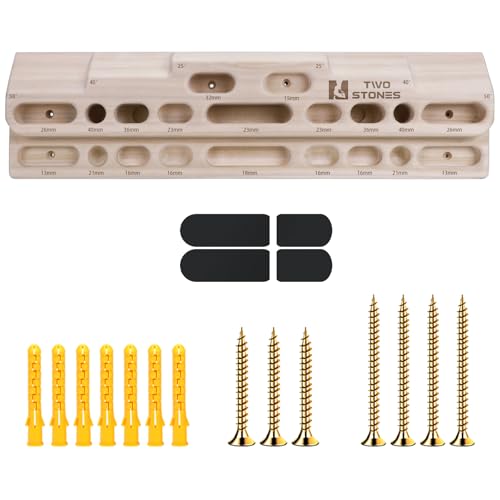
TWO STONES Climbing Hangboard with Jugs, Slopes and Pockets

YY Vertical Hang Holds Portable Hangboard
A Deeper Look At The Lineup
The Trymaker set isn’t a hangboard in the traditional sense; it’s a 15-piece kit of small climbing holds designed to screw into a wall or play structure and turn it into a low-stakes bouldering surface. The “small size” framing means the grips suit smaller hands, which makes the kit a natural fit for kids’ bedrooms, basement play areas, or backyard tree houses.
Installation hardware ships with the holds, so there’s no separate parts run to the hardware store. For households building a play wall rather than training for crimp pulls, the Trymaker set covers a need none of the wooden hangboards here touch.
Points In Its Favor
- Multi-piece kit lets you arrange routes and adjust difficulty over time
- Smaller hold dimensions suit children’s grip spans, unlike standard adult-sized wooden rungs
- Mounting hardware included, so the build is a single-afternoon project
- Plastic holds handle weather and rough play better than bare wood
Honest Caveats
- Not designed for adult hangboard training, so serious climbers will outgrow the holds quickly
- Wall surface and stud placement limit where you can mount, so installation may need patching later
Made For
Parents building a play wall for kids rather than climbers chasing finger strength.
Look Elsewhere When
The TWO STONES Rock Climbing Fingerboard Door Mounted Training Station is the better match for adults who want finger-training grips in a similar low-commitment setup.
The CJ-HB2051 is the budget end of the Two Stones lineup, but it still ships with the grip variety you usually find on pricier boards: flat slopes at three angles, a polygon ball slope, one- to four-finger pockets at three depths, and edges that mimic real rock holds. CNC milling from a single wood block (rather than glued pieces) is a durability detail worth flagging, since glued seams are where cheaper boards tend to crack first.
For climbers starting out who want a real training tool without dropping premium-tier money, this board covers most of what you’d actually use day to day. The included climbing hanger and rubber plate let you adjust difficulty, which keeps the board useful as your fingers get stronger.
Real-World Strengths
- Three slope angles and three pocket depths let you scale intensity as you progress
- Single-block wood construction reduces the seam cracks common on budget boards
- Adjustable hanger and rubber plate shift the difficulty curve without buying extra accessories
- Compact footprint fits a hallway doorframe or garage beam
Points To Keep In Mind
- Pocket depth range is narrower than the more expensive Two Stones board below, so advanced climbers may hit a ceiling sooner
- Wood species and finish aren’t specified, so you’ll want to inspect for rough grain that could irritate skin on long hangs
Key Product Details
Right Fit For
First-time hangboard owners who want real grip variety at a starter price point.
Consider Something Else When
The TRANGO Rock Prodigy Hangboard Finger Training Board suits intermediate climbers who want a wider depth range and a known hardwood surface.
Where the CJ-HB2051 leans toward a multi-grip training board, this Two Stones model trims the layout to the essentials. You get outer jugs (the big hold-everything rims), two slope angles, one- to four-finger pockets at four depths, and edges, plus a doorframe-friendly mount. The design serves both beginners learning dead hangs and advanced climbers running offset and bent-arm progressions.
Apartment dwellers who don’t want to drill into a wall get the most out of this board. The jugs also make it usable for pull-up accessory work, so the same setup doubles as a home pull-up bar on rest days.
What Works In Its Favor
- Four pocket depths cover a broader beginner-to-intermediate progression than the CJ-HB2051
- Doorframe mount avoids permanent wall damage, which renters appreciate
- Outer jugs double as pull-up grips, giving the board a second use beyond hang sessions
- Edge variety supports both open-hand and crimp grip training
Worth Bearing In Mind
- Doorframe mounting limits the load and the height of larger climbers, so taller users may need to mount lower or use a stool
- Holds are more clustered than a full-size hangboard, so simultaneous two-pad contact drills can feel cramped
Best Suited To
Renters and apartment climbers who need a door-mounted board that pulls double duty as a pull-up station.
Not Your Match When
The YY Vertical Hangboards for Rock Climbing is a better match for climbers who prefer a wall-mounted setup with engineered wood and broader hold selection.
YY Vertical designs its hangboard line in the French Alps and builds each board from poplar wood with rounded, skin-friendly edges. The brand worked with physiotherapists and climbing coaches on the ergonomics, and the lineup is structured as a progression: different boards target first sessions through expert-level training.
The poplar choice is deliberate. Poplar is softer than beech or maple, which translates to less skin abrasion on long repeater sessions. Climbers who log serious weekly volume, or anyone rehabbing a finger tweak, tend to gravitate toward this board for that reason alone.
Standout Benefits
- Poplar construction is gentler on skin than harder hardwoods, so longer sessions sting less
- Ergonomic edge rounding reduces hot spots under the fingers during hangs
- Progressive lineup means you can graduate within the brand rather than swap brands later
- Designed with input from physiotherapists, which shows up in pocket dimensions and edge depths
Small Caveats
- Premium-tier pricing puts it above most budget boards on this list, so it’s an investment rather than an impulse purchase
- Soft poplar can dent under very hard crimping, so heavy-finger climbers may see wear sooner than on harder woods
Feature Snapshot
Whose Shelf It Belongs On
Climbers training multiple days a week who care about long-term finger health as much as raw strength.
Reach For A Different Pick When
The TWO STONES CJ-HB2051 is the smarter call for climbers who want a broader grip variety at a lower price and don’t mind skipping the ergonomic refinements.
The Rock Prodigy sits in the middle of TRANGO’s lineup and is the board most climbers picture when they hear “hangboard.” Twelve grips cover the major training positions: two variable-depth rails from 10 to 33 mm, three pockets from 27 to 38 mm, a 10 mm closed crimp, and small and large pinches. The beech wood is the headline detail, since beech is harder than poplar and holds up to heavy crimping longer.
For climbers already past the beginner stage, the rail depth range in particular sets this board apart. A 10 mm rail trains tiny crimp tendons, and a 33 mm rail lets you rest or work larger muscle groups, so the same board scales to different session goals.
The Upside
- Twelve grips cover the main training positions you’d use at a climbing gym
- Beech hardwood resists dents from heavy crimping better than softer woods
- Variable-depth rails (10-33 mm) cover both small crimp work and larger holds
- Multiple pocket depths let you run finger-specific progressions
Trade-Offs
- Beech feels rougher on skin than the YY Vertical poplar board, so longer hangs can shred tape faster
- No doorframe mount included, so you’ll need to wall-mount or buy a separate hanger
Feature Card
Who Should Grab It
Intermediate to advanced climbers who want a hardwood board with a wide depth range for serious finger training.
Swap It Out When
The YY Vertical Hangboards for Rock Climbing is the better pick for climbers logging high weekly volume who want a gentler wood on the skin.
The flagship of the Two Stones lineup trades the doorframe mount for a deeper pocket library: ten depths total across one- to four-finger pockets, three slope angles, jugs, and edges. The board is CNC milled from a single natural wood block, with no chips or splicing in the construction, which is the same durability story as the CJ-HB2051 but on a wider grip layout.
Climbers chasing progressive finger overload benefit most. With ten pocket depths to choose from, you can micro-adjust difficulty session to session without swapping boards.
A Strong Showing
- Ten pocket depths let you tune difficulty in small steps rather than jumping between boards
- Single-block CNC construction keeps the structure consistent across the gripping surface
- Includes jugs alongside small pockets, so it covers both warm-up and max-effort hangs
- Slope variety supports open-hand and half-crimp training angles
Potential Sticking Points
- Larger hold library makes the board longer than the CJ-HB2051, so wall clearance matters during mounting
- Wood finish and species aren’t called out, so you’ll want to check edge smoothness on arrival
Who Will Love This
Climbers who want maximum pocket variety in a single wall-mounted board and don’t mind the larger footprint.
A Better Fit Elsewhere
The TRANGO Rock Prodigy Hangboard Finger Training Board suits climbers who prefer a smaller, harder-wood board from a brand with a longer track record.
The Hang Holds is YY Vertical’s portable entry, built from rubberwood (a denser, sustainable hardwood often used in lighter training tools) and small enough to throw in a carry-on. Twelve grip options cover most training positions, and the “Turn & Pull” system lets you rotate the board to any angle, which matters more than it sounds when a doorframe branch or tree limb is your only mounting point.
Rounded edges are a familiar YY Vertical design choice and show up here too. Climbers heading to a crag, sharing a vacation rental, or stuck in a hotel gym for a week get the most from this board.
Where It Excels
- Rubberwood and compact build make it light enough for travel
- Twelve grip options cover most training positions despite the small footprint
- Turn & Pull angle adjustment works on uneven mounting surfaces like tree limbs or beams
- Rounded edges protect skin during long sessions, matching the rest of the YY Vertical line
Factors To Consider
- Smaller board size means only one or two grip positions fit per hang, so multi-pad drills aren’t realistic
- Portable design means a softer feel than full-size wall boards, which advanced climbers may notice
Perfect Match For
Frequent travelers and climbers who want a real hangboard that fits in a bag and mounts anywhere.
Skip It When
The TRANGO Rock Prodigy Hangboard Finger Training Board is the stronger call for climbers training at home who want a fixed wall setup with hardwood durability.
Matching The Board To Your Training Style
A hangboard purchase lives or dies on whether the holds match your current finger strength and your training space. Climbers with weak crimp tendons should look for boards with deeper pockets and shallower rails first, while experienced climbers chasing small-edge gains want the opposite. The wood species matters more than beginners expect: poplar is gentler on skin but dents faster, while beech and other hardwoods hold up to heavy crimping but punish the skin during long sessions.
Mounting style changes the calculus too. Renters get more value from a doorframe-friendly board like the TWO STONES Door Mounted Training Station, while homeowners with a stud wall can run a wall-mounted setup. Frequent travelers should weight rubberwood or smaller-format boards like the YY Vertical Hang Holds over full-size options. And anyone building a kids’ play wall belongs in a completely different category, where molded plastic holds like the Trymaker kit replace the wooden training boards entirely.
Match Wood Density To Your Skin And Volume
Hardwood boards (beech, maple, and dense tropical species) tolerate repeated heavy crimping and resist denting, but the harder surface generates more friction during long hangs. Softer woods (poplar and many softwoods) feel kinder to skin during high-volume training, but they show wear sooner under max-effort crimping. Match the wood to your weekly training volume rather than to your max strength.
Where Shoppers Go Wrong
First-time buyers often grab the cheapest board they see without checking pocket depth range. A board with only three pocket depths may be too easy within months, leaving you shopping again. Conversely, beginners sometimes buy a steep, small-edge board and ramp up intensity too fast, which is one of the most common finger-injury paths in climbing training.
The Upgrade Payoff
Premium-tier boards earn their cost through wood quality, edge ergonomics, and broader depth ranges that budget boards can’t match. The upgrade is worth pursuing once you’re training more than twice a week and have a clear sense of which grip positions you actually use.
Frequently Asked Questions
How often should you train on a hangboard? Beginners typically start with two short sessions per week, allowing 48 hours between finger-specific training for tendon recovery. More experienced climbers can add volume, but daily max-effort hangs are widely discouraged.
What pocket depth should beginners start with? Deeper pockets (around 25-35 mm) reduce the load on finger tendons and let new climbers build base strength before moving to smaller holds. Shallow pockets under 15 mm belong later in a progression.
Do you need a doorframe mount or a wall mount? Doorframe mounts work for renters and avoid wall damage, but they limit the hanging height for taller climbers. Wall mounts on a 2×4 secured into studs offer more mounting freedom and a sturdier setup for heavier users.
How important is wood species for a hangboard? Wood species affects both skin comfort and board durability. Softer woods like poplar are easier on skin but dent faster, while hardwoods like beech resist wear but feel rougher on long hangs.
Can kids use a hangboard? Standard wooden hangboards aren’t designed for small hands and present injury risk for undeveloped tendons. Purpose-built plastic hold sets for play walls are a safer option for younger children.
Closing Remarks
The right board depends less on specs on paper and more on how you actually train. Match the grip variety to your current level, the wood to your weekly volume, and the mount to your living space, and any of these seven options will pull its weight. Start lighter than you think you need, build consistency, and upgrade once the beginner board starts feeling easy.