
When the trail drops cell signal, a solid pair of two-way radios becomes your group’s lifeline, whether you’re coordinating campsites, keeping tabs on kids at a riverside loop, or simply staying in touch across a sprawling dispersed camp. The right camping walkie talkies shrug off rain, push through forest cover, and run long enough to last a full weekend on a single charge. This roundup covers seven well-matched options across backcountry hikes, family basecamps, jobsite-sized crews, and budget builds.
The Essentials At A Glance
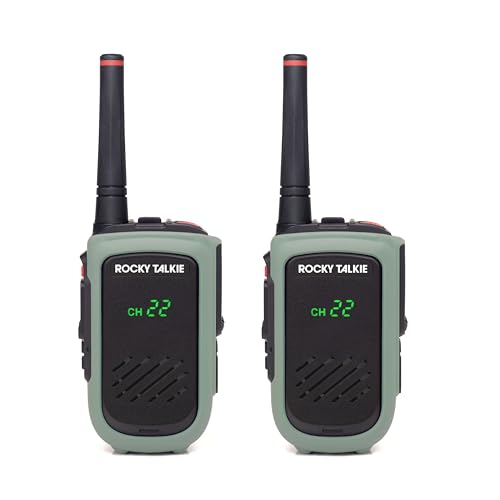
Rocky Talkie Expedition 5W GMRS Radio (2 Pack)

DEWALT DXFRS800 FRS Walkie Talkies (2 Pack)

DEWALT DXFRS300 FRS Walkie Talkies (2 Pack)

DEWALT DXFRS800 FRS Walkie Talkies 6 Pack

Baofeng UV-5R Mini Ham Radio (2 Pack)

Nicama Baofeng UV-5R Dual Band 6 Pack
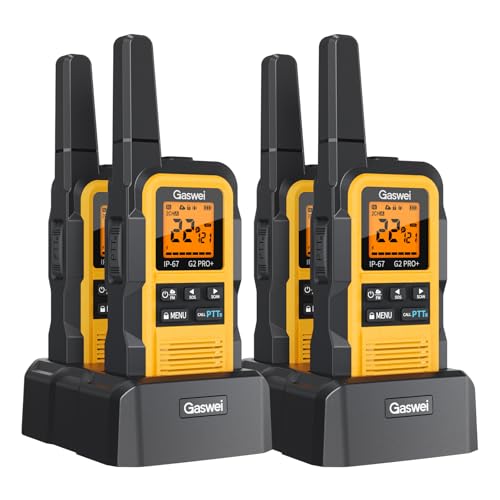
Gaswei G2pro+ Floating Walkie Talkies (4 Pack)
More On The Choices That Made The List
Built for the kind of weekend that ends with soaked jackets and tired legs, the Rocky Talkie Expedition earns its spot at the top of the backcountry list. It runs on GMRS (General Mobile Radio Service), the legal U.S. band that allows higher transmit power than the license-free FRS (Family Radio Service) channels used by casual blister-pack radios. That extra wattage matters when you’re trying to push a signal through tree cover, granite walls, or the long saddle between two ridges.
The body carries an IP67 rating (fully dust-tight and submersible to one meter for short periods), which means a sudden rainstorm or a drop in a creek crossing is not a catastrophe. NOAA weather alerts (the free emergency broadcast channel run by the National Oceanic and Atmospheric Administration) feed straight into the radio, handy when afternoon storms roll through high country. For most backpackers, this is the radio you forget you’re carrying until you actually need it.
Standout Benefits
- 5-watt GMRS output, the maximum handheld power allowed, giving you a real edge on long ridge-to-ridge calls.
- IP67 sealed housing stands up to rain, dust, and brief immersion during stream crossings.
- NOAA weather alerts keep afternoon storm warnings in your pocket without a phone.
- Removable antenna makes pack-down and replacement easier after a rough trip.
- Specialized 1800 mAh rechargeable battery delivers multi-day runtime for most weekend itineraries.
- Eight repeater-capable channels (a repeater is a fixed radio that re-broadcasts your signal to extend range) let experienced users link through mountain-top repeaters when available.
Things To Consider
- GMRS operation in the U.S. requires an FCC license, a small paperwork step many casual campers skip.
- The 5-watt rating claims long theoretical range, but real backcountry performance typically lands at 2–8 miles in forested terrain.
- Charging uses a proprietary cable, so owners commonly stash a spare or a small power bank for multi-day trips.
Who It Suits Best
Backcountry hikers and small-group backpackers who already understand that real-world range is shorter than spec-sheet promises and want the most rugged sealed option in this list.
Look Elsewhere When
The Baofeng UV-5R Mini suits tech-savvy operators who want to program custom frequencies more than they want a plug-and-play backcountry radio.
Where the Rocky Talkie leans into backcountry GMRS power, the DEWALT DXFRS800 keeps things simpler and more approachable. It runs on FRS channels, meaning no license, no menus full of repeater offsets, just pick a channel and talk. For a family basecamp where half the group has never held a two-way radio, that ease is hard to beat.
The 2-watt output is the highest FRS allows on the dedicated FRS frequencies, and the spec sheet claims reach across 300,000 square feet or 25 floors, more useful for navigating a sprawling campground than for punching through a wilderness canyon. Twenty-two channels plus 121 privacy codes (sub-audible tones that filter out other users on the same channel) help cut cross-talk when the campground next door is full of noisy radio users.
Real-World Strengths
- IP67 sealed and drop-rated to 2 meters, so kids and clumsy adults are not a warranty claim waiting to happen.
- Anti-slip textured housing stays put on a wet picnic table or a dusty truck seat.
- Auto-squelch (a circuit that mutes static between transmissions) keeps the speaker quiet unless someone is actually talking, which matters on a long campfire evening.
- 18-hour battery life covers a full day of mixed use without a top-up.
Points To Note
- The DXFRS800 is noticeably heavier than typical blister-pack radios, partly because of that drop-rated shell.
- Range claims assume clear line of sight; dense tree cover will clip that to a fraction of the rated reach.
- Belt clips are functional but not particularly robust, so owners commonly replace them after a season of hard use.
Built With In Mind
Family campers and group leaders who want license-free simplicity, a body that survives drops and rain, and channels busy enough to ignore most campground chatter.
Consider Something Else When
The DEWALT DXFRS800 6 Pack with gang charger suits crews running more than two radios and a single charging station across the vehicle.
The DXFRS300 is the lower-wattage sibling of the DXFRS800 above, designed for shorter hops around a tight camp rather than wide ridge calls. At 1 watt, it sits in the middle of the FRS power tier, perfectly fine when your group stays within a quarter mile of basecamp and the trees are not too dense.
You still get the same IP67 sealing, the same drop-rated housing, and the same 22 channels with 121 privacy codes. For most campers, the question is whether the extra reach of the DXFRS800 justifies its higher cost. On an open lakeside campground, the difference is barely noticeable; in a deep forest, it can be the difference between a clear signal and static.
Well-Handled Touches
- Same rugged IP67 shell as the higher-tier DXFRS800 at a friendlier outlay.
- Anti-slip grip pattern works just as well on a wet kayak deck.
- Auto-squelch and 121 privacy codes help cut interference during peak weekend use.
Worth Noting
- Range drops to roughly 250,000 square feet or 20 floors, noticeably less than the DXFRS800 in real use.
- Battery life shrinks to about 12 hours, so a mid-trip top-up becomes part of the routine on longer weekends.
- At 1 watt, signal breaks up faster through wet forest or around large rock outcrops.
The Right Fit
Weekend campers running tight basecamps within a quarter mile, where a license-free radio and a sealed body matter more than long range.
Skip It When
The Rocky Talkie Expedition suits backpackers who actually need backcountry miles rather than campground hops.
Same radio as the DXFRS800 reviewed above, but here in a six-pack with a gang charger (a multi-bay cradle that charges all six radios at once). That charger alone changes how a group trip actually works. Drop six depleted radios into the bay overnight in the cabin or trailer, and every unit is topped off by morning. No more borrowing the one wall outlet for four hours while half the group waits.
Six units also let you split a large party into channeled sub-groups. Parents on channel 4, kids on channel 7, the trailhead shuttle on channel 3, all using the same rugged hardware. The 2-watt output and IP67 sealing stay identical, so you do not lose performance, you just gain logistics.
Where It Helps
- Gang charger turns a fleet of six radios into one overnight routine.
- 2-watt FRS output is the top of the license-free tier, no paperwork needed.
- IP67 sealed and drop-rated to 2 meters, important when more radios means more chances for accidents.
- 22 channels and 121 privacy codes let you split groups without cross-talk.
Trade Offs
- The gang charger is a sizeable brick, awkward to pack on foot trips or short overnights.
- Six radios is overkill for couples or small families who only need two units.
- Replacing one lost or damaged unit means buying a whole new pack, since spares are not included separately.
Who Should Grab It
Outing leaders, scout troops, and large extended-family campouts who run a central charging station and want everyone on the same hardware.
Swap It Out When
The Gaswei G2pro+ four-pack suits families whose camping revolves around a lake or river where floating bodies actually matter.
The Baofeng UV-5R Mini steps out of the casual FRS sandbox and into amateur radio territory. A “ham” radio (licensed under the Amateur Radio Service) opens up far more frequencies than FRS or GMRS allows, and with the right programming, these little units can hit local repeaters, simplex ham channels, and NOAA weather. The catch is real: transmitting on amateur frequencies in the U.S. requires an amateur radio license, a small multiple-choice test most people can pass with a weekend of study.
For those willing to put in that prep, the UV-5R Mini is a remarkable little package. Up to 999 channels, dual-watch (monitoring two frequencies at once), dual PTT (push-to-talk buttons) for quickly switching between two channels, VOX (voice-activated transmission that lets you talk hands-free), and Chirp compatibility (free PC software used to program channel lists). The 2200 mAh battery and included USB-C charger are friendly touches that earlier Baofeng models lacked.
What Stands Out
- 999 programmable channels give tech-oriented users room to customize.
- Dual PTT buttons let you flip between two frequencies without diving through menus.
- USB-C charging matches the cable most campers already pack for phones and headlamps.
- 5-watt output on supported frequencies gives the radio genuine reach in open terrain.
Honest Caveats
- Programming via Chirp has a learning curve, and owners commonly spend an afternoon with YouTube tutorials the first time.
- Owning a ham radio does not exempt you from licensing requirements when transmitting on amateur bands.
- The Mini’s smaller chassis shrinks the speaker compared to full-size handhelds, which can feel quiet on a windy ridge.
Best Suited To
Tech-savvy campers and preppers who already hold, or plan to earn, an amateur radio license and want a compact, customizable unit.
A Better Fit Elsewhere
The DEWALT DXFRS800 suits campers who want license-free simplicity and would rather not touch programming software.
Nicama bundles the classic UV-5R platform into a six-pack aimed at clubs, teams, and prepper groups who want ham-band flexibility at a low per-unit cost. Each radio covers the 144–148 MHz and 420–450 MHz amateur bands (the two VHF/UHF slices most commonly used by ham operators), with 128 memory channels, dual-watch, dual-standby, and a built-in LED flashlight that doubles as a campsite utility light.
It is the same form factor that has made the UV-5R a staple for two decades, so accessories, batteries, and antennas are everywhere. The 1800 mAh battery keeps the radio going through a full day, and the dual-band display lets you monitor two frequencies at the same time. The honest read is this: you trade some refinement and waterproofing for raw channel count and a friendly price tag.
The Upside
- Dual-band VHF/UHF coverage matches the most common ham repeater pairs.
- Six radios in one package drops the per-unit cost dramatically.
- Built-in flashlight is genuinely useful around a dark campsite.
- Compatible with the huge UV-5R accessory and antenna ecosystem.
Some Limits To Know
- No IP rating is claimed, so wet weather demands a dry bag or careful packing.
- Output tops out at 4 watts on high power, less than the Mini 5-watt unit reviewed above.
- Programming takes patience on first use, and the menu layout is dated.
Perfect Match For
Large crews and group leaders who need lots of ham-capable radios without a per-unit premium and who can carry a dry bag for weather protection.
Another Choice May Suit
The DEWALT DXFRS800 6 Pack suits crews who want license-free FRS channels and sealed bodies rather than ham-band flexibility.
The Gaswei G2pro+ rounds out the list with a feature most camping radios ignore: it floats. Drop one off the canoe or the dock and it bobs to the surface instead of sinking to the muddy bottom. For families whose camping revolves around a lake, river, or coast, that single trait justifies a closer look.
The bright yellow shell helps you spot it drifting, and the IP67 rating covers the same dust and rain conditions as the heavier jobsite models above. Dual PTT buttons let you keep two channels live at once, useful when one group is on the dock and another is at the campsite. You also get NOAA weather, VOX hands-free, an SOS function, and an FM radio for downtime at the fire pit.
Strengths Worth Knowing
- Floating body turns a dropped radio into a recoverable one rather than a sunken loss.
- Dual PTT keeps two channels live for split groups.
- NOAA weather, VOX, and SOS add safety features that match a family camping trip.
- IP67 sealing handles rain and dust without complaint.
Less Ideal Details
- Floating bodies tend to be bulkier than non-floating radios, so pocket carry is less comfortable.
- Long-range claims depend on open water; dense tree-lined shorelines reduce effective reach.
- FM radio drains the battery faster when left on, which owners commonly note on multi-day trips.
Whose Shelf It Belongs On
Families and friend groups whose camping centers on a lake, river, or ocean and who want a waterproof, easy-to-spot radio for kids and adults alike.
Reach For A Different Pick When
The Rocky Talkie Expedition suits backpackers who need long-distance trail reach more than they need a floating body at the dock.
What Matters Most Before Choosing Camping Walkie Talkies
Range Claims Versus Real Terrain
Manufacturer range numbers are measured on open water or flat salt flats, not under a pine canopy. Tree density, humidity, and elevation changes can shrink advertised reach by half or more. Most campers find that 1–3 miles of real terrain is a more reliable expectation than any spec sheet headline. Choose a higher-wattage GMRS radio if your trips regularly involve deep forest or long valleys.
Channel Type And Licensing
FRS radios need no paperwork and work straight from the box, which suits most families. GMRS radios push more power and reach further but require an FCC license in the U.S., a small one-time fee. Ham radios open the most frequencies but require passing an amateur radio exam. Match the radio class to how much admin work your group is willing to absorb.
Battery Life And Charging Style
Multi-day trips punish radios with short runtimes. Look for at least 12–18 hours of claimed battery life if you intend to use VOX or NOAA alerts frequently. USB-C charging, found on the Baofeng Mini, is a quiet blessing since the cable is already in your pack for phones and headlamps.
Durability And Water Handling
An IP67 rating is the practical sweet spot for camping: dust-tight and submersible to one meter for short periods. Jobsite-rated shells add drop protection to 2 meters, which matters when kids are involved. Floating bodies make sense around water but add bulk that hikers may not want.
Key Considerations Across These Picks
Pitfalls Shoppers Hit
The most common slip is trusting the headline range number, then feeling disappointed when the radio cuts out halfway through the forest. Real-world reach is shorter than any spec sheet. Another trap is buying a radio that requires a license and never bothering to get one, which means transmitting illegally on GMRS or ham bands. Finally, skipping spare batteries or charging cables is a frequent regret on multi-day trips where wall outlets are scarce.
Where The Extra Money Goes
Spending more in this category typically buys three things: a sealed, drop-rated housing, higher transmit power, and accessory ecosystems with gang chargers or ham-programming support. The upgrade is worth it for crews who travel often, push into real backcountry, or run large groups that need matched fleets. For occasional family campouts in open campgrounds, a basic FRS pair will get the job done and save a meaningful amount of money.
Frequently Asked Questions
How far do camping walkie talkies really reach?
In open terrain, top-tier GMRS units may push 5–8 miles, but wooded or hilly ground typically limits you to 1–3 miles. FRS radios usually reach under a mile in real camping conditions.
Do I need a license to use camping walkie talkies?
FRS radios in this list require no license. GMRS radios require a low-cost FCC license in the U.S., and ham-band units require passing an amateur radio exam before transmitting on those frequencies.
Are waterproof walkie talkies safe to submerge?
An IP67 rating means the radio can handle temporary submersion to about one meter, but it is not designed for swimming or sustained underwater use. Floating bodies like the Gaswei G2pro+ are better suited to lake and river mishaps.
How long do the batteries last on a camping trip?
Most radios in this roundup are rated between 12 and 18 hours of mixed use, with the Rocky Talkie claiming multi-day runtime under lighter duty. Heavy VOX or NOAA-alert use drains the battery faster, so plan a top-up strategy for trips longer than two nights.
Can I mix brands and still communicate?
Yes, as long as the radios share the same channel and privacy code setup. FRS channels are standardized, so a DEWALT and a Gaswei can talk to each other without trouble. Ham and GMRS frequencies are more sensitive to exact tuning and may not align across brands without programming.
Bottom Line
The right camping walkie talkies come down to your terrain, your group size, and your appetite for paperwork. Backcountry hikers will appreciate the sealed, higher-power reach of the Rocky Talkie Expedition. Family basecamps tend to click with the license-free simplicity of the DEWALT DXFRS800 or the floating safety of the Gaswei G2pro+. Crews and club trips get the most out of six-packs with gang chargers, while tech-oriented campers will gravitate toward a Baofeng ham unit. Pick the one that matches how your group actually camps, and the rest tends to fall into place.