
Cooking at a campsite asks more of your gear than a home kitchen does. You balance heat sources, gusty wind, uneven ground, and limited storage space, all while trying to put together something that actually tastes good. A well-matched cookware setup removes most of that friction and lets you focus on the trip.
This guide rounds up nine cooking kits built for outdoor use, from ultralight backpacking tools to full car-camping kitchens. You’ll find sets aimed at backpackers counting ounces, families feeding a crew, and weekend grillers who just want their tools in one organized bag. Each entry below calls out real trade-offs, who benefits most, and where another pick might suit you better.
A Fast Comparison Of The Options
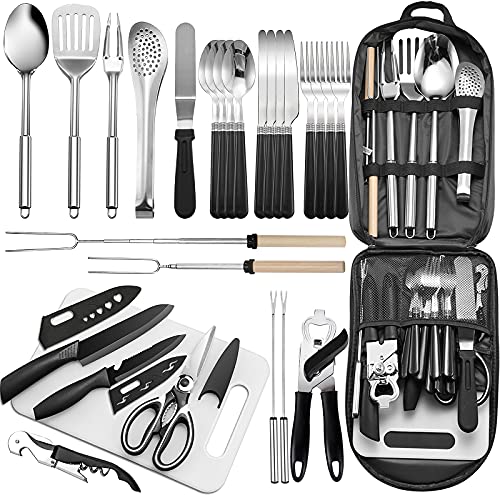
Freehiker 27-Piece Stainless Steel Camping Utensil Set

Life 2 Go 12-Piece Camp Cooking Utensil Set

EWOVUV 18-Piece Camping Cooking Utensils Set
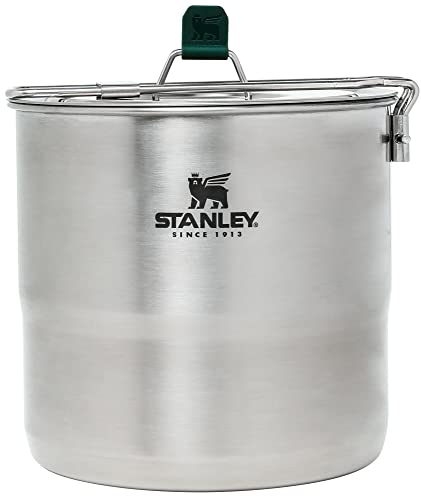
Stanley Adventure Even-Heat Camp Pro Cookset

Gerber ComplEAT Camping Utensils Set

Firebox Locking Bail Handle Camping Pot Kit
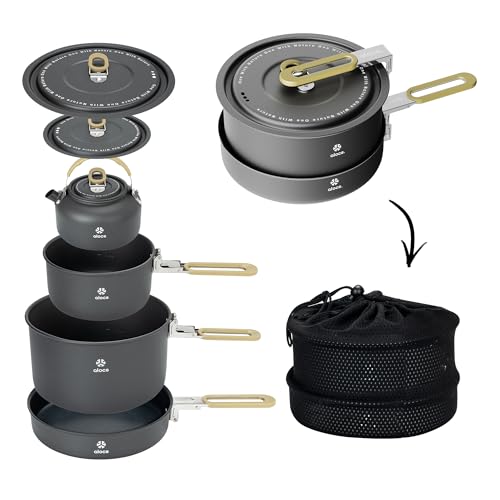
ALOCS Non-Stick Mess Kit with Foldable Handle

BOMKI 13-Piece Grilling and Camping Utensils Set
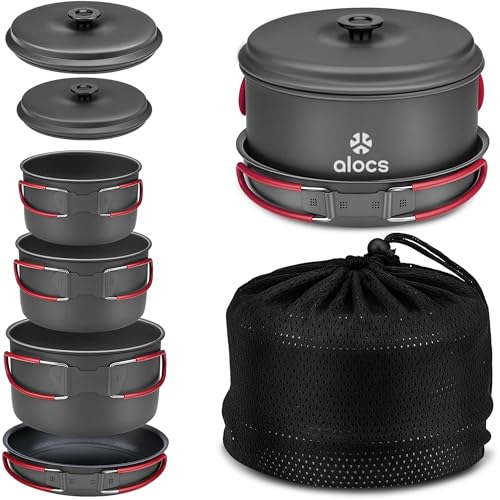
ALOCS Compact Camping Pots and Pans Set
Taking A Closer Look At The Options
The Freehiker set is the broadest tool kit in this roundup, packing twenty-seven pieces into a roll-style organizer that lays flat at the campsite. Stainless steel runs through the line, which matters because cheap plastic scrapes and melts faster than most campers expect over a real season of use. For families splitting cooking duties across three or four people, having a dedicated spatula, slotted spoon, tongs, skewers, and a grill brush per station cuts down on the bottleneck of one person serving everyone.
Where it differs from tighter kits like the Life 2 Go set is sheer breadth: this one aims to cover grilling, prep, and serving in a single bag. You trade compactness for that depth, so it suits weekend car camping more than long-distance backpacking.
A Favorable Mix
- Twenty-seven tools means you stop improvising with a pocket knife and a stick.
- Stainless build handles grill heat and frequent washes without the warping that haunts plastic sets.
- Includes skewers, a brush, and a bottle opener for the cooking steps most kits skip.
- Roll organizer lets you see every tool at a glance, which speeds cleanup.
- Works across camp stoves, charcoal grills, and RV cooktops.
Things To Consider
- Heavier than the Gerber ComplEAT set, so backpackers will feel the weight on long trails.
- More pieces mean more to dry and store after washing; owners commonly report towels become essential.
- Some niche tools duplicate what you already carry, depending on your existing kit.
Who It Suits Best
Group campers, RV travelers, and weekend grill hosts who want every tool in one bag and don’t mind a little extra weight.
Look Elsewhere When
A solo hiker counting every ounce should reach for the Gerber ComplEAT set, which packs down to a fraction of this kit’s footprint.
The Life 2 Go set trims the fat from the broader Freehiker kit and lands on twelve essentials, including a spatula, tongs, knives, and serving pieces. Everything nests into a compact carry case in navy, which slips into a car trunk or trailer without hogging real estate. For tailgate cooks and short-stay campers, the focus on the most-used tools avoids the clutter of extras that rarely leave the bag.
Compared with the Freehiker set, you give up some specialty tools like skewers and a grill brush. In return, the carry case is tighter and easier to stow, which matters when packing space is at a premium.
Notable Upsides
- Stainless steel construction holds up to repeated campfire exposure.
- Compact case keeps every tool in one place, so nothing gets left behind at the site.
- Tool count matches what two or three people actually use on a real trip.
- Lightweight enough for short hikes to a picnic site.
Trade Offs
- No skewers, brush, or bottle opener, which the Freehiker set covers.
- Carry case is functional rather than padded, so tools can rattle on rough roads.
- Twelve pieces may feel short for groups feeding five or more.
Made For
Car campers, tailgaters, and couples who want the essentials without the bulk of a full kit.
Reach For A Different Pick When
Larger groups should step up to the Freehiker 27-Piece set for the extra tool variety.
The EWOVUV set leans into the practical side of outdoor cooking: an eighteen-piece kit that includes a chopping board, barbecue fork, storage bag, and the usual spatula and spoon lineup. It reads like a starter pantry for new campers who don’t yet own any dedicated tools. For a family setting up camp for the first time, having a chopping board in the same bag as the grilling tools removes a forgotten item from the packing list.
Versus the Freehiker kit, you trade tool depth for inclusion of prep basics like the board. Versus the Life 2 Go set, you get more pieces in a similar carry bag, though finish quality can vary run to run depending on owner feedback.
Features That Help
- Eighteen pieces balance cooking and prep in one bag, useful for first-time campers.
- Includes a chopping board, which many utensil-only kits skip.
- Storage bag keeps everything together for transport and storage at home.
- Suits park picnics, RV weekends, and backyard cookouts alike.
Points To Note
- Material mix leans toward lighter-gauge steel, which can dent if packed carelessly.
- Storage bag has no padding, so wrapping sharp tools in a towel helps on rougher trips.
- Some pieces duplicate what experienced campers already own, reducing long-term value.
The Right Fit
New campers, casual families, and gift shoppers who want a broad starter kit without a heavy price tag.
Skip It When
Backpackers should look at the ALOCS Compact Camping Pots and Pans Set, which focuses on cooking gear rather than utensils.
Stanley’s Adventure Even-Heat Camp Pro Cookset is the only entry here that bundles cooking and dining into one nested kit. You get an eleven-piece setup with a 2.6-quart pot, serving utensils, bowls, and sporks sized for up to four people. The compact nesting system, a hallmark of Stanley’s outdoor line, fits a small fuel canister inside the pot, which tightens the pack down to a single stack.
Where it stands apart from the utensil-focused kits above is meal-serving logic: you cook in the pot and eat from the same stack. A BPA-free build and locking pot handle round out the practical touches. It’s the kind of kit that fits a small family at a state park site without leaving you short a plate or a spoon.
Well-Handled Touches
- Eleven pieces serve up to four people, covering cook and eat in one bag.
- Compact nesting leaves room for a small fuel canister inside the pot.
- BPA-free construction, important since bowls and sporks touch food directly.
- Locking pot handle keeps grip stable when pouring hot liquids.
Possible Compromises
- Pot size favors small groups; large families may need a second pot.
- No skewers or grill brush, so BBQ-heavy trips still need a separate tool kit.
- Fuel canister is not included, which is standard but worth flagging.
Best Suited To
Small families and friend groups of three to four who want a single all-in-one system for car camping.
Swap It Out When
BBQ-focused cooks should pair this with the Freehiker set or grab the BOMKI Grilling kit for skewers and a grill brush.
The Gerber ComplEAT set is the minimalist play in this roundup, aimed squarely at solo backpackers and hikers. You get a fork, spoon, spatula, and a four-function multi-tool that nest together for transport. Components snap together to convert into useful shapes, including a long-handled spoon for reaching into freeze-dried bags. The whole package comes in at a pack size that barely registers in a side pocket.
Versus the Life 2 Go set, you trade breadth for portability and end up with fewer serving pieces. The trade works because a solo hiker rarely needs a full serving set, and the multi-tool earns its space by replacing a separate gadget. For anyone counting grams on a multi-day trek, this is the practical choice.
What It Does Well
- Nesting design drops the kit to roughly the size of a pocket flashlight.
- Multi-tool replaces several single-purpose gadgets, saving weight.
- Snap-together components adapt to different cooking tasks mid-trail.
- Works for freeze-dried meals and one-pot dinners on small stoves.
Where It May Fall Short
- No serving pieces, so group meals still need a separate kit.
- Lightweight construction flexes more than the heavier steel sets when stirring thick food.
- Spork-style eating may feel awkward for anyone used to full-size cutlery.
Whose Shelf It Belongs On
Solo backpackers, thru-hikers, and minimalists who prioritize pack weight over tool variety.
Another Choice May Suit
Group cooks should reach for the Stanley Adventure Even-Heat Camp Pro Cookset, which adds bowls and a real pot.
The Firebox kit is built for open-fire and bushcraft cooking rather than backpacking stoves. You get a Zebra Loop Handle Pot, an inner pan, and two stainless steel handle clips that lock the bail handle upright, which keeps the metal away from campfire heat and frees the lid for pouring or covering. For folks cooking over a wood fire or a charcoal bed, this handle logic is the difference between burned fingers and a smooth cook.
Compared with the ALOCS kits below, this is a different beast: a single rugged pot instead of a nested cookware stack. Where it shines is durability in rough conditions and the locking handle, which is genuinely useful when flames lick up the sides of the pot.
The Good Stuff
- Locking handle keeps metal away from open-flame heat during use.
- Inner pan doubles as a lid and a separate cooking surface.
- Spring-tempered stainless steel clips add real durability in field conditions.
- Pours cleanly with the handle locked, reducing spill risk over coals.
A Few Limitations
- Single pot design means no matching pan for frying sides.
- No plates or utensils in the kit, so you’ll need a separate dining set.
- Heavier than ultralight kits, so backpackers may want a lighter option.
Perfect Match For
Bushcrafters, survival instructors, and open-fire cooks who prioritize rugged build over kit breadth.
A Better Fit Elsewhere
Car campers who want matched pots and pans should consider the ALOCS Non-Stick Mess Kit, which nests into a fuller cookware set.
The ALOCS Non-Stick Mess Kit covers more cooking ground than most kits in this roundup. You get a 1.7-liter pot, a 3-liter pot, a 0.8-liter kettle, and an eight-inch frying pan, all packing into one bag at roughly 3.3 pounds total. The foldable handles are heat-resistant, which keeps hands off hot metal and speeds meal transitions at busy basecamps.
Versus the Stanley Even-Heat set, this kit trades place settings for more cookware variety, including a kettle. The non-stick coating on the pan helps with eggs and quick sautés, which matters at a campsite where cleaning water is precious. Owners commonly report that the non-stick surface holds up well if you avoid metal utensils.
What Pays Off
- Two pots, a kettle, and a frying pan cover real meal variety.
- Foldable handles save space and protect hands from hot cookware.
- Non-stick coating cuts down on oil use and eases cleanup with limited water.
- Packs into a single carry bag at a manageable weight for car campers.
Honest Caveats
- Non-stick surfaces need gentle cleaning and plastic or wood utensils to last.
- 3.3 pounds is heavier than backpacking-focused kits like the Gerber ComplEAT.
- Kettle is small, so boiling water for a group of five takes multiple rounds.
Who Should Grab It
Car campers, basecamp cooks, and small families who want a full cookware spread without buying pieces separately.
Where A Sibling Pick Shines
Thru-hikers should choose the Gerber ComplEAT set for fraction-of-the-weight trail meals.
The BOMKI kit is built around the grill-and-go crowd, with thirteen pieces and a crossbody carrying bag in brown. Stainless steel runs through the tool lineup, and the crossbody strap leaves your hands free for hauling a cooler or a folding chair. For tailgate hosts who walk across parking lots with gear in tow, the hands-free carry is the standout detail.
Compared with the Freehiker set, you give up some specialty tools but gain a more thoughtful carry solution. The thirteen-piece count lands between the Life 2 Go and Freehiker kits, which makes sense for BBQ-focused cooks who want grill tools without a full kitchen set.
Good Reasons To Consider
- Crossbody bag frees both hands for carrying coolers, chairs, and fuel.
- Stainless tools handle grill heat and resist rust through rainy weekends.
- Thirteen pieces cover grilling without overpacking the bag.
- Bag style transitions easily from campsite to backyard cookouts.
Where It Is Less Suited
- Tool count is lower than the Freehiker kit, so prep-focused cooks may want extras.
- Crossbody strap is comfortable but adds bulk versus a flat organizer.
- No kettle or pot means it pairs best with an existing cookware kit.
Who Will Love This
Tailgaters, BBQ hosts, and grill-first cooks who walk any distance to their cooking spot.
Not Your Match When
Campers focused on stove cooking should pair this with the ALOCS Compact Pots and Pans Set for matched cookware.
The second ALOCS entry trades the larger Non-Stick Mess Kit’s kettle and pan for a tighter three-pot stack. You get a 2.3-quart pot, a 1.3-quart pot, a 1.1-quart pot, and a non-stick pan in hard-anodized aluminum with food-grade silicone handles. Hard-anodized aluminum is a treatment that hardens the surface for scratch resistance and even heating, which matters on small camp stoves that run hot in the center.
Versus the Stanley Even-Heat kit, this one focuses purely on cooking and skips the bowls and sporks. Versus the Firebox Locking Pot, you trade open-fire ruggedness for stove-friendly efficiency and a non-stick pan. For two-to-three-person backcountry trips, the pot sizes are well matched to real portion planning.
Positive Takeaways
- Three pots plus a pan handle real meal variety without excess weight.
- Hard-anodized aluminum resists scratches and spreads heat evenly on small stoves.
- Non-stick pan handles quick sautés and eggs without sticking.
- Food-grade silicone handles stay cool enough to grip without a towel.
Factors To Consider
- Aluminum body requires hand washing to preserve the anodized surface.
- No plates, bowls, or utensils included, so dining still needs a separate kit.
- Pot sizes assume two-to-three people; larger groups will run out of capacity fast.
Who It Suits Best
Two-to-three-person backcountry campers and lightweight car campers who want real cookware in a tight stack.
Consider Something Else When
Open-fire cooks will find the Firebox Locking Pot better suited, since it tolerates flame heat more confidently.
Choosing Gear That Actually Works At The Campsite
A camping cookware set earns its place when it matches how you actually travel. Backpackers carrying everything on their back should weigh grams more than tool count, while car campers with a packed trunk can prioritize variety and family-friendly serving. The dividing line is usually weight versus utility, and the right answer depends on your trip length, group size, and how involved you want to be at mealtime.
Material choice drives both weight and durability. Stainless steel resists dents and handles open flame, though it weighs more per pot. Hard-anodized aluminum heats faster and cuts weight, but it doesn’t love direct fire and prefers a stove or a grill plate. Non-stick coatings help with eggs and quick sautés but require plastic or wood utensils to last.
Cooking style matters too. Grill-heavy cooks need skewers, a grill brush, and long-handled tools to keep hands away from heat. Stove-first cooks should focus on pot sizes that match their portions, with lids that double as plates. For groups larger than four, a single nested kit usually runs short, and pairing a cookware set with a separate utensil bag becomes the practical move.
Finally, think about cleanup. Sites without running water reward non-stick surfaces and tight part counts. Sites near a spigot open the door to broader kits with more pieces to wash. Owners commonly report that drying towels become essential at any site where rust could settle overnight.
Key Considerations Across These Picks
Wrong Turns To Avoid
The most common mistake is buying a giant kit for a quick overnight and ending up hauling weight you never touch. Match the kit to your trip type: a day at a state park calls for a mid-range utensil set, while a week-long basecamp benefits from full cookware. Another trap is ignoring fuel compatibility. Some kits expect a small canister stove, and assuming your existing stove fits without checking can leave you with pots that don’t sit flat on the burner. Material confusion also trips up newcomers. Stainless looks like aluminum, but the weight and heat behavior differ enough to matter on a windy day.
Where The Extra Money Goes
Higher-priced kits in this category tend to spend the difference on materials, nesting logic, and accessories that actually fit. Hard-anodized aluminum costs more than plain aluminum because the surface treatment adds real durability. Locking handles, like those on the Firebox pot, cost more to engineer and assemble but reduce burned fingers in real use. Larger kits with bowls, sporks, and serving tools save you from buying those separately. The honest read is that the upgrade pays off most for people who cook often outdoors and need gear that survives season after season.
Frequently Asked Questions
What is the best size camping cookware set for two people?
A two-pot stack with a small frying pan handles most two-person meals. Look for pot sizes around 1.1 to 1.7 quarts, which fit dehydrated meals, pasta portions, and breakfast scrambles without overpacking.
Can you use camping cookware on a regular home stove?
Most camping pots and pans work on home stoves without issue. The reverse is the trickier direction, because home pans often lack the nesting or weight savings that make camping kits worth carrying.
How do you clean camping cookware without running water?
Wipe down while still warm, then use a small amount of biodegradable soap with a bandana or microfiber cloth. Owners commonly report that drying everything before packing prevents rust and mildew on the trip home.
Is stainless steel or aluminum better for camping cookware?
Stainless steel handles open fire and rough use, while aluminum heats faster and weighs less. For backpacking, aluminum wins on weight. For open-fire cooking, stainless tends to hold up longer.
Do camping cookware sets include plates and utensils?
Some do, like the Stanley Even-Heat Camp Pro Cookset, while others focus on pots and pans only. Check the included pieces before you shop, since adding dining gear separately is common.
Wrap Up
The right camping cookware set depends on how you travel, what you cook, and how much weight you want to carry. Backpackers tend to do well with minimal kits like the Gerber ComplEAT, while car campers and families often prefer fuller setups like the Stanley Even-Heat or ALOCS Non-Stick Mess Kit. Match the kit to your trip, and the gear usually takes care of itself.