
Cooking over fire takes a different shape when the site is a tent pad instead of a patio. The grill still has to feed everyone, hold heat through a breeze, and fit inside a packed vehicle. The picks below cover that spectrum, from charcoal classics with a 14-inch footprint to pellet cookers big enough to feed a crowd on a tailgate.
Some of these are obvious camping choices: small, light, and durable. Others earn their spot because they travel well in a truck or handle both the campsite and a Saturday at home. The aim is a balanced shortlist, not a one-size list. Each entry below pairs a real-world use case with the honest trade-offs that come with it.
The Choices Worth Comparing

Weber Jumbo Joe Charcoal Grill 18-Inch
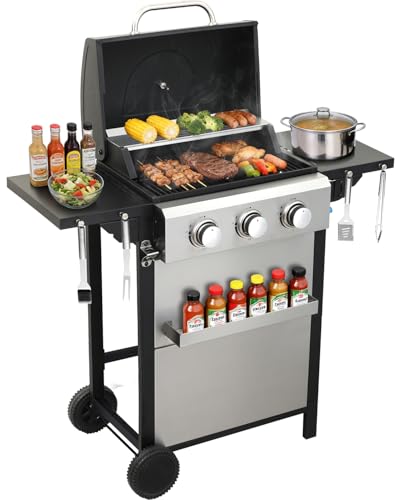
3 Burner Propane Gas Grill 30,000 BTU Stainless Steel

Old Smokey Charcoal Grill #18 (Medium)

Old Smokey Charcoal Grill #14 (Small)

Pit Boss 500 FB2 Series Wood Pellet Grill & Smoker

Pit Boss 150 Wood Pellet Grill & Smoker

Pit Boss 3-Series Propane Gas Vertical Smoker

Pit Boss 4-Burner Propane Fold & Go Portable Griddle

Pit Boss 1300 Navigator Series WiFi & Bluetooth Pellet Grill

Pit Boss 500 Carbon Series Wood Pellet Grill & Smoker
The Weber Jumbo Joe sits in a sweet spot that explains its long-running popularity. The 18-inch plated steel grate gives you real cooking surface without making the grill a chore to pack, and the porcelain-enameled bowl and lid are tough enough to shrug off a long drive on dirt roads. Compared to the smaller Old Smokey #14 coming up later, this Weber trades a tighter footprint for noticeably more cooking area.
For campers who want charcoal flavor without managing a full-size kettle, the Jumbo Joe feels like the natural middle ground. Aluminum dampers let you tune airflow for a low-and-slow cook, and the lid holds enough heat for indirect roasting on a chilly morning. Most owners find it cleans up quickly once the ashes cool, and the parts that matter most are all replaceable.
Real Benefits
- 240 sq in of cooking surface, enough for a family dinner or a dozen burgers at a tailgate
- Porcelain-enameled bowl and lid help resist rust through many seasons of camp trips
- Tunable aluminum dampers give real control over heat without guesswork
- Light enough that one person can carry it from the truck to the fire ring
- Compatible with widely available charcoal accessories and replacement parts
Things To Consider
- Charcoal-only means you’ll haul fuel and wait for coals to reach cooking temp
- No side shelves or work surface built in, so a separate prep table helps
- Wheels are functional but small, rough gravel can make moving it a workout
Who It Suits Best
Weekend campers and tailgaters who want a proven charcoal grill that travels in a trunk and feeds a small group without ceremony.
Where Another Pick Suits Better
Solo travelers packing light into backcountry camps will find the Old Smokey Charcoal Grill #14 (Small) easier to manage at the trailhead.
Propane changes the rhythm of camp cooking. The 3 Burner Propane Gas Grill from ideamaxx delivers three independent stainless steel burners that total 30,000 BTU, so you can sear steaks on one side while warming tortillas on the other. The 322 sq in surface handles family-sized meals, and the two foldable side shelves give you a real prep area when the picnic table is a folding camp chair.
This is a drive-in camp grill rather than a backpack model. Set it up at a serviced site with a flat surface and a propane tank, and it cooks like a backyard unit. Compared to the Weber Jumbo Joe above, you trade charcoal flavor for speed, control, and the ability to grill on a windy evening without babysitting a fire.
What Makes Sense
- Three independently controlled burners let you run different temps at once
- Foldable side shelves create usable prep space, then collapse for storage
- Stainless steel build handles outdoor conditions and wipes down easily after a greasy cook
- 322 sq in cooks enough for a group of six without crowding the grate
Worth Noting
- Requires a propane tank you must transport and store separately
- Bulkier than charcoal portables, better suited to car camping than tight storage
- Wind can cool a gas grill’s lid zone, so a windscreen improves low-and-slow cooks
Made For
Car campers and RV travelers who want fast, predictable cooking and the convenience of gas at a campsite with vehicle access.
Consider Something Else When
Backcountry hikers will struggle with the propane footprint; the Old Smokey Charcoal Grill #18 (Medium) drops fuel weight considerably.
The Old Smokey #18 Medium is one of those grills that has barely changed in decades, and for good reason. The barrel-style design uses aluminized steel that resists rust far better than standard painted steel, and the simple construction means almost anyone can assemble it without a manual longer than a recipe card. It is heavier than it looks in the spec sheet, but that mass helps it hold steady heat on a breezy day.
Compared to the Weber Jumbo Joe above, this Old Smokey leans into no-frills charcoal cooking with fewer accessories but a sturdier feel. If you want a grill you can leave outside under a tarp and not worry about, this is the shape of grill that fits that lifestyle.
Useful Strengths
- Aluminized steel body shrugs off weather better than painted alternatives
- Deep barrel design holds charcoal volume for longer cooks
- Made in the USA from domestic and imported parts, with a simple parts catalog
- No electronics or gas lines, so it starts with a match and keeps working
Trade Offs
- Lid fit and finish are functional rather than refined
- No wheels built in, so moving it requires two hands or a helper
Best Suited To
Charcoal traditionalists who want a sturdy, low-maintenance grill at a permanent camp or rental cabin.
Look Elsewhere When
Cooks wanting pellet convenience and app control will prefer the Pit Boss 1300 Navigator covered later in this list.
The Old Smokey #14 Small is the smallest charcoal grill on this list and one of the simplest. Its round, 14-inch aluminized body weighs very little, fits in a car trunk without Tetris, and cooks enough food for two hungry campers or a couple with leftovers. There are no clever features here, and that is exactly the point.
For tight storage, motorcycle camping, or a base-camp setup where you only need to grill a few items, this grill does the job. It pairs naturally with the Old Smokey #18 above for larger groups, though the #14 is the better pick when packing space matters more than capacity.
Bright Spots
- Compact aluminized build keeps weight and storage footprint minimal
- Simple round design is easy to clean, store, and transport
- Made in the USA with straightforward assembly
- Charcoal cooking without the bulk of a kettle grill
Honest Caveats
- Cooking surface is small, so it limits batch size for groups
- Lacks a lid handle and accessories found on larger charcoal grills
- No wheels or stand, so you’ll set it on a table or the ground
Perfect Match For
Couples and solo campers who pack light and value simplicity over cooking surface area.
Swap It Out When
Families or group cooks needing more space should look at the Weber Jumbo Joe Charcoal Grill for noticeably more grate room.
The Pit Boss 500 FB2 brings pellet versatility to a campsite that can handle the weight. With eight cooking functions (smoke, bake, braise, roast, grill, barbecue, char-grill, and sear), it can replace a full outdoor kitchen if you give it shelf space. The 518 sq in of porcelain-coated steel cooking surface spans two tiers, enough for a brisket and a tray of vegetables at the same time.
Where the charcoal grills earlier in this list ask you to manage fire, this Pit Boss manages it for you through its LCD digital controller. The included meat probe tracks internal temperature so you can step away from the grill without losing track of the cook. Compared to the smaller Pit Boss 150 covered below, you get more hopper capacity and significantly more cooking surface in exchange for size.
A Favorable Mix
- Eight cooking modes cover almost any camp recipe in one unit
- 518 sq in over two tiers handles full family meals or large cuts of meat
- Included meat probe supports hands-off cooks on long smoking sessions
- 180°F to 500°F range handles low-and-slow smoking and high-heat searing
Points To Note
- Heavier than charcoal portables, so it suits car camping more than backpacking
- Requires a steady supply of wood pellets and a power outlet for the controller
Right Fit For
Long-weekend family campers with power access who want pellet flavor and set-and-forget cooking.
Not Your Match When
Travelers needing a pellet grill they can carry one-handed will find the Pit Boss 150 much easier to take on the road.
The Pit Boss 150 is built for people who refuse to choose between pellet flavor and portability. The latch-lock lid and dual handles let you carry it like a cooler, and the automatic start-up and cool-down cycles mean the cooker handles itself once plugged in. With 256 sq in of cooking surface, it feeds a small group without dominating the campsite.
This is a different category of pellet grill than the larger 500-series covered earlier. You lose hopper capacity and overall cooking space, but you gain the option to take a real smoker to a tailgate, a cabin, or a fishing trip. The 180°F to 500°F range mirrors the bigger Pit Boss units, so the actual cooking capability stays serious.
Positive Takeaways
- Latch-lock lid and dual handles make transport genuinely manageable
- 256 sq in surface fits ribs, a small brisket, or a full burger batch
- Automatic start-up and cool-down simplify pellet cooker operation
- Flame broiler option adds direct-heat searing in a pellet unit
Small Caveats
- Still requires a power outlet, so it’s not a true off-grid cooker
- 7 lb hopper means refilling pellets for cooks longer than a few hours
- Compact design leaves limited workspace for prep or platters
Whose Shelf It Belongs On
Tailgaters, cabin-goers, and road-trippers who want pellet smoking that travels in the back seat or trunk.
A Better Fit Elsewhere
Cooks feeding large groups on long weekends will get more cooking area from the Pit Boss 500 FB2 covered above.
The Pit Boss 3-Series is a vertical gas smoker designed for volume. Four adjustable racks add up to 983 sq in of cooking space, and the wood chip tray lets you add smoke flavor without converting the unit. The 2,500 BTU burner is intentionally modest because smokers work best with slow, even heat, and the rear wheels make repositioning the cabinet easier than expected.
Unlike the charcoal grills earlier on this list, this is a dedicated low-and-slow unit. You will not be searing steaks over direct flame, but you can cold-smoke cheese, hot-smoke ribs, and run two trays of fish at once. The 100°F to 300°F range is narrower than the pellet units, but it covers the realistic band for traditional smoking.
Good Reasons To Consider
- 983 sq in across four racks supports big batch cooks
- Wood chip tray adds smoke flavor without managing a separate firebox
- Analog HVR controller is simple to dial in and adjust mid-cook
- Removable grease cup streamlines cleanup after long cooks
Things That May Matter
- Tall vertical cabinet needs a vehicle with the clearance to transport it
- Propane smokers run warmer in direct sun and cooler in cold weather, so ambient conditions affect cook times
- Single burner limits recovery if the door opens frequently
Who Should Grab It
Big-batch camp cooks hosting large gatherings who want consistent smoke output across multiple racks.
Reach For A Different Pick When
Anyone needing a grill that doubles as a high-heat searer will get more versatility from the Pit Boss 500 Carbon Series.
Flat-top cooking at a campsite is a different experience than grilling over grates, and this Pit Boss griddle is built for it. The 753 sq in surface measures 37 inches long by 20 inches wide, with four separately controlled burners producing a combined 62,000 BTU. That is enough firepower to run a pancake station for a dozen campers while flipping bacon at the same time.
The fold-and-go design with a hard cover makes it more road-trip-friendly than its size suggests, and it pairs naturally with the propane gas grill covered earlier for cooks who want both griddle and grate options. Where the Weber Jumbo Joe excels at charcoal sear marks, this Pit Boss delivers even heat across a wide surface, ideal for breakfast, smashburgers, and stir-fried vegetables.
Everyday Advantages
- Four burners create distinct temperature zones across the griddle
- 753 sq in cooking area handles large breakfast or dinner batches
- Hard cover protects the cooktop during transport and storage
- Fold-and-go frame fits in many truck beds and SUV cargo areas
Practical Considerations
- Requires a propane tank and a level surface for safe operation
- Flat-top cleaning takes more time than a standard grate after greasy cooks
The Right Fit
Group campers and tailgaters who cook breakfast and one-pan meals more often than classic grilled cuts.
Where A Sibling Pick Shines
Cooks focused on seared steaks and burgers over an open flame will get more satisfaction from the Weber Jumbo Joe charcoal grill.
The Pit Boss 1300 Navigator is the largest grill in this roundup and the most connected. With 1,329 sq in of cooking space, a 30 lb pellet hopper, and a touchscreen controller backed by WiFi and Bluetooth, it functions as a serious outdoor kitchen for big cookouts. Two meat probes come included, and the flame broiler adds direct-heat capability that most pellet units skip.
This is overkill for a quick camp dinner but ideal for hosts who want long-smoke cookouts with phone-based monitoring. Compared to the Pit Boss 500 Carbon Series later in this list, you get nearly triple the cooking area, app control, and a much larger hopper. The trade-off is weight, footprint, and a heavier reliance on consistent power.
Strong Points
- 1,329 sq in cooking area handles large cuts and full meal spreads
- WiFi and Bluetooth connectivity enable remote temperature monitoring
- 30 lb pellet hopper supports hours-long smokes without refilling
- Touchscreen controller gives precise digital temperature management
Where It Is Less Suited
- Size rules out most small campsites and limits transport options
- WiFi features depend on network coverage, which can be weak at remote sites
Built With In Mind
Backyard cooks and tailgate hosts who want app-driven control and large-capacity pellet smoking.
Another Choice May Suit
Campers needing a more compact pellet experience will find the Pit Boss 150 easier to manage on the road.
The Pit Boss 500 Carbon Series rounds out the list as a mid-size pellet cooker without the extra connectivity of the Navigator. The 543 sq in porcelain-coated cooking surface delivers enough room for a small family cookout, and the LCD digital controller covers the standard 180°F to 500°F pellet range. A meat probe is included for hands-off cooks, and the 13.5 lb hopper balances capacity against unit size.
This Carbon Series sits between the smaller Pit Boss 150 and the much larger Navigator. For campers who want pellet convenience and a meaningful cooking area without hauling the biggest model on the list, it is a sensible middle option. It is also the most approachable Pit Boss unit for first-time pellet owners in this guide.
A Few Highlights
- 543 sq in surface balances batch size and portability for car camping
- Porcelain-coated steel grates simplify post-cook cleanup
- 180°F to 500°F range covers low smoking and high searing in one unit
- Automatic start-up and cool-down simplify pellet operation
Potential Compromises
- Lacks the larger Navigator’s app control and expanded hopper capacity
- Heavier than charcoal options at the same cooking-area tier
Who Will Love This
Campers stepping into pellet cooking who want a straightforward mid-size unit without premium-tier features.
Skip It When
Tech-driven hosts will appreciate the WiFi and Bluetooth upgrades built into the Pit Boss 1300 Navigator instead.
What To Weigh Before Picking Your Camping Bbq
Fuel choice sets the tone for every other decision. Charcoal delivers flavor and independence from power, but it adds setup time and ash cleanup. Propane gives fast heat and precise control at the cost of a tank you must transport. Pellets blend smoke flavor with set-and-forget cooking but require a power outlet and a steady pellet supply.
Cooking area matters more than headline BTU. A larger grate handles family meals and reduces the number of batches, while a smaller grate keeps weight and storage manageable. For solo or couple camping, 14 to 18 inches of cooking surface usually suffices. Group cooks often want 500 sq in or more.
Portability has more layers than weight. Footprint, folded dimensions, latch systems, and wheel placement all change how a grill fits into a vehicle and a campsite. A 30-pound grill with awkward handles feels heavier than a 40-pound grill with a smart carry frame.
Build materials influence how a grill weathers the trip. Aluminized steel resists corrosion better than standard painted steel, while stainless steel stands up to grease and outdoor humidity. Porcelain coatings on grates make cleanup faster and slow rust on the cooking surface.
Things Worth Knowing Before You Commit
Common Shopping Slip Ups
The biggest mistake is choosing by BTU alone. High heat helps sear, but uneven heat distribution ruins cooks just as easily. Look at grate material, burner configuration, and lid fit alongside any output number.
Another slip is underestimating fuel logistics. Charcoal requires cool, dry storage. Propane tanks must be transported upright and stored safely. Pellets need sealed containers to stay dry in humid camp conditions.
Where The Extra Money Goes
Higher-tier pellet grills add larger hoppers, better controllers, and connectivity that simplifies long cooks. The upgrade matters most when you smoke for hours at a time, because fewer hopper refills and remote monitoring save real attention.
Larger cooking areas cost more in material, weight, and fuel consumption. The case for paying up is straightforward if you cook for groups often. For solo trips and short weekends, a smaller grill usually gives better value per dollar.
Frequently Asked Questions
What size grill is best for car camping?
For two to four campers, 240 to 322 sq in of cooking surface handles most meals without crowding the grate. Group cooks of six or more usually want 500 sq in or more.
Can pellet grills work without electricity?
No. Pellet grills use electric augers and controllers, so they require a power source such as an outlet or a portable power station to operate.
Is charcoal or propane better for windy campsites?
Propane tends to perform more consistently in wind because burners resist gusts better than open charcoal. A charcoal grill still works, but wind can cool it faster and extend cook times.
How do I clean a portable grill at the campsite?
Let the grill cool, then wipe grates with a wire brush and empty ash catchers into a metal container. For stuck residue, a small amount of cooking oil on a paper towel works on warm grates.
Are foldable side shelves worth it?
Foldable shelves add useful prep space at the campsite and collapse for transport, which helps in tight storage situations. They matter most when a picnic table is unavailable.
Bottom Line
The right camping grill depends on how you travel. Charcoal models like the Weber Jumbo Joe and Old Smokey series keep things simple and fuel-flexible, while propane options deliver speed and control. Pellet units add smoke flavor and automation for cooks who can supply power. Match the fuel and footprint to your campsite, and the rest of the decision follows.