
A long weekend at a quiet lake spot, a string of devices to keep alive, and not a wall outlet for miles. That is the daily reality behind portable power, and it is exactly why camping battery options matter more than ever for tent campers, overlanders, and backyard tailgaters alike. The picks below cover a range of scales, from gas-driven inverter generators and high-capacity LiFePO4 power stations down to tiny slide-on tool-battery inverters that fit in a coat pocket. Use this list to match the right setup to how you actually camp, not just to the wattage on the box.
The Main Contenders

Honda EU2200i Companion 2200W Inverter Generator

EF ECOFLOW Delta 3 Portable Power Station 1024Wh

BLUETTI AC200L Portable Power Station 2048Wh
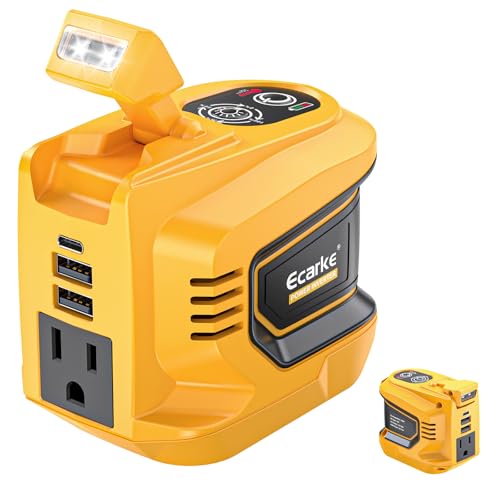
Ecarke 220W Portable Power Inverter for DeWALT 20V

Ecarke 220W Power Inverter for DeWALT 20V (2-Pack)
Ecarke 350W Portable Power Inverter for DeWALT 20V

STARYLINE 1000W Portable Power Station 1024Wh LiFePO4

Ecarke 300W Portable Power Inverter for DeWALT 20V
Taking A Closer Look At The Options
The Honda EU2200i Companion has earned a strong reputation among RVers and base-campers who care more about conversation-friendly noise levels than raw wattage. An inverter generator (one that produces clean, stable AC suitable for sensitive electronics like laptops and CPAP machines) puts out 2200 watts in a compact frame, and the Companion trim adds a 30A outlet designed for RV hookups. Inverter units like this also throttle down at low load, so the fuel economy at idle is genuinely better than a traditional open-frame generator.
For most weekend campers, the noise rating matters more than the spec sheet suggests. Quieter operation at the campsite is a quality-of-life upgrade you feel in the first evening, not after months of ownership. The trade-off shows up in weight, since you will still be hauling roughly 47 pounds plus a tank of gas.
Useful Highlights
- Inverter-grade output safe for laptops, cameras, and CPAP machines
- 30A RV-ready outlet removes the need for a separate adapter in many setups
- Parallel capability with a second EU2200i doubles available wattage
- Low fuel draw at idle stretches runtime on a single tank
- Honda’s engine reputation tends to translate to long service intervals
Things To Consider
- You will need to bring gasoline and deal with exhaust, unlike the battery stations below
- At 47 pounds dry, it is heavier than every LiFePO4 option on this list
- Running microwaves or hair dryers will shorten runtime noticeably
Feature Snapshot
Made For
RVers and base-camp hosts who run fridges, lights, and small kitchen appliances on a regular weekend and want gas-grade runtime without the roar.
Skip It When
The EF ECOFLOW Delta 3 Portable Power Station suits tent campers and quiet campers who cannot or do not want to run gas in their setup.
The EF ECOFLOW Delta 3 sits in the sweet spot for campers who want real AC output without gas, plus fast turnaround between outings. The 1024Wh LiFePO4 battery (a lithium iron phosphate chemistry known for long cycle life and thermal stability) paired with 1800W of inverter output means you can run a small fridge, charge laptops, and still have headroom for a coffee maker on a brisk morning. ECOFLOW’s claim of an 80% recharge in roughly 30 minutes is the kind of feature that changes trip-day logistics.
Where the Delta 3 separates from the Honda generator up above is silence and indoor-friendliness. There is no exhaust, no spark arrestor worry, and no fuel stabilizer ritual at season end. You do give up indefinite runtime, and heavier continuous loads will drain the pack fast, so it helps to know your real watt-hour budget before you commit.
Positive Points
- 1800W output covers most household-style loads you would bring camping
- LiFePO4 chemistry typically delivers thousands of cycles before noticeable degradation
- Expandable into a broader ECOFLOW battery ecosystem for growing needs
- Fast AC input shortens the window between trips
Worth Noting
- Total stored energy is finite, so heavy induction cooking and AC compressors will eat capacity quickly
- The unit is meaningfully heavier than small power banks, so plan a vehicle spot for it
- Premium pricing usually reflects the brand’s app ecosystem and recharge speed
Right Fit For
Campers who split time between weekend trips and home-backup duty and value silent, gas-free operation with fast turnaround.
Consider Something Else When
The BLUETTI AC200L Portable Power Station fits better for crews running induction cooktops or full-size RV fridges on long-haul trips.
Step up in capacity and the BLUETTI AC200L enters a different weight class. At 2048Wh with a 2400W output ceiling, this LiFePO4 unit is built for groups, off-grid cabins, and anyone running gear that punishes smaller stations. Compared to the EF ECOFLOW Delta 3 covered above, you are getting roughly double the stored energy plus serious headroom for power-hungry appliances. The modular expansion path is also part of the design: stack compatible battery packs and you can scale into the multi-kWh range without buying a second full unit.
One honest read: this is the right pick for trips that look more like base camp than quick overnights. If your weekend revolves around lights, two phones, and a JetBoil, you are paying for capacity you will not touch. If, however, you regularly run a portable fridge, camera charging stations, and an induction cooktop, the AC200L stops feeling oversized fast.
Points In Its Favor
- 2400W inverter handles most RV and household appliances under load
- LiFePO4 chemistry favors long cycle life over older lithium-ion builds
- Expansion batteries let you grow capacity without replacing the main unit
- Multiple AC and DC ports keep cable juggling to a minimum
Room For Improvement
- The base unit alone weighs over 60 pounds, so this is a cart-from-the-car product
- Charging speed, while solid, does not match the ECOFLOW Delta 3’s quick-turnaround claim
- Real value shows up only when you actually use the expanded capacity
Who It Suits Best
Overlanders and group campers who run fridges, induction cooking, and camera gear across multi-day trips away from shore power.
Where Another Pick Suits Better
The STARYLINE 1000W Portable Power Station is a friendlier size for couples and lighter weekend use.
Not everyone needs a full power station. The Ecarke 220W Portable Power Inverter is a slide-on adapter that turns a DeWALT 20V battery into a 110V AC outlet, plus USB-A and Type-C ports for direct device charging. At well under a pound of inverter weight, it slips into a glove box or backpack pocket. The concept leans entirely on batteries you already own, which makes it a low-friction add for anyone running DeWALT tools on a job site or campsite.
The trade-off shows up the moment you push past 220W continuous. Heavy loads will drain a tool battery faster than expected, so this is a charger-and-laptop solution rather than a fridge runner. For most backpackers and day-trippers, that is exactly the right balance.
What Earns Its Place
- Uses DeWALT 20V batteries you may already own, no separate battery platform needed
- Type-C port covers modern laptop and phone charging in one adapter
- Fits in places a power station never could, like a coat pocket or glove box
- LED light adds a campsite reading lamp without another gadget
Points To Note
- Battery and charger are not included, factor those into total cost if you start fresh
- 220W continuous rules out small kitchen appliances and most AC compressors
- Runtime is fully tied to your tool-battery capacity, which limits long sessions
Best Suited To
DeWALT-equipped campers and contractors who need a quick AC outlet for laptops, lights, and phone charging without hauling a full station.
A Better Fit Elsewhere
The STARYLINE 1000W Portable Power Station suits backpackers without a tool battery platform who want a self-contained camping battery option.
The two-pack version of the Ecarke 220W inverter solves a very specific problem: running two AC loads at once from separate tool batteries, in separate corners of camp. Same per-unit capability as the single pack reviewed above, but spread across two adapters, so a tent and a cook area can each have their own outlet. Pair the two with a couple of DeWALT 20V packs and you have a quietly capable micro-grid for off-grid lighting and laptop duty.
The honest read is that the value is tied to how you split the work. Buying two when a single inverter plus a long extension cord would do is overkill. Buying two when you want to keep a charging station and a cooklight on different circuits, with no cord trailing through the dirt, makes sense.
Good Reasons To Consider
- Two independent inverters let you run loads in parallel without sharing capacity
- Cost per unit tends to be lower than buying two singles separately
- Same compact form factor as the single, so neither piece becomes bulky
- Useful when one inverter stays at base camp and the other lives in a vehicle
Some Limits To Know
- Each unit still tops out at 220W continuous, so neither can run a hot plate solo
- Two batteries and chargers are not included, and that extra spend is easy to overlook
- Adapters rely on the same chemistry, so runtime is still bounded by your tool-battery inventory
Who Should Grab It
Group campers and overlanders with multiple DeWALT batteries who want flexibility across tents, vehicles, and cook zones.
Look Elsewhere When
The Ecarke 350W Portable Power Inverter fits solo campers who want a single higher-output inverter for small kitchen loads.
The Ecarke 350W is the step-up sibling to the 220W model reviewed above, with one extra AC outlet, two Type-C ports, and a quirky RGB LED light that doubles as a campsite lantern. Output at 350W continuous opens up small kitchen tasks like running a 12V fridge compressor via inverter or powering a projector for an outdoor movie night. Owners commonly report that the extra headroom makes the difference between babying the inverter and just plugging things in.
The trade-off is real: more ports and more wattage also means faster drain on your DeWALT batteries. You will want at least one high-capacity pack to keep runtime reasonable. For anyone already invested in the 20V platform, that is a manageable ask.
Practical Advantages
- 350W continuous handles small appliances that the 220W model has to skip
- Two AC outlets reduce the need for power strips at camp
- RGB LED light replaces a separate lantern for tent or cook area lighting
- Type-C ports handle modern laptops without a wall brick
Honest Caveats
- Battery is sold separately, and a high-output inverter without a high-capacity pack is a bottleneck
- Fire-retardant housing helps, but storing in direct sun still shortens component life over time
- Push past 350W and the inverter will drop output, so check appliance draw before you plug in
Perfect Match For
DeWALT-owning campers who want a single inverter to cover laptops, lights, and the occasional small kitchen appliance from one tool battery.
Reach For A Different Pick When
The EF ECOFLOW Delta 3 Portable Power Station suits campers who want a self-contained camping battery without depending on a separate tool platform.
The STARYLINE 1000W is the sort of mid-size camping battery that fits naturally between small overnight trips and full base-camp duty. Capacity sits at 1024Wh from a LiFePO4 cell, and the 1000W continuous output is plenty for routers, lights, mini fridges, and laptop duty across a long weekend. Compared to the BLUETTI AC200L covered above, this is a friendlier size for a couple of campers rather than a full group setup.
Where it lands well is dual-purpose use. You can pull it out of storage for camping in spring and roll it into a hallway for power outage duty in winter. The Type-C PD port covers laptop fast-charging, which is a quality-of-life detail more travelers appreciate each season.
Benefits That Matter
- LiFePO4 cells favor long cycle life over older lithium-ion chemistries
- Five simultaneous ports reduce cable juggling during a busy evening
- Type-C PD output fast-charges a laptop without a separate adapter
- Capacity covers multi-day outages for a small household of essentials
Trade Offs
- 1000W output will not run full-size kitchen appliances or space heaters
- Storage size means a vehicle trip, not a backpack trip
- Recharge time stretches longer than smaller-capacity stations under heavy draw
Quick Facts
Who Will Love This
Couples and small households who want one unit that covers weekend camping and short home-backup scenarios.
Swap It Out When
The BLUETTI AC200L Portable Power Station suits larger groups who run induction cooking and full-size fridges across multi-day trips.
The Ecarke 300W lands between the 220W and 350W models reviewed above, with broad compatibility across the DeWALT 20V battery line, two AC outlets, three USB ports, and a Type-C 18W output for phone fast-charging. Compatibility spans the usual DeWALT packs (DCB206, DCB205, DCB204, and similar models), which removes most of the platform anxiety before buying. For RV owners with a DeWALT toolkit already on board, this slides in as a quiet, gas-free upgrade over a noisy inverter generator.
One practical note: at 300W continuous, the inverter is right on the edge of what a tool battery can comfortably supply. Owners commonly report shorter-than-expected runtime when running loads close to the ceiling, so pack a spare high-capacity battery for longer evenings.
What Helps Most
- Wide DeWALT 20V compatibility covers most packs you may already own
- Dual AC outlets let you run two devices without a power strip
- Type-C 18W output handles fast phone and tablet charging
- Compact form factor stows in a toolbox drawer or cab seat
Possible Compromises
- Runtime is fully dependent on tool-battery capacity, so plan a spare for long sessions
- 300W is the comfort ceiling, not a hard one; pushing higher triggers inverter drop
- No battery or charger included, so factor that into your total spend
Built With In Mind
RV owners and tool-platform campers who want a quiet, gas-free inverter to bridge the gap between small electronics and modest appliances.
Another Choice May Suit
The Honda EU2200i Companion Inverter Generator better fits RV campers who want long runtime on full-size appliances and accept gas power.
What Matters Most Before Choosing a Camping Battery
Matching the right unit starts with how you actually camp, not the spec sheet. A solo backpacker running a phone and headlamp has very different needs than a family of four with a portable fridge, lights, and a coffee maker on a long weekend.
Capacity Versus Output
Capacity, measured in watt-hours (Wh), is the total energy stored. Output, measured in watts (W), is how much power the unit can deliver at one moment. A small 1024Wh station might cover lights and phones for days, but a 1500W induction cooktop will drain it in under an hour. Run your highest-draw appliance first, then size capacity around the hours you need it.
Battery Chemistry
LiFePO4 cells cost more up front but tend to last far more charge cycles than older lithium-ion packs. For anyone using a camping battery more than a handful of times a year, that extra cycle life quietly pays off across years of ownership.
Inverter Grade
Pure sine wave inverters (clean AC power that mimics household electricity) are worth seeking out if you plan to charge sensitive electronics like laptops, camera batteries, or medical gear. Modified sine wave can cause buzzing or heat in some devices and shorten their lifespan.
Weight And Footprint
A 60-pound station behaves very differently from a 5-pound one on a long walk from the car to the campsite. Match the unit to your carry method, not just your wattage wishlist.
Key Considerations Across These Picks
Wrong Turns To Avoid
A common slip is buying for peak output without checking continuous ratings. Many inverters advertise a peak number that the unit can hold only briefly. Always check the continuous rating for the appliance you plan to run, and add a buffer for startup surges on motors and compressors. Another trap is underestimating watt-hours; a 1024Wh station sounds large but disappears fast when running a 60W portable fridge around the clock.
Where The Extra Money Goes
Higher-tier models earn their premium in three places: battery chemistry, inverter quality, and recharge speed. LiFePO4 cells last longer than older lithium-ion packs, pure sine wave inverters protect sensitive gear, and fast AC input means less downtime between trips. For weekend-only users, those upgrades are nice to have. For frequent campers and anyone depending on a unit during outages, they are the reason one pick holds up while another wears out.
Frequently Asked Questions
How big of a camping battery do I need?
Start by adding the watt-hours of every device you want to run, then multiply by the hours you need them on. A rough rule: 500Wh covers phones and lights for a long weekend, 1000Wh adds a small fridge, and 2000Wh or more supports cooking and group use.
Can I take a portable power station on a plane?
Most airlines limit lithium batteries to 100Wh in carry-on and prohibit higher-capacity packs in checked baggage. Station capacities above 100Wh typically cannot fly, so plan to ship or drive any unit over that limit.
Do I need solar panels with a camping battery?
Solar is optional. It extends off-grid runtime when wall charging is unavailable, but the panel adds cost and setup time. For weekend trips with a vehicle and AC power at the trailhead, you can rely on AC charging alone.
How long does a LiFePO4 camping battery last?
LiFePO4 cells are commonly rated for 2000 to 4000 cycles before noticeable capacity loss, which translates to several years of regular use. Store the unit partially charged in a cool, dry place during long off-seasons to maximize lifespan.
Is a gas generator quieter than a battery station?
Battery stations are essentially silent in operation, while even quiet inverter generators produce measurable noise. For tent camping and shared campgrounds, battery stations win the noise comparison by a wide margin, but gas units still offer longer runtime under heavy load.
The Takeaway
The right camping battery depends less on wattage bragging rights and more on how you actually spend time outside. Pair your trip profile, your carry method, and your runtime needs to the right scale, and any of these eight picks will serve you well. Start with the use case, then let the spec sheet follow.