
A long weekend in the woods still needs a way to charge a headlamp, run a camp stove, or keep a camera battery topped up. Camping battery packs solve the kind of small, real problem that turns a good trip into a frustrating one. The lineup below mixes full-size portable power stations for car campers and basecamps with pocket-sized banks for backpackers, so you can match capacity and weight to how you actually travel.
A Snapshot Of The Selections

Jackery Expansion Battery Pack 2000 Plus 2042Wh

BLUETTI Elite 200 V2 Portable Power Station 2073.6Wh
Enphase IQ PowerPack 1500Wh Portable Power Station
Liahomco 70000mAh Power Bank 30W USB-C

Liahomco 80000mAh Portable Charger 30W PD
Liahomco 80000mAh Power Bank 30W Fast Charging

SOARAISE Solar Power Bank 48000mAh with 4 Cables
SOARAISE Solar Power Bank 48000mAh Wireless Battery

Solar Power Bank 48000mAh with 4 Built-in Cables
A Deeper Look At The Lineup
This Jackery expansion battery is built for campers who treat their vehicle like a rolling basecamp. The 2042.8Wh LiFePO4 (lithium iron phosphate) cell is engineered to pair with the Jackery Explorer 2000 Plus, and the modular design lets you stack packs for far more capacity when a trip stretches past a weekend.
For a family running a fridge, lights, and a laptop out of a rooftop tent, the headroom here is generous. You will want to confirm you already own (or plan to buy) the Explorer 2000 Plus host unit, since this pack is not a standalone power station.
A Few Highlights
- 2042.8Wh LiFePO4 cell rated for long cycle life, ideal for repeated camping seasons.
- Modular design scales up to about 12kWh when chained with additional packs.
- Quiet, fume-free operation suited to tent-adjacent setup and national park rules.
- Stable chemistry makes storage in a hot car trunk less concerning than older chemistries.
Trade-Offs To Consider
- Does not work on its own, so the total investment grows once the host unit is included.
- Weight and bulk make it a poor match for backpackers or canoe campers.
- Due to hazardous-materials shipping rules, replacement through the retailer can be more involved than a standard return.
Key Product Details
Who It Suits Best
Car campers and overlanders who already own the Explorer 2000 Plus or want a scalable basecamp battery that grows with their setup.
Swap It Out When
Pick the BLUETTI Elite 200 V2 instead if you need a standalone station without committing to a proprietary modular ecosystem.
The BLUETTI Elite 200 V2 targets campers who treat electricity like a utility. Where the Jackery expansion above relies on a host unit, this is a fully standalone station with enough AC headroom to run higher-wattage campsite gear. It carries a 2073.6Wh LiFePO4 battery and a 2600W continuous AC output that climbs higher in power-lifting mode for brief surges.
That kind of output handles coffee makers, hair dryers, and small induction cooktops without tripping into overload. For a basecamp with a real kitchen setup, the difference between “charges phones” and “runs the cook station” is this whole unit.
What Stands Out
- 2600W continuous AC output covers high-wattage campsite appliances.
- Power-lifting mode handles brief surges for motor-driven gear.
- Eleven output ports let an entire group charge at once.
- LiFePO4 chemistry supports a long service life across many seasons.
Points To Keep In Mind
- Heavier than pocket-sized banks, so it lives in the car, not the pack.
- Power-lifting mode is for short bursts, not sustained loads above the continuous rating.
Feature Snapshot
Right Fit For
Car campers and tailgaters running real appliances like induction cooktops, coffee makers, and small coolers from a single unit.
Reach For A Different Pick When
The Liahomco 80000mAh bank is a smarter match for backpackers who care more about ounces than watts.
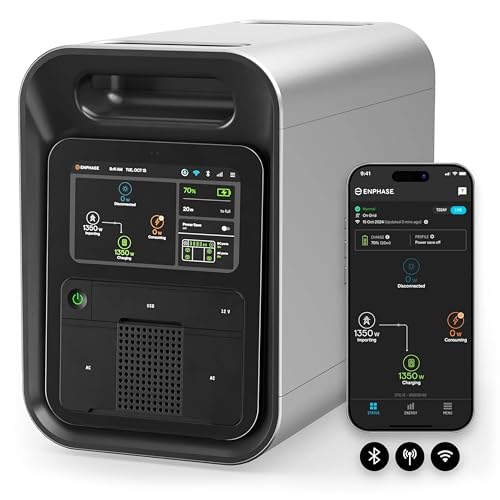
The Enphase IQ PowerPack 1500 sits in an interesting middle ground. It is a camping battery pack on paper, yet it is built around the same safety and certification philosophy Enphase brings to home solar gear. For campers who also want a unit that earns its place during a home outage, that dual identity is the point.
The 1500Wh LiFePO4 capacity is smaller than the BLUETTI above, but the safety story (UL 9540A is a thermal-runaway safety standard for energy storage) is genuinely distinct. Eleven output ports cover a typical basecamp without forcing you to play outlet-tetris.
Bright Spots
- UL 9540A thermal runaway certification adds a real safety margin for indoor or covered use.
- LFP chemistry rated for 2,500 cycles, useful for daily-charge users.
- Eleven output ports cover phones, lights, and AC loads at the same time.
- IQ8 microinverter tech ties into Enphase’s monitoring app for state-of-charge tracking.
Softer Spots
- Smaller capacity than the Jackery or BLUETTI options above, so runtime is shorter under heavy loads.
- App-based controls require a phone for the full monitoring experience.
Best Suited To
Campers who split time between the trailhead and a home office, and want one station that handles both worlds cleanly.
Look Elsewhere When
The Jackery Expansion Battery Pack 2000 Plus makes more sense if you mainly care about expandable capacity for long basecamp stays.
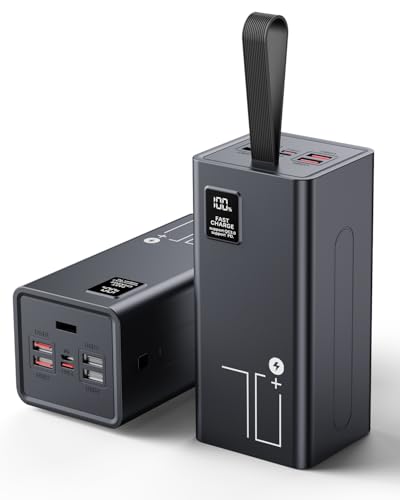
Switching from basecamp to backpacker, the Liahomco 70000mAh bank is the smallest serious-capacity option here. It skips AC outlets entirely and focuses on phones, tablets, headlamps, and other USB-driven gear. At roughly 259Wh, it is small enough to slip into a daypack yet large enough to refill a phone many times.
The 30W USB-C Power Delivery port is the spec that earns this bank a spot on the list. Power Delivery (PD) is a fast-charging standard that negotiates higher voltages for laptops and modern phones. Pair that with a five-output, two-input layout and you have a pack that can top up a whole tent’s worth of devices overnight.
A Few Strong Suits
- Compact form factor fits in a daypack without weighing you down.
- 30W USB-C PD output supports tablets and many ultrabook laptops.
- Five simultaneous outputs keep a small group happy around one charger.
Honest Caveats
- No AC outlets, so it cannot run a laptop charger or camp kettle.
- LED display is helpful, but the bank itself takes several hours to refill from empty.
Whose Shelf It Belongs On
Backpackers and weekenders who need phone-and-tablet charging on the trail without hauling a brick.
Not Your Match When
Step up to the BLUETTI Elite 200 V2 if you need to run AC appliances at a car-camping basecamp.
This Liahomco 80000mAh bank takes the same USB-first approach as the 70000mAh model above and stretches the capacity further. For families or small groups sharing one charger, the extra headroom means fewer “wait your turn” moments around the picnic table.
QC 3.0 (Quick Charge 3.0) and PD support cover the fast-charging standards used by most Android phones, iPhones, and modern tablets. The non-slip exterior is a small but welcome detail when the pack lives on a dusty car hood.
Benefits That Matter
- Higher capacity than the smaller Liahomco without crossing into AC-station territory.
- PD and QC 3.0 fast-charging protocols handle most modern phones and tablets.
- Non-slip shell stays put on uneven car trunks and tailgates.
Possible Compromises
- Adds weight and bulk over the 70000mAh version, so backpackers may feel the difference.
- USB-only design still rules out AC appliances like a small fan or pump.
Feature Rundown
Made For
Family campers and small groups who want one shared bank that keeps everyone’s phones and tablets alive.
A Better Fit Elsewhere
Choose the SOARAISE solar bank below if your trips go long enough that sun-based recharging matters.
The third Liahomco on the list is the same 80000mAh class packaged slightly differently, with the same five-output, two-input layout and a 30W USB-C PD port. In practice, the difference comes down to which listing fits your cart best, since the underlying role is identical: a USB-only fast charger for power-hungry devices.
For campers carrying USB-C laptops, this is the bank that lets you leave the chunky laptop charger at home on shorter trips. Pair it with a folding solar panel and you have a workable off-grid laptop station.
The Good Stuff
- 30W USB-C PD handles many ultrabooks and tablets, not just phones.
- Five simultaneous outputs cover a multi-device loadout.
- LED display shows remaining capacity at a glance.
Worth Bearing In Mind
- Charging speed depends on your cable quality; a thin cable caps PD output.
- USB-only design still rules out AC appliances like a small fan or pump.
Perfect Match For
Campers who work remotely from a tent or van and need to keep a USB-C laptop topped up between solar top-offs.
Skip It When
Pick the SOARAISE solar bank if you want built-in cables and a wireless pad on the trail.
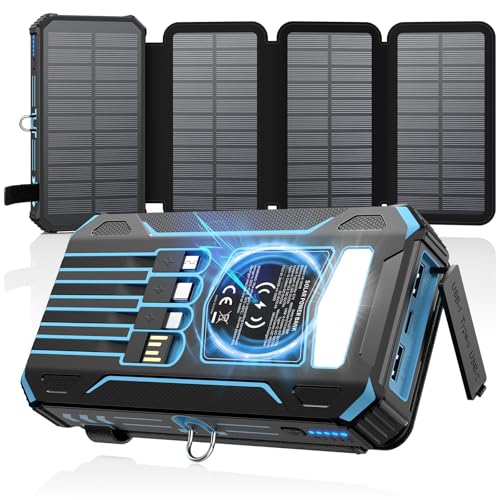
The SOARAISE 48000mAh solar bank is built around a different idea: leave the cable bag at home. Four built-in charging cables tuck into the body, so a single pack covers Lightning, USB-C, and Micro-USB devices without you digging through a stuff sack. The four-panel solar array on the back is a genuine solar panel, not a single small cell, which is the upgrade over older solar-bank designs.
Wireless charging on top rounds out the convenience story. For emergency kits and trailheads, that combination of built-in cables and wireless top-off removes the most common failure point: forgotten cables.
Positive Takeaways
- Four built-in cables eliminate the “who forgot the cord” problem on group trips.
- Wireless charging pad handles compatible phones without any cable at all.
- Four-panel solar array charges meaningfully faster than single-panel designs.
Some Limits To Know
- Solar input is a top-up method, not a primary way to refill a depleted bank.
- Lower total capacity than the Liahomco 80000mAh banks above.
Quick Facts
Built With In Mind
Day hikers and emergency-prep shoppers who want a grab-and-go bank that charges almost any phone without packing extras.
Consider Something Else When
The Liahomco 70000mAh bank is a smarter buy if you prioritize pure capacity over built-in cables.
Listing eight is the SOARAISE twin of the previous pick, sharing the same 48000mAh lithium-polymer core, four-panel solar array, and built-in cable set. The emphasis here lands on the wireless charging pad for travelers carrying newer phones that support cable-free top-ups.
For trips where the whole point is to simplify what you carry, that wireless option earns its place. Drop a phone on the pack during a coffee stop and pick it up at a higher percentage without plugging anything in.
What Pays Off
- Wireless charging pad removes the cable dance at rest stops.
- Same four-panel solar array as the sibling SOARAISE model for faster solar top-ups.
- Four built-in cables cover legacy devices alongside modern USB-C phones.
A Few Limitations
- Wireless charging is slower than a 30W USB-C cable connection.
- Solar is best treated as a backup refill, not a primary way to recharge.
Who Will Love This
Travelers packing multiple phone types, including wireless-charging flagships and older Lightning or Micro-USB devices.
Where Another Pick Suits Better
Step up to the Enphase IQ PowerPack 1500Wh if you also want safety certification and AC outlets in the same unit.
Rounding out the list is the third SOARAISE-flavored entry, another 48000mAh solar bank with the same four-panel array, built-in cables, and wireless charging pad. As a group-trip or shared emergency-kit option, the redundancy here is the actual selling point: hand the pack to a friend and they have everything they need to charge any device in the bag.
The trade-off is shared across all three SOARAISE models: capacity is lower than the Liahomco 80000mAh banks, so the pack shines on shorter trips rather than week-long off-grid adventures.
Practical Advantages
- Four built-in cables plus wireless charging mean fewer accessories to forget.
- Four-panel solar array outpaces single-panel solar banks in real outdoor conditions.
- Compact body fits in a backpack top pocket for quick access.
Things To Weigh Up
- Lower total capacity than the Liahomco 80000mAh picks above.
- Wireless charging requires careful phone placement to actually engage.
Who Should Grab It
Group-trip organizers and emergency-prep shoppers who want one pack that covers every phone type in the car.
Where A Sibling Pick Shines
The Jackery Expansion Battery Pack 2000 Plus is the right call for a long basecamp that needs true multi-day capacity.
What Matters Most Before Choosing Camping Battery Packs
Capacity Versus Portability
Capacity and weight always pull in opposite directions, and the right balance depends on how you travel. A 2000Wh power station can run a camp fridge for a weekend, but it lives in the trunk and not the pack. A 70000mAh bank fits in a daypack yet tops out at phone-and-tablet charging. For most car campers, the sweet spot sits between 80000mAh and 1500Wh, while backpackers tend to want the smallest pack that still covers their device count.
Ports, Standards, And Real-World Charging
Count the ports and check the standards before anything else. PD (Power Delivery) and QC (Quick Charge) are the two fast-charging protocols that matter for modern phones and laptops. AC outlets open the door to small appliances, while USB-C ports at 30W or higher can even refuel an ultrabook. A pack with five USB outputs and one AC outlet handles more scenarios than one with a single high-amp port.
Chemistry, Cycle Life, And Safety
LiFePO4 (lithium iron phosphate) is the chemistry to look for in 2026. It trades a bit of energy density for far better thermal stability and longer cycle life, which matters for packs that get bounced around in a car. UL 9540A is a thermal-runaway safety standard for stationary storage; seeing it on a camping unit is a meaningful upgrade if you store the pack indoors between trips.
Common Slip Ups And When Spending Up Pays Off
Pitfalls Shoppers Hit
The most common mistake is buying a pack sized by phone recharges rather than the actual device list. A tablet, headlamp, watch, and camera battery together pull more power than four phones, and the math rarely works out the way shoppers expect. The other trap is treating solar as a primary charging method. Solar top-ups on a backpack-sized bank are slow and weather-dependent, so any serious off-grid plan still needs wall or car charging between days.
Where The Extra Money Goes
Higher-tier models earn their price with longer cycle life, modular expandability, and AC outputs that turn a camping battery into a real utility. The Jackery Expansion Battery Pack and BLUETTI Elite 200 V2 both sit in that zone, and the upgrade shows up most clearly on multi-day trips. For weekend warriors who only need phone charging, the lower tiers make more sense and leave budget for a small folding panel.
Frequently Asked Questions
How long can a camping battery pack power a phone?
Most banks in this lineup refill a typical phone ten to twenty times per charge, depending on the phone’s battery size and the pack’s actual capacity rating. Power stations in the 1500Wh to 2000Wh range run a phone charger for well over a week of continuous use.
Can a portable power station run a camp fridge or coffee maker?
Yes, but only the larger stations on this list. The BLUETTI Elite 200 V2 with its 2600W output handles coffee makers and small appliances directly, while the Enphase IQ PowerPack 1500 can run smaller fridges and low-wattage gear.
What is the difference between mAh and Wh on a battery pack?
mAh (milliamp-hours) measures charge at a fixed voltage, while Wh (watt-hours) measures total energy. Wh gives a more honest comparison across packs because it accounts for the actual voltage the battery delivers to your devices.
Is solar charging on a battery pack practical?
Solar is best as a slow top-up between wall charges. The four-panel SOARAISE banks can meaningfully extend runtime in direct sun, but no pocket-sized solar bank refills quickly enough to be your only charging method on a multi-day trip.
Are LiFePO4 batteries safer than regular lithium-ion?
LiFePO4 is more chemically stable and less prone to thermal runaway, which is why it dominates newer camping and home storage designs. It is also rated for far more charge cycles, making it the better long-term value for frequent campers.
Bottom Line
The right camping battery pack depends almost entirely on how you travel and what you plug in. Car campers with real appliances should anchor on the BLUETTI or Jackery options, while backpackers get more out of a high-mAh USB bank like the Liahomco models. The SOARAISE solar banks fill the gap for group trips and emergency kits where built-in cables and wireless top-ups matter more than raw capacity. Match the pack to the trip, and the rest tends to take care of itself.