
A rough night on hard ground can sour an otherwise great trip. The right sleeping setup means you wake up with a back that actually works, ready to hike, fish, or just drink coffee in peace. These self-inflating mats cover three-season car camping, cold shoulder-season trips, and the rare overnighter where comfort matters more than ultralight bragging rights. The picks below lean on real specs, sensible trade-offs, and fit for the kind of camping you actually do.
The Choices Worth Comparing

Sea to Summit Camp Plus SI Tapered Regular

Sea to Summit Camp Plus SI Tapered Large
Sea to Summit Camp Plus SI Rectangular Large

LLUAII Self-Inflating Sleeping Pad with Electric Pump

Sea to Summit Camp Plus SI Rectangular Regular

INVOKER Camping Sleeping Pad Self-Inflating Green

INVOKER Connectable Sleeping Pad Blue

INVOKER Connectable Sleeping Pad Green

Elegear 4″ Thick Sleeping Pad 9 R-Value
Meet The Standout Selections
The Sea to Summit Camp Plus SI in the Tapered Regular shape is aimed at campers who want warmth without hauling a wide mat. The 2.6-inch foam core fills in under a minute once you crack the valve, and the tapered cut trims weight off the foot end where your body doesn’t need the extra real estate. For shoulder-season trips where ground chill is real, that thicker foam profile does a lot of the work before you ever top off the pad.
Compared to the rectangular versions further down the list, this one saves pack space and shaves a noticeable chunk of ounces. The flip side is a narrower sleeping platform, so restless side sleepers may bump the edges at night.
The Upside
- 2.6-inch thickness delivers real cushioning over roots and rocks
- Self-inflating foam core removes the need for lung power or foot pumping
- Multi-function reversible valve speeds up pack-up and lets you fine-tune firmness
- Tapered geometry saves weight for backpackers counting every ounce
Things To Consider
- Narrower profile than rectangular pads, so active sleepers may roll off
- First inflation takes longer than purely air-based pads
Key Specs
Who It Suits Best
Three-season backpackers who want a thicker, warmer pad without paying the weight of a full rectangular.
Where Another Pick Suits Better
Campers who sleep flat on their back and want maximum surface area should consider the Sea to Summit Camp Plus SI Rectangular Regular instead.
The Tapered Large stretches the Camp Plus formula into a longer, roomier package that suits taller campers and anyone who drifts while sleeping. You keep the same 2.6-inch foam core that earned the Regular its reputation, just with extra length for your feet and shoulders. The self-inflating valve gets you to roughly 80 percent full on its own, and a few breaths finish the job.
The trade is bulk. This rolls up noticeably bigger than the Tapered Regular, which is fine for car camping but eats backpack space. Compared to the rectangular Large later in the list, you give up some flat sleeping surface in exchange for a tighter pack profile.
Points In Its Favor
- Extra length accommodates tall sleepers without feet dangling off the edge
- Same warm foam core and reversible valve as the rest of the Camp Plus line
- Tapered shape still trims weight over a full rectangular
Worth Noting
- Larger packed size makes it a tougher fit inside a backpack
- Tapered ends may feel cramped for sleepers who roll onto their side with knees bent
Feature Snapshot
Made For
Side sleepers and taller campers who need length but want a tighter pack than a rectangular offers.
Look Elsewhere When
Backpackers with limited pack volume should grab the Tapered Regular, which gives up less space.
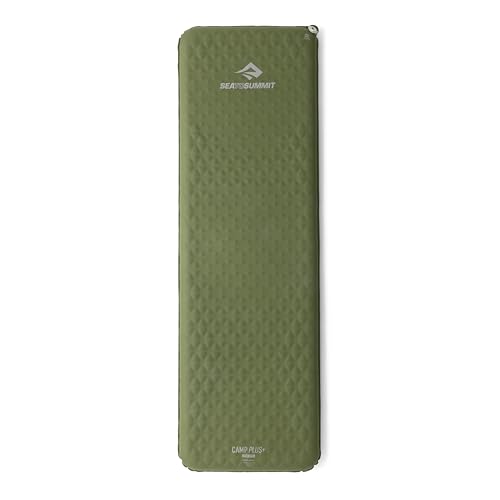
The Rectangular Large gives up any pretense of weight savings in favor of flat, full-coverage comfort. You get the same 2.6-inch foam build and the same reversible valve, just laid out in a shape that mirrors a regular bed. For car campers and family setups, that flat platform matters: pillows don’t slide off, kids don’t roll into the taper, and gear has somewhere to sit.
This is also the slowest of the three Sea to Summit shapes to roll up, and the packed volume is real. Owners commonly report letting it sit open for a few hours after the first inflate so the foam can fully expand.
Everyday Advantages
- Full rectangular footprint for spread-out sleepers and restless kids
- Generous length handles taller users comfortably
- Same dependable foam core and insulation performance as the tapered siblings
Honest Caveats
- Heaviest and bulkiest of the Sea to Summit Camp Plus shapes
- Takes longer to deflate and roll for storage than narrower pads
Quick Facts
Perfect Match For
Car campers and family tent setups where space and comfort matter more than pack size.
Swap It Out When
Backpackers should reach for the Sea to Summit Camp Plus SI Tapered Regular to save weight.
The LLUAII takes the manual labor out of camp bed setup. A built-in electric pump handles inflation and deflation with a single button press, so you’re not huffing into a valve at the end of a long day. The 4-inch foam-and-air hybrid feels closer to a guest bed than a typical camp pad, and the built-in pillow saves you from packing a separate one. There’s also enough vertical insulation to handle genuinely cold ground.
The trade shows up at the car. Owners commonly report that vacuum packaging flattens the foam on arrival, and you need to give the pad a full inflate plus a 30-minute rest before first use to reach the listed loft. Once expanded, it performs like the spec sheet promises.
Well-Handled Touches
- One-touch electric inflation eliminates manual pumping
- 4-inch thickness feels more like a mattress than a pad
- Built-in pillow removes one more piece of gear to remember
- High R-value supports cold-weather and shoulder-season camping
Practical Considerations
- Requires a power source for the electric pump to function
- First-time setup needs patience for the foam to fully loft
- Bulkier than slim backpacking pads once rolled
Who Should Grab It
Car campers, overlanders, and truck-bed sleepers who want camp comfort without the breathing-and-pumping routine.
A Better Fit Elsewhere
Backpackers counting every cubic inch should look at the Sea to Summit Camp Plus SI Tapered Regular for a lighter alternative.
The Rectangular Regular is the shape most people picture when they imagine a camp pad. It runs the same 2.6-inch foam construction as the rest of the Camp Plus family, so you trade pack compactness for a flat, predictable sleeping surface. That symmetry is genuinely useful if you share a tent with a partner who tosses, or if you keep a stuff sack at the head of the pad.
Versus the rectangular Large, this one is shorter and lighter, which makes it more backpack-friendly in a pinch. It still rolls larger than the tapered shapes and isn’t the right call for gram-counting hikers.
Practical Pluses
- Rectangular footprint gives gear and pillows a stable place to sit
- Reversible valve speeds inflation and pack-up
- 4.3 R-value handles cool nights without extra insulation
Small Caveats
- Shorter length may leave taller users with feet off the edge
- Heavier and bulkier than tapered Sea to Summit options
Spec Overview
Best Suited To
Average-height campers who want a familiar rectangular shape without the bulk of a large-format pad.
Reach For A Different Pick When
Taller sleepers should grab the Sea to Summit Camp Plus SI Rectangular Large for the extra length.
The INVOKER self-inflating pad is the kind of straightforward, no-frills mat that works fine for casual car camping and the occasional weekend trip. The 3.15-inch foam core gives you a bit more vertical cushion than many entry-level pads, and the double valve opens up to let the foam do most of the inflating work. It’s also lighter on the wallet, which matters when you’re kitting out a family.
Compared to the Sea to Summit Camp Plus options above, the INVOKER trades name-brand refinement for honest value. Owners commonly report the knit outer fabric feels soft against the skin, and the waterproof underlayer handles damp ground reasonably well. Cold-weather performance isn’t its strong suit, so winter campers should look elsewhere.
Good Reasons To Consider
- 3.15-inch foam height sits between thin pads and thick mattress-style mats
- Self-inflating core requires no pump or breath work
- Knit fabric top layer feels softer than basic nylon shells
Trade Offs
- Insulation rating falls short for genuine cold-weather use
- Build quality feels a step below premium brands on first inspection
Whose Shelf It Belongs On
Weekend campers and budget-conscious families who mostly sleep in mild weather.
Where A Sibling Pick Shines
For real shoulder-season camping, the Elegear 4″ Thick Sleeping Pad delivers much stronger insulation.
The INVOKER Connectable Sleeping Pad is built around a clever modular idea. Horizontal air chambers cushion your body while a built-in pillow supports your neck, and the sides snap together so two pads form a wide, shared bed. A foot pump inflates the pad without any mouth-work, which is genuinely nice after a long drive. The 40D nylon shell with TPU coating holds up well against moisture and abrasion.
This pad lands somewhere between a self-inflating mat and a pure air pad, so the foam feel is reduced. You trade some insulation for the convenience of the foot pump and the connectable sides.
What Helps Most
- Connectable sides let you build a custom-width sleeping platform
- Built-in foot pump speeds setup without manual labor
- 4-inch height with horizontal chambers gives stable body contouring
Room For Improvement
- Less foam insulation than the self-inflating options above
- Foot pump adds a step that pure self-inflating pads skip
Built With In Mind
Couples and parent-kid tent setups where a single shared sleeping surface beats two separate pads.
Not Your Match When
Solo campers in cold weather should pick the Elegear 4″ Thick Sleeping Pad for stronger insulation.
The Green version of the INVOKER Connectable Sleeping Pad shares the same build as the Blue above, just in a different color that blends into forest and grass setups a bit better. You still get the 75 by 24-inch platform, 4-inch air chamber height, built-in pillow, and foot pump. For campers who own both colors, the mix-and-match potential is genuinely useful for group tents.
Like its blue sibling, this is an air-and-foam hybrid rather than a true self-inflating mat, so the foam feel is lighter and the cold-weather rating is modest.
Benefits That Matter
- Color-coding helps organize multi-pad tent layouts
- Connectable sides link with the Blue version for a custom-size bed
- Foot pump inflates the pad in minutes without manual effort
Factors To Consider
- Insulation performance trails the foam-core pads higher up the list
- Packed size is bulkier than slim backpacking-specific pads
The Right Fit
Group campers who already use the Blue version and want to expand their connectable setup.
Consider Something Else When
Solo winter campers should grab the Elegear 4″ Thick Sleeping Pad for much stronger insulation.
The Elegear 4-inch pad is the warmest option on this list, by a wide margin. Its 9 R-value puts it firmly in winter-camping territory, where R-value (a measure of how well a pad blocks heat flow to the ground) makes the difference between restful sleep and a long, cold night. The 4-inch loft feels closer to a mattress than a typical camp pad, and the multi-layer build handles genuinely freezing ground without extra blankets.
The pad is heavier and bulkier than anything else here, which is the expected trade-off for serious insulation. Owners commonly report it takes a few cycles to fully loft right out of the bag, especially after vacuum-sealed shipping.
What Earns Its Place
- 9 R-value supports four-season use, including freezing ground
- 4-inch thickness delivers mattress-style comfort
- Multi-layer insulation system handles damp and cold together
Less Ideal Details
- Heavier than three-season self-inflating pads
- Packed volume is significant in a backpack
Who Will Love This
Winter campers, hunters, and shoulder-season backpackers who camp when temperatures really drop.
Skip It When
Three-season fair-weather campers will find the Sea to Summit Camp Plus SI line plenty warm and easier to pack.
How To Choose Camping Air Pads That Actually Work For You
Match The R-Value To Your Climate
R-value measures how well a pad blocks heat from escaping into the ground, and it’s the single most important spec for sleeping comfort. Three-season campers usually want an R-value of 3 to 5, while shoulder-season and winter trips push that number higher. The Sea to Summit Camp Plus options land at a 4.3 R-value, which covers most conditions short of snow camping. The Elegear 4-inch pad pushes to 9 for genuinely cold nights, and budget options like the INVOKER 3.15-inch model fall short of true winter use.
Decide Between Self-Inflating And Air Pads
Self-inflating pads combine open-cell foam with a valve, so the foam expands on its own and you add a few breaths to top off. They tend to be more durable and insulating, and they feel more like a traditional mattress. Pure air pads, including the INVOKER Connectable models, inflate fully with a pump or lung power and pack down smaller, but they usually trade insulation and foam comfort for compactness. Foam-and-air hybrids like the LLUAII electric pad split the difference with thick loft and easy inflation.
Weight And Packed Size For Your Trip Type
Backpackers care about ounces and liters in the pack. Tapered self-inflating pads save weight, while rectangular and four-season pads eat space fast. Car campers can ignore packed size almost entirely, which opens the door to thicker, plusher options like the LLUAII electric pad or the Elegear winter pad. Choosing the wrong shape for your trip type is the most common mistake.
Sizing, Shape, And Sleeping Position
Your sleeping position drives shape choice more than anything else. Side sleepers and restless sleepers usually want a wider rectangular or large tapered pad so shoulders and knees stay on the surface. Back sleepers and minimalists can get away with a regular or tapered pad to save weight. Taller users should look at Large variants to keep feet on the pad through the night.
Key Considerations Across These Picks
Pitfalls Shoppers Hit
The most common mistake is buying a pad that’s too warm or too cold for the conditions you actually camp in. A 9 R-value winter mattress in July feels like overkill, while a thin summer pad in October means a miserable night. Watch out for inflated thickness claims that ignore foam loft, and remember that the listed R-value only matters when ground contact is real. Pack size is the second trap: a pad that fits the car trunk but not the backpack forces awkward compromises.
Where The Extra Money Goes
Higher-tier pads in this category buy you thicker foam, better valves, and stronger fabrics that resist abrasion and moisture. The jump from a basic self-inflating mat to a premium option usually shows up as longer lifespan, easier inflation, and more consistent warmth in cold weather. Pay for the upgrade when you camp often, in real cold, or on rough ground. Skip it when your camping stays light, occasional, and warm.
Frequently Asked Questions
What R-value do I need for three-season camping?
An R-value between 3 and 5 handles spring, summer, and fall nights for most campers without supplemental insulation. The Sea to Summit Camp Plus pads land at 4.3, which sits comfortably in that range.
How thick should a camping air pad be?
Two and a half inches is the practical minimum for comfort over uneven ground, with three to four inches feeling much more mattress-like. Pure backpackers often go thinner to save weight, while car campers benefit from the extra loft.
Can I use a self-inflating pad in winter?
Only if its R-value is high enough for the conditions. Three-season pads around 4 R-value fall short once the ground freezes, so winter use calls for a pad rated 6 or higher, like the Elegear 4-inch option.
How do I clean and store a self-inflating mat?
Wipe the surface with a damp cloth and mild soap, dry it thoroughly, and store it unrolled or loosely rolled with the valve open. Long-term compression in a stuff sack can damage foam loft over time.
Do connectable pads really work for two people?
Yes, the snap-together edges hold pads firmly side by side and create a flat shared sleeping surface. The trick is matching pad heights and brands so the seam stays even through the night.
Bottom Line
A great camping air pad comes down to matching warmth, thickness, and shape to the kind of trips you actually take. Backpackers gravitate toward tapered Sea to Summit options for warmth without bulk. Car campers and cold-weather travelers should look at thicker, higher R-value picks like the LLUAII electric pad or the Elegear 4-inch mat. Pick the shape and rating that fit your climate, and the rest takes care of itself.