
Hauling drinking water to a campsite is rarely as simple as it sounds. Cooks need water, dishes need water, gear needs cleaning water, and emergencies demand a reserve you can reach quickly. The right camp water containers turn that logistics puzzle into a routine you barely think about, whether you’re car camping for a weekend, basecamping with a large group, or stockpiling supplies for an off-grid stretch.
The Lineup, Simplified
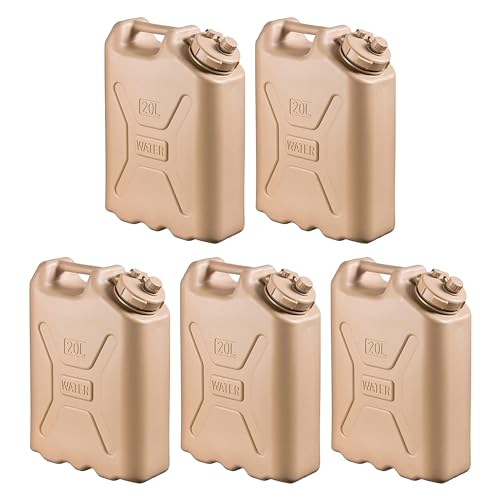
Scepter 5-Pack Military Style Water Container, 5 Gallon

Scepter 3-Pack Portable Military Style Water Container, 5 Gallon

3.2 Gallon Camping Water Jug with Spout

Chuangdi Holy Water Bottle Gold Cross, 50 ml, 100 Pcs

2000L/528 gal Foldable Portable Water Tank

113 L/30 gal Foldable Portable Water Tank
400 L/100 gal Foldable Portable Water Tank
760 L/200 gal Foldable Portable Water Tank
240 L/63 gal Foldable Portable Water Tank
What Each Pick Brings To The Table
Group camping trips run on logistics, and water is the heaviest one. The Scepter 5-Pack delivers five rigid 5-gallon jugs in a single bundle, giving basecamp cooks, scout troops, and overlanding crews a ready stockpile the moment they park.
Each jug carries a top handle for two-handed lifting and a small spout that threads into standard water bottles. Built from food-grade LDPE and HDPE plastic (LDPE is low-density polyethylene for flexibility; HDPE is high-density for rigidity), they stay BPA-free, so stored water keeps a clean taste across a long weekend.
Useful Touches
- Five-jug bundle means 25 gallons of reserve without juggling separate orders.
- Rigid walls stack cleanly in a truck bed or storage shelf.
- BPA-free plastic keeps stored drinking water free of off-flavors.
- Compact spout makes refilling personal bottles less messy.
- Carry handle balances the load for short walks to the cook tent.
Points To Keep In Mind
- Full 5-gallon weight is heavy for one person over distance, so plan a vehicle drop point.
- Sand color shows dirt and scuffs during repeated outdoor use.
Feature Snapshot
Whose Trip It’s Built For
Large groups and basecamp crews who want a single bundle that covers drinking, cooking, and cleanup for a long weekend.
Where Another Pick Fits Better
Solo campers and van travelers save space with the GIGYES 3.2 Gallon Camping Water Jug with Spout, which is lighter to haul and easier to lift into a tight galley.
Sometimes five jugs is more than you need and three hits the sweet spot. The Scepter 3-Pack keeps the same military-style rigid shell as the 5-pack above, just sized down for smaller crews who still want serious capacity.
At 15 gallons total reserve, this set covers a couple’s weekend or a small family’s day-to-day camp water without dominating the cargo area. Green color blends into wooded campsites, and the same food-grade plastic construction keeps stored water tasting clean across hot afternoons.
Notable Upsides
- Three-jug bundle totals 15 gallons, a comfortable reserve for small crews.
- Rigid body resists dents during truck-bed transport.
- BPA-free build protects taste on long storage stretches.
- Top carry handle balances well when moving short distances.
Trade Offs To Consider
- Empty jugs still take up shelf space when stored at home.
- Lacks a built-in spigot, so pouring requires lifting the full jug.
Spec Overview
Who Will Love This
Couples and small families who car camp regularly and want dependable rigid jugs without paying for a five-pack reserve they won’t use.
Not Your Match When
Anyone needing walk-up dispensing should consider the GIGYES 3.2 Gallon Camping Water Jug with Spout, which ships with a built-in spigot for hands-free pouring.
The 5-gallon jugs above solve the volume problem, but solo travelers rarely need that much water at once. The GIGYES 3.2 Gallon Camping Water Jug with Spout trims capacity down to a manageable single-carry size without sacrificing the camp-friendly features that make life easier.
A built-in spigot sits on the side of the jug, so pouring into a pot or bottle happens without lifting the whole container. The military green shell carries a sealing ring at the cap, and owners commonly report that tightened jugs stay drip-free on bumpy walks back to camp.
What It Does Well
- 3.2-gallon capacity stays light enough for one person to carry a full jug.
- Side-mounted spigot allows pot filling without heavy lifting.
- Sealing-ring cap reduces splash and drip on rough trails.
Small Caveats
- Smaller volume means more frequent refills for multi-day trips.
- Spigot requires occasional rinsing to keep sediment from building up at the valve.
Feature Snapshot
Right Fit For
Solo campers and couples on short trips who want a lighter, easier-to-pour alternative to a full 5-gallon rigid jug.
Swap It Out When
Multi-day group basecamps call for the larger reserve of the Scepter 5-Pack Military Style Water Container, which totals 25 gallons across five jugs.
This pick lives in a different lane from the rest of the list. The Chuangdi Holy Water Bottle is a decorative 50 ml vessel with a gold cross design, intended for first communion favors, religious gifts, and small keepsake ceremonies rather than hauling camp water.
One hundred bottles ship per order, which suits party planners and church coordinators who need volume. The compact size slips into a wallet or pocket, and the thin glass build gives the bottle a keepsake feel that plastic camp jugs cannot match.
Practical Pluses
- Bulk 100-piece order fits large celebration guest lists.
- Compact 50 ml size travels easily in pockets and small bags.
- Gold cross design adds a finished look for religious occasions.
Points To Note
- Glass construction is fragile compared with plastic camp jugs.
- Tiny 50 ml volume makes these unsuitable for cooking or drinking water at camp.
Best Suited To
Party hosts, church coordinators, and gift shoppers who need decorative keepsake bottles for religious celebrations rather than outdoor water hauling.
Consider Something Else When
Campers actually moving water to a site should reach for the Scepter 5-Pack Military Style Water Container, which is purpose-built for outdoor hauling.
When the conversation shifts from portable jugs to serious reserves, the MXQMKL 2000L foldable water tank enters the chat. At 528 gallons of stored water, this bladder covers long basecamp stays, drought prep, and property-level emergency stockpiles in a single container.
The double-sided PVC mesh cloth lays flat when empty and folds down to roughly 79 inches long by 59 inches wide once filled, weighing 21.2 lbs before water. Built-in inlet and outlet valves accept standard hose fittings, which makes pump-and-fill setups far easier than improvising with smaller jugs.
Everyday Perks
- 528-gallon capacity covers a week of family drinking and cleanup water.
- Folds flat for storage in a garage or vehicle when empty.
- PVC mesh cloth resists punctures better than thin plastic sheeting.
Honest Caveats
- Filled weight exceeds 4,400 lbs, so placement must be on solid, level terrain.
- Large footprint needs a wide staging area during fill and drain.
- PVC material requires shading from direct sun for long-term storage to slow material aging.
Key Specs
Whose Property It Belongs On
Off-grid households, large basecamp hosts, and emergency-prep shoppers who need a property-scale reserve they can deploy once and forget about.
A Better Fit Elsewhere When
Overlanders and van campers should look at the MXQMKL 113 L/30 gal Foldable Portable Water Tank, which fits in a cargo bay and is easier to deploy solo.
Big bladders solve big problems, but most campers don’t need 528 gallons rolling around. The MXQMKL 113 L/30 gal bladder drops capacity to a manageable 30 gallons and folds small enough to ride in a van or under a truck seat.
The double-sided PVC mesh fabric resists the kind of abrasion that ruins cheaper tarp-style tanks, and at 3.7 lbs dry, positioning the bladder before filling takes one person. Standard 1-inch inlet and 3/4-inch outlet valves fit common garden hose and gravity-fed setups.
Advantages To Know
- 30-gallon capacity is comfortable for two people over a long weekend.
- Folds to roughly 33 by 17 inches for tight cargo spaces.
- PVC mesh build handles abrasion from truck-bed transport.
- 3.7 lb dry weight makes solo setup realistic.
Less-Strong Areas
- Smaller reserve means refilling sooner on longer trips.
- Outlet valve flow is slower than a hard-plumbed spigot.
Who Should Grab It
Van lifers, truck-bed campers, and weekend basecampers who want a soft, stowable reserve that doesn’t dominate cargo space.
Look Elsewhere When
Family-scale stockpiles need the larger MXQMKL 400 L/100 gal Foldable Portable Water Tank, which doubles the reserve without doubling the footprint.
The middle of the MXQMKL range suits more campers than either extreme. At 400 liters (100 gallons), this bladder is large enough for a family’s drinking and cleanup needs yet small enough to deploy on a single camping pad.
Dry weight sits at 7.5 lbs, and the roughly 39 by 31 inch footprint fits a covered porch or trailer awning. The same PVC mesh construction handles the rough transport the smaller 30-gallon tank above also uses, so owners stepping up get more volume without switching materials.
A Few Highlights
- 100-gallon capacity covers a family of four for several days.
- Same reinforced PVC mesh as larger MXQMKL tanks.
- Folds flat for attic or garage storage between trips.
- Standard hose fittings on inlet and outlet valves.
Soft Spots
- Filled weight approaches 830 lbs, so a flat, solid base is essential.
- Requires a ground tarp or pad to prevent abrasion underneath.
Built With In Mind
Family campers and small-group basecamps who want a foldable reserve they can leave in place for a long weekend and roll up after.
Another Choice May Suit When
Single travelers and van dwellers get more mileage from the MXQMKL 113 L/30 gal Foldable Portable Water Tank, which rides easily in a small cargo bay.
For shoppers targeting property-level reserves without committing to the full 528-gallon tank above, the 760 L/200 gal MXQMKL bladder threads the needle. It’s large enough to be a primary emergency reserve yet manageable enough to fill with a standard garden hose setup.
The 59 by 39 inch footprint gives the tank a low, wide profile that resists tipping, and the 9.9 lb dry weight means two people can position it before filling. Standard 1-inch inlet and 3/4-inch outlet valves match common pump and hose hardware.
Useful Strengths
- 200-gallon reserve is a solid primary emergency supply for short outages.
- Low-profile shape resists tipping on uneven ground.
- PVC mesh construction handles repeated fill cycles.
- Folds flat for attic or vehicle storage between uses.
Practical Considerations
- Filled weight exceeds 1,600 lbs, so site selection matters.
- Wide footprint requires planning before fill day.
Perfect Match For
Property owners and small off-grid setups who want a serious but not industrial-scale water reserve they can deploy and refill as needed.
Skip It When
Casual weekend campers get more use from the MXQMKL 240 L/63 gal Foldable Portable Water Tank, which is easier to deploy and refill.
The 240 L/63 gal bladder sits in the sweet spot between the 30-gallon entry tank above and the 100-gallon family reserve. It’s the right size for couples and small group trips who want more than a weekend’s supply without committing to a four-figure-fill operation.
At 5.7 lbs dry, setup is a one-person job, and the 39 by 23 inch footprint fits under most RV awnings and trailer tongues. PVC mesh construction matches the larger MXQMKL tanks, so stepping up later to a bigger reserve means a familiar material.
Practical Advantages
- 63-gallon reserve is comfortable for couples and small groups.
- Slim 23-inch width fits under awnings and trailer tongues.
- 5.7 lb dry weight makes solo positioning realistic.
- Same PVC mesh build as larger MXQMKL bladders.
Factors To Consider
- Filled weight approaches 500 lbs, so choose a flat base.
- Smaller volume means shorter intervals between refills on extended stays.
Made For
Couples and small groups who want more than a weekend’s reserve but don’t need the family-scale capacity of the 400 L tank above.
Reach For A Different Pick When
Solo travelers find the MXQMKL 113 L/30 gal Foldable Portable Water Tank easier to handle, and basecamp families scale up to the 400 L version.
Picking Camp Water Containers That Actually Fit Your Trip
Matching water storage to your camping style starts with three honest questions: how many people need water, how long the trip runs, and how far the container travels between vehicle and site. Rigid jugs like the Scepter 5-gallon options reward vehicle-camp setups where the jug rarely moves more than a few feet. Foldable bladders from MXQMKL trade rigid structure for flat storage and lighter dry weight, which matters when cargo space is tight or the fill site sits far from the cook tent.
Capacity sizing is the next lever. Solo travelers and couples running short weekends do fine with 3 to 5 gallons of drinking reserve plus a small cleanup supply. Family basecamps generally want 25 to 60 gallons on hand, and property-level emergency prep moves into the 100 to 500 gallon range. A 3.2-gallon jug is light enough to lift full, while a 528-gallon bladder should never be moved once filled.
Material and fittings decide how the container performs over time. Food-grade plastics keep stored water tasting clean, and PVC mesh cloth on the MXQMKL tanks resists the abrasion that wears through thinner materials on truck-bed trips. Inlet and outlet valve diameters matter too, since standard hose and pump fittings save the headache of adapters every fill cycle. For most campers, the honest read is that a single 30 to 60 gallon soft bladder covers 80% of trips, with a smaller rigid jug for daily drinking on top.
Common Shopping Slip Ups In The Camp Water Container Aisle
Volume alone is rarely the right starting point. Buyers chasing the largest bladder often end up with a tank that needs a flat concrete pad, a pump, and a tarp underneath, when a stack of rigid 5-gallon jugs would have handled the same trip from the back of an SUV.
A second mistake is ignoring valve compatibility. Bladders with non-standard fittings force adapters and slow fills. Standard 1-inch inlets and 3/4-inch outlets work with most garden hoses and gravity kits without extra parts.
Why Higher Tier Camp Water Containers Cost More
The jump from a 30-gallon entry bladder to a 200 or 500-gallon tank shows up in three places: PVC mesh weight, valve hardware, and seam reinforcement. Thicker mesh resists puncture from rocks and truck-bed edges, metal-reinforced valves hold up through repeated fill cycles, and welded seams prevent the slow leaks that ruin cheaper tanks within a season.
For most campers, paying up makes sense when the tank will sit filled for days at a time. A weekend warrior who fills and drains each trip can stick with the smaller, lighter options.
Frequently Asked Questions
How many gallons of water should I bring per person per day at camp? Plan for at least one gallon per person per day for drinking and basic cleanup. Add extra if you cook from scratch, wash dishes often, or camp in hot weather where hydration needs climb.
Are foldable water bladders safe for drinking water? Yes, when made from food-grade PVC or similar materials. Look for tanks that specifically list food-safe construction, and clean the bladder with a dilute bleach rinse before first use.
How do I keep a camp water container from tipping over? Place rigid jugs on level ground away from foot traffic, and use a ground tarp under soft bladders to spread weight and reduce abrasion. Wider, low-profile tanks tip less than tall, narrow ones.
Can I leave a foldable water tank outside between trips? Briefly, yes, but prolonged sun exposure ages PVC faster. Store filled tanks in shade and empty tanks indoors to extend material life.
Do I need a pump to fill a large water bladder? Not always. A standard garden hose works for filling most bladders if a spigot is nearby. Pumps help when the water source sits below the tank or far from the fill site.
Wrap Up
The right camp water container depends less on the trip you hope to have and more on the trip you actually plan. Solo campers save space with compact 3-gallon jugs, while families and basecamps step up to 100-gallon bladders for breathing room. Match the container to your crew size, your cargo capacity, and how far the water needs to travel, and the rest of the camp routine falls into place.