
Cooking outdoors used to mean boiling water and calling it dinner. Today, camp cooks want fresh bread, roasted vegetables, and even small cakes on the trail. The category has stretched well beyond single-burner setups, and the right gear can turn a tent site into a working kitchen. This guide covers seven solid picks that bring real cooking range to the outdoors, from compact canister stoves to heavy-duty propane stations and the small accessory that keeps them level on bumpy ground.
How The Shortlist Stacks Up

Coleman Cascade 18 1-Burner Camping Stove, Portable Cooktop
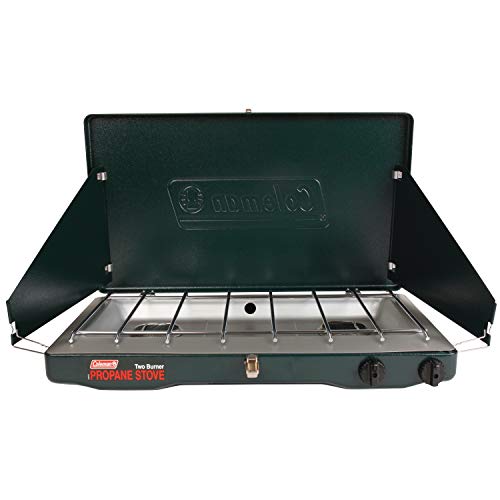
Coleman Classic Propane Camping Stove, 2 Burner

Pipopa 2 Burner Propane Camp Stove, 150,000 BTU

Camp Chef Leg Levelers, 4-Pack

Coleman Tabletop 2-in-1 Grill & Stove

Jetboil Flash 1.0L Portable Fast Boil Stove

Pipopa 3 Burner Propane Camp Stove, 225,000 BTU
More On The Choices That Made The List
Pull this stove out of the trunk at a tailgate or a quiet campsite and you’re cooking in minutes. The single burner pushes 8,000 BTUs, enough to bring a pot of water to a rolling boil or sear a pair of burgers in a 12-inch skillet. Rotary ignition (a knob you turn to spark the burner without a match) lights the flame on the first try, and the smooth knob rotation makes simmering a real option rather than a guessing game.
The aluminized steel cooktop wipes clean with a damp cloth after a greasy breakfast, and the detached grate flips 180 degrees so the whole unit stores flat in a trunk or under a seat. Unlike the bigger Coleman Classic that follows, the Cascade 18 trades raw output for portability, which matters more for short trips where space is tight.
Notable Gains
- Matchless rotary ignition removes the need for lighters at the campsite
- 8,000 BTU output handles a 12-inch pan for family-size portions
- Detachable grate that flips flat cuts the storage footprint noticeably
- Aluminized steel top cleans quickly after messy cooks
- Built-in regulator storage keeps the hose tucked out of the way
Points To Keep In Mind
- Single burner limits simultaneous pots and pans
- Wind protection is minimal compared to larger models
Who Will Love This
Solo campers, weekend tailgaters, and anyone who wants fast, reliable heat without hauling a bulky two-burner box to the picnic table.
A Better Fit Elsewhere
Camp cooks running a full oven or cooking multiple dishes at once will get more from the Coleman Classic Propane Camping Stove with its twin burners.
The Coleman Classic has earned its place at countless campsites for a simple reason: it just works. Two adjustable burners deliver up to 20,000 BTUs combined, with enough surface to fit a 12-inch and a 10-inch pan at the same time. For a family breakfast of pancakes on one side and bacon on the other, this is the tool that turns a picnic table into a short-order kitchen.
Wind-blocking panels fold up to shield the flames from gusts that would otherwise steal heat from your pots. A built-in pressure regulator keeps output steady even as the cylinder cools down. The body measures 4.1 by 21.9 by 13.7 inches, which means it sets up wide on the table but folds down into a manageable slab for transport.
Noteworthy Benefits
- Two independent burners let you run a main dish and a side at once
- 20,000 BTU total output supports real high-heat searing
- Wind-blocking panels preserve flame stability in open campsites
- Pressure regulator maintains consistent heat as fuel runs low
- Compatible with a standard 16.4 oz propane cylinder for easy fueling
- Proven long-term design refined over many production runs
Honest Caveats
- Runtime tops out near one hour on high with a single small cylinder
- Larger footprint demands a sturdy table or ground space
Made For
Family campers and small groups who want a time-tested two-burner setup that handles full breakfasts and dinner spreads with no fuss.
Skip It When
Backpackers counting every ounce should reach for the Jetboil Flash 1.0L Portable Fast Boil Stove instead, which weighs a fraction of this unit.
Step up to high-pressure territory and the cooking game changes. The Pipopa 2-Burner puts out 150,000 BTUs total, with 75,000 BTUs per burner, which is the kind of heat that brings a big stockpot to a hard boil in minutes rather than waiting around a small flame. Cast-iron-style grates sit over each burner and shrug off the heavy pans needed for outdoor cooking at scale.
Wind is less of an enemy here because the burners run hot enough to power through a cross breeze. A dustproof cover ships with the unit and shields the cooking surface when the stove is stowed between trips, useful for tailgates where grit is unavoidable. Compared to the Coleman Classic reviewed above, this is a tool aimed at base camps and food trucks more than family tents.
A Strong Showing
- 75,000 BTU per burner handles woks, cast iron, and stockpots
- High-pressure design reduces wind sensitivity
- Included dust cover extends the working life in gritty environments
- Sturdy frame supports heavy cookware without flex
Trade Offs
- Requires a high-pressure propane setup, not a standard camping cylinder
- Bulkier and heavier than collapsible camp stoves
- Heat output exceeds what casual weekend cooks actually need
The Right Fit
Tailgaters, base-camp cooks, and outdoor event organizers running continuous, high-volume cooking sessions.
Reach For A Different Pick When
Family campers seeking a gentler learning curve will prefer the Coleman Classic Propane Camping Stove, which pairs well with standard propane bottles.
Even the best stove on uneven ground will tilt a pan of grease toward disaster. The Camp Chef Leg Levelers solve that with a simple twist-on design that fits most camp stoves and tables. Each unit adjusts up to 2.5 inches, so a sloped tent pad or a tilted picnic table becomes a stable cooking surface in seconds.
The threaded design cleans itself as you twist, which keeps debris from grinding into the mechanism. You insert the leveler into the bottom of each stove leg, then dial it up or down until the whole unit sits flat. It’s a small accessory, but it pairs naturally with the heavier stoves higher on this list that need every bit of stability they can get.
A Few Highlights
- Adjusts each leg up to 2.5 inches for true leveling on rough terrain
- Twist-and-go threaded design self-cleans during use
- Four-pack covers every corner of a standard camp stove
- Easy-grip exterior means no extra tools needed at the campsite
Small Caveats
- Only fits stoves with compatible leg diameters
- Plastic threaded section may wear faster than all-metal alternatives
Best Suited To
Anyone cooking on dirt, gravel, or grass with a multi-burner stove that needs rock-solid footing to perform safely.
Not Your Match When
Backpackers using the Jetboil Flash 1.0L Portable Fast Boil Stove won’t need these, since that integrated system has its own low-profile base.
The hybrid format splits the cooking surface between a grill grate and a stove burner, both adjustable, so you can sear burgers on one side while simmering chili on the other. Total output reaches 20,000 BTUs, matching the classic two-burner above but with the bonus of a chrome-plated grill grate that pulls out for cleaning. Push-button ignition gets both sides fired up without fumbling for matches.
Wind guards rise around the edges to keep the flame stable when the breeze picks up, and a removable grease tray sits beneath the grill to catch drippings. Non-skid feet keep the frame from sliding on a slippery tabletop. Where the Coleman Classic focuses on pure stovetop cooking, this model opens up genuine grilling without packing a second appliance.
Useful Touches
- Independent grill and stove burners expand menu options
- Push-button ignition lights both burners without a separate lighter
- Wind guards preserve heat in exposed setups
- Removable chrome grate and grease tray simplify post-cook cleanup
- Non-skid feet reduce sliding on smooth surfaces
Things To Consider
- Grill and stove split means less continuous cooking surface than a full two-burner unit
- Grease tray needs regular emptying during heavy grilling sessions
Right Fit For
Cooks who want both grilled and stove-cooked dishes at the same campsite without hauling two separate units.
Another Choice May Suit
Anyone needing maximum stovetop space should look at the Coleman Classic Propane Camping Stove, which dedicates its full surface to pots and pans.
The Jetboil Flash collapses the cooking system into a single 1.0L cup with a burner mounted underneath. One-step auto-ignition (half-turn of the knob) starts the flame with no matches, and the integrated heat exchanger (a metal coil that captures and redirects burner heat into the pot) pushes water to a boil in roughly two minutes, which is faster than any of the multi-burner stoves on this list.
Everything nests inside the cup for transport, so the packed size is closer to a tall water bottle than a camp stove. The trade-off is capacity: this is a system for freeze-dried meals, coffee, and soup, not for a skillet of pancakes. Compared to the Coleman Cascade 18, which opens up to a flat 12-inch cooktop, the Jetboil is built for backpack weight, not breakfast spreads.
What Makes Sense
- Auto-ignition gets you boiling with one knob turn
- 1.0L cooking cup doubles as the carry case
- Heat exchanger design cuts fuel use on every boil
- Compact pack size fits in a daypack or backpacking kit
Practical Considerations
- Cup-style design limits meals to boiling and rehydration
- Requires proprietary fuel canisters, not standard propane
- Cooking surface is too small for searing or baking
Whose Shelf It Belongs On
Thru-hikers, solo backpackers, and minimalists who care more about weight and boil speed than menu variety.
Where Another Pick Suits Better
Camp cooks who want full meals with a pan should choose the Coleman Cascade 18 1-Burner Camping Stove, which supports a real 12-inch skillet.
Three burners running 75,000 BTUs each pushes total output to 225,000 BTUs, enough to handle a stir-fry, a boiling pasta pot, and a side of grilled vegetables all at once. The high-pressure design keeps flames stable under wind that would push around a smaller unit, and the included dust cover protects the burners between events.
This is the unit you set up at a base camp where a group of ten expects a real meal, or at a hunting camp where dinner is the social hour. Compared to the Pipopa 2-Burner reviewed earlier, the extra burner opens room for a third cook in the workflow. The frame is large and demands a sturdy surface, so pairing it with Camp Chef Leg Levelers is a sensible move on any uneven ground.
The Good Stuff
- 75,000 BTU per burner handles large pots and heavy pans
- Three burners support parallel cooking for full menus
- High-pressure system resists flame loss in wind
- Dust cover extends service life in sandy or dirty sites
- Robust frame designed for repeated transport and setup
Factors To Consider
- Requires a high-pressure propane source rather than a standard camp cylinder
- Full-size frame is too large for casual weekend use
- Heat output exceeds typical home-cook needs by a wide margin
Built With In Mind
Large-group cooks, hunting camps, and event organizers running continuous high-volume meal service outdoors.
Where A Sibling Pick Shines
Smaller gatherings get all the heat they need from the Pipopa 2 Burner Propane Camp Stove, which keeps the same burner quality with one fewer cooking zone.
What To Weigh Before Choosing Your Camp Cooking Setup
Matching Heat Output To Your Menu
BTU ratings (British Thermal Units, a measure of how much heat a burner produces per hour) tell you how fast a stove can push water to a boil or bring a skillet up to searing temperature. A single burner around 8,000 BTUs covers breakfast for two, while 150,000-plus BTUs across multiple burners handles a full dinner service for a group. Match the output to the meals you actually cook, not to the largest number on the spec sheet.
Fuel Type And Availability
Standard propane cylinders work with most family-oriented camp stoves and are easy to find at any outdoor retailer. High-pressure stoves need a different fuel source and a separate regulator setup, which adds steps to every trip. Backpackers typically use small isobutane canisters because they pack light, though they cost more per boil than bulk propane.
Portability Versus Surface Area
A 1.0L canister stove packs into a backpack, while a three-burner high-pressure unit fills a truck bed. Think about how the stove travels to the campsite and how much table space you have once it arrives. For car camping, weight matters less and surface area matters more.
Wind Performance And Stability
Open campsites with steady wind demand either wind-blocking panels or burners powerful enough to overpower the breeze. Pairing a heavy stove with leg levelers solves the wobble problem on uneven ground and keeps a full pot of hot liquid from sliding off the cooktop.
Smart Choices Across This Shortlist
Where Shoppers Go Wrong
Picking the stove with the highest BTU rating and assuming it covers every cooking style is a common trap. Massive heat output from a three-burner high-pressure unit is wasted on a single pot of coffee, and the bulk becomes a burden. Match the tool to the trip. Backpackers buying multi-burner stoves and family campers buying featherweight canister systems both end up frustrated.
Where The Extra Money Goes
Higher-tier models in this category deliver stronger frames, better wind resistance, and more refined ignition systems. The premium also covers useful accessories like dust covers and pressure regulators that extend service life across seasons. For casual weekend use, the extra cost rarely pays back. For cooks who use a camp stove weekly, those upgrades translate into years of reliable service rather than a season of annoying repairs.
Frequently Asked Questions
What size camp stove works for a family of four?
A two-burner unit around 20,000 BTUs handles most family menus, fitting a 12-inch and a 10-inch pan at the same time for full breakfasts and dinners.
Can a camp stove replace a full outdoor oven?
A dedicated camp oven accessory sits on top of a two-burner stove and bakes small dishes, but a single-burner or canister stove lacks the surface area for oven-style cooking.
How long does a standard propane cylinder last?
Runtime depends on flame setting, but a 16.4 oz cylinder typically runs a two-burner stove for about an hour on high before needing a swap.
Are high-pressure stoves safe for casual campers?
High-pressure stoves are safe when paired with the correct regulator and hose setup, though they require more attention during connection than a standard low-pressure system.
Do I need leg levelers for my camp stove?
Leg levelers help most on dirt or gravel where the ground shifts under foot, and they matter more for heavy multi-burner stoves than for compact single-burner units.
Closing Thoughts
A camp stove with real cooking range opens up the kind of meals that make outdoor trips memorable. The right pick depends on how you cook, where you cook, and how much gear you want to haul. Browse the list, match the tool to your next trip, and start planning meals that go beyond the boil.