
A warm shower after a long day on the trail changes everything, yet finding a reliable way to heat water off-grid often turns into a juggling act. Between balancing fuel weight, battery life, and water pressure, the wrong setup leaves you shivering or constantly babysitting a flame. This roundup sorts ten camp shower water heaters by real-world use case, so you can match the right heat source to your camping style, whether you’re pitching a tent at a remote site, hot-rodding a van build, or just want to clean up after a beach day without a cold surprise.
A Side-By-Side Look

CAMPLUX Nano 3 Ultra Constant Temperature Portable Propane Water Heater
Fohil 6000mAh Portable Shower for Camping

RIWORY 85000 BTU On Demand Propane Tankless Water Heater

dessports Portable Camping Shower 6000mAh Pump

CAMPLUX Nano 3 Max Portable Propane Water Heater & Shower Pump
Iron Hammer Portable Electric Camping Shower

WADEO 2026 Upgraded Portable Camping Shower with Heater

CAMPLUX Nano 3 Pro Battery Powered Portable Water Heater

RIWORY 102000 BTU Tankless Water Heater Propane Indoor

RIWORY 15×18 Tankless RV Water Heater 65000 BTU
A Closer Look At Each Pick
The Nano 3 Ultra sets itself apart with a real constant-temperature controller, which holds water within roughly ±1°F rather than cycling between hot and cold mid-shower. For campers who hate the surprise splash of ice water, that consistency is the headline feature. Press the +/- buttons to dial in a steady output, and the unit pairs that with a rechargeable pump for a self-contained setup that works off a small propane canister.
Safety hardware reads like a checklist, including CSA-certified shutoffs for overheat at 122°F, dry-run pump protection, low-voltage warning, and a 45° tip-over kill switch. Compared to the simpler battery-powered entries below, this is a more complete hot-water platform with a real controller, which makes it feel closer to a home unit than a hose-on-a-bucket rig.
Useful Touches
- Tight ±1°F temperature hold translates to no jarring hot-cold swings during a long rinse
- Layered safety sensors (overheat, tip-over, dry-run, low-voltage) suit families new to propane gear
- Rechargeable pump and quick-connect design mean one person can set it up in a few minutes
- Compatible with standard propane camping bottles, no special fuel required
Things To Consider
- Heavier than pump-only models like the Fohil entry below, so pack space matters on long treks
- Requires ventilation in fully enclosed spaces since it burns propane
Key Specs
Who It Suits Best
Glampers and car campers who want predictable shower temperatures and don’t mind the extra weight of a propane setup.
Where Another Pick Suits Better
Thru-hikers counting every ounce will find the CAMPLUX Nano 3 Pro a lighter carry, while cabin owners needing whole-house flow should look at the RIWORY 85000 BTU tankless unit.
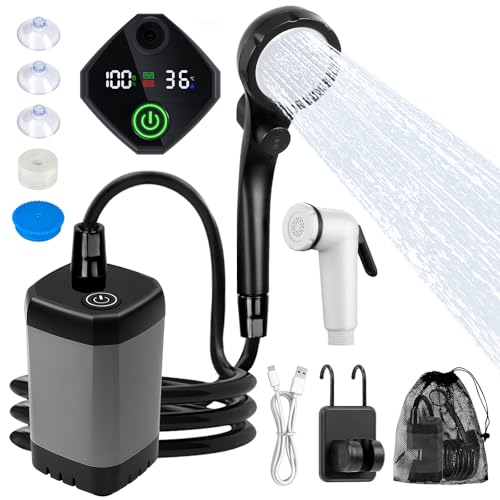
The Fohil leans into the pump-only side of the category with a generous 6000mAh battery that, per the manufacturer, runs between roughly 120 and 150 minutes on a single charge. That runtime is enough for several showers or a long rinse-down after a beach day, which puts it ahead of older 2400mAh designs still floating around.
Charging happens through a modern Type-C port, so the same cable that tops up your phone or laptop will refill the pump, with car USB ports and power banks as backup sources. The integrated LED screen shows battery state at a glance, removing the guesswork that plagues simpler units. Where the Nano 3 Ultra above adds a real burner, this one assumes you’ll pre-warm water in the sun or a kettle.
A Strong Showing
- 120 to 150 minute runtime covers multi-day trips on a single charge
- Type-C charging means you can share cables with other electronics
- LED display removes battery anxiety mid-shower
Worth Noting
- Does not heat water on its own, so cold mornings still need a sun-soaked bucket or a kettle pre-warm
- Battery longevity depends on full drains being avoided, a habit worth building
Made For
Backpackers and beach campers who already heat water a different way and just need a long-running, dependable pump.
Skip It When
You want true on-demand heat without a kettle; in that case, the CAMPLUX Nano 3 Max pairs a battery pump with real propane heating.
Stepping away from portable pumps, this RIWORY is a real indoor tankless unit built for cabins, tiny homes, and accessory dwelling units where 2 to 3 water points run at once. With 85,000 BTU on tap and a 3.6 GPM flow ceiling, it covers a shower plus a sink without the cold-water sandwich effect common to smaller tankless heaters.
Staged combustion technology trims fuel use by modulating the burner across four output levels, so you’re not firing full-blast for a slow trickle of warm dishwater. Freeze protection is a notable feature for anyone winterizing a remote cabin, although proper venting and gas-line installation remain non-negotiable. Where the Fohil above is grab-and-go, this one demands professional setup.
Reasons It Performs
- 3.6 GPM handles 2 to 3 fixtures simultaneously, a real shift from single-point units
- 4-stage burner staging cuts propane use during low-demand tasks
- Freeze protection supports unheated cabins in shoulder seasons
Trade Offs
- Requires a 3/4″ NPT gas line and proper venting, so installation is not plug-and-play
- Overkill for casual campers and far heavier than every battery-powered pick on this list
Feature Snapshot
Right Fit For
Cabin owners and small-property managers who want whole-home hot water without a storage tank taking up floor space.
A Better Fit Elsewhere
Van and RV owners get a tighter, DC-compatible solution with the RIWORY 15×18 Tankless RV Water Heater.
Where many camp showers sound like a muffled blender, the dessports pump is engineered for quiet operation even while fully submerged, with an IPX8 rating that lets it sit at the bottom of your wash bucket without drama. That waterproofing lets you drop the pump in a cooler, a stream-fed basin, or a tub without worrying about a splash ending the shower.
The 6000mAh battery sits in the same range as the Fohil above, which keeps runtime competitive across the category. Owners commonly find this unit shines at quiet campsites, where a loud pump draws attention from neighbors or wildlife. Just remember, like all pump-only designs, this assumes your water source is already warm or you’re willing to add a solar shower bag.
Bright Spots
- Submerged-operation design removes the awkward “float the pump” balancing act
- Whisper-quiet motor suits early-morning showers at shared sites
- IPX8 rating offers real confidence around lakes and stream-fed tubs
Honest Caveats
- Does not include a heating element, so cold-water performance matches any unheated pump
- Submersed design means keeping the intake screen clean after silty river dips
Who Should Grab It
Quiet-campground regulars and stream-side campers who want a no-fuss pump that disappears underwater.
Swap It Out When
Cold mornings are the norm for you, in which case the WADEO 2026 Upgraded Portable Shower with Heater adds an immersion heater and 5-gallon bucket.
The Nano 3 Max broadens the temperature range to 50°F through 122°F with a real-time readout on the front panel, which is a meaningful step up from guesswork dials. You get the same quick-connect design that makes the Nano line friendly to first-timers, and CSA-rated safety covers the basics: overheat cutoff and a flame-failure sensor.
Compared to the Nano 3 Ultra above, this one swaps precise constant-temperature hold for a wider overall range, which suits car campers who deal with genuinely cold mornings. Pet-cleaning and car-wash duty both fall comfortably inside that band. Owners commonly report the quick-connect propane fitting makes teardown at the end of a trip unusually painless.
Notable Gains
- Wide 50 to 122°F range handles everything from cool rinses to warm pet baths
- Front-panel readout shows power level and temperature at a glance
- One-step quick-connect gets first-timers up and running fast
- CSA safety certification covers overheat and flame-failure scenarios
Points To Keep In Mind
- Still propane-dependent, so ventilation matters in popup shelters
- Lacks the Ultra model’s tight ±1°F constant-hold behavior
Quick Facts
Best Suited To
All-season car campers who want real flame heat without committing to a precision constant-temp controller.
Consider Something Else When
You want whole-home flow instead of a single-shower output, the RIWORY 85000 BTU unit is the right scale.
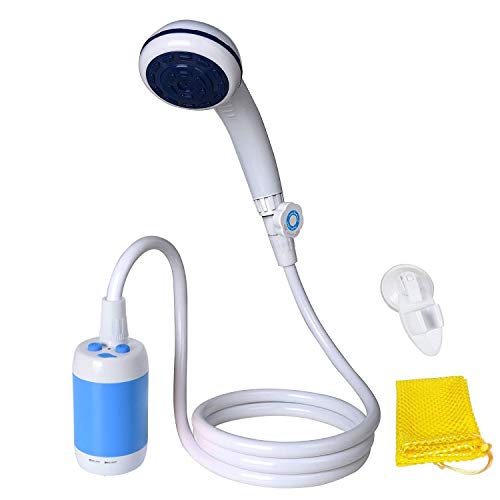
The Iron Hammer is the lightest unit in this roundup, with a 3.7V/2400mAh dual-cell battery pack that the manufacturer rates above 90 minutes per charge. A built-in high/low mode switch and a shut-off valve at the shower head let you throttle the spray, so a slow trickle is always one click away from a stronger rinse.
Compared to the 6000mAh entries above, runtime is shorter, but the trade comes as a meaningfully lighter carry. Festival-goers, paddlers, and quick overnight campers tend to find that a smaller battery is a fair exchange for less pack weight. The whole unit feels like a grab-and-go tool rather than a piece of campsite infrastructure.
Why It Works Well
- Sub-2-lb carry weight is friendly to backpack volume
- Dual flow modes let you conserve water or rinse faster on demand
- Shower-head shutoff valve prevents waste while soaping up
Possible Compromises
- 90-minute runtime falls short of the 6000mAh Fohil and dessports models
- Does not heat water, so pairing with a sun-warmed bag or kettle is the norm
Whose Shelf It Belongs On
Festival campers and ultralight weekenders who value weight savings above all else.
Reach For A Different Pick When
You regularly need longer runtime, the Fohil 6000mAh model runs noticeably longer per charge.
This is the closest thing in this roundup to a turnkey shower station: a 2000W immersion heater drops into the included 5-gallon foldable bucket, with a digital thermometer to track water temperature in real time. Four spray modes on the shower head cover everything from a gentle rinse to a pressure-style blast, which is more variety than the single-spray pumps above.
Where the CAMPLUX Nano entries burn propane, the WADEO runs on shore power or a portable power station, so it suits driveway camping and tailgates more than backcountry trips. The stainless heater guard is a nice durability touch, since bare immersion coils tend to wear quickly. The honest read is that this is a basecamp shower, not a pack-along solution.
A Few Highlights
- 2000W immersion heater warms a 5-gallon bucket in just a few minutes
- Four spray modes suit rinsing gear, washing pets, or showering
- Stainless guard on the heating element extends service life
- Included thermometer removes the “too hot, too cold” guessing game
Small Caveats
- Needs a power source, so it is not a true backcountry option
- 5-gallon capacity serves one shower before a refill
Perfect Match For
Family car campers and driveway tailgaters who already have a power station or generator on hand.
Look Elsewhere When
You hike to your campsite, propane-fueled portability like the CAMPLUX Nano 3 Max fits the backcountry better.
The Nano 3 Pro trims weight aggressively at roughly 1 lb, which is the headline number for anyone who counts grams. It still burns propane for true on-demand heat, so you get a real hot shower without the heavy burner footprint of a portable tankless rig.
The CSA safety package includes an E6 over-temperature alert, flame-failure protection, and a tip-over sensor, which keeps the safety profile comparable to the larger Nano models above. The catch is output: a 1-lb unit cannot push the same volume as the 85000 BTU RIWORY, so this is single-shower scale. For one person in a bivy or tent, that is plenty.
Everyday Advantages
- About 1 lb carry weight keeps pack volume open for other essentials
- CSA-certified safety set matches the heavier Nano siblings
- On-demand propane heat removes the need for a kettle or solar soak
Areas To Watch
- Single-shower output, so back-to-back rinses need a cool-down cycle
- Battery still needs charging, just less often than pump-only designs
Built With In Mind
Ultralight backpackers who refuse to skip a hot shower at the end of a long trail day.
Not Your Match When
You want whole-house performance, the RIWORY 102000 BTU indoor tankless is sized for that workload.
Bumping up from the 85000 BTU sibling, this RIWORY pushes 102,000 BTU and a 4.3 GPM ceiling to serve 3 to 4 water points at once. That is enough capacity for a shower plus a sink plus a dishwasher in a small household, all without waiting on a storage tank to refill.
The same staged-combustion logic shows up here, so fuel burn scales with demand rather than running flat-out. Freeze protection returns for cold-climate installations, which is a real plus for cabins that sit empty through winter. Compared to the 85000 BTU model, the trade is the higher gas-line requirement and the larger footprint of the unit itself.
What Earns Its Place
- 102,000 BTU output covers 3 to 4 fixtures in larger households
- 4.3 GPM flow rate prevents the cold-shower effect when multiple taps run
- Staged combustion lowers fuel use during light tasks
What To Weigh
- Larger physical size and higher BTU rating demand more installation space and a properly sized gas line
- Overkill for small cabins better served by the 85000 BTU version
Feature Rundown
The Right Fit
Owners of larger cabins or multi-bath properties who need simultaneous hot-water service without a tank.
Another Choice May Suit
RV owners should look at the RIWORY 15×18 Tankless RV Water Heater, sized for 12V systems and tighter compartments.
The 15×18 case footprint is built specifically for RV compartments, with 65,000 BTU and a 3.9 GPM ceiling that delivers continuous hot water without the cold-burst gap common to older RV tanks. DC 12V compatibility keeps it friendly to standard RV electrical systems, and the integrated outdoor shower port adds a useful campsite rinse point.
Freeze protection makes this a four-season option for snowbirds, while staged combustion helps stretch propane on long trips. Where the indoor RIWORY models above assume permanent installation, this unit is sized and wired for mobile use. Owners commonly find the outdoor shower port doubles as a dish-washing station, dog bath, or sandy-foot rinse.
Real Benefits
- 3.9 GPM continuous flow handles long RV showers without cold gaps
- Anti-freeze protection supports winter travel in cold climates
- Outdoor shower port adds campsite utility beyond the indoor bathroom
- Staged combustion stretches propane across longer trips
Practical Considerations
- Replacement requires confirming 15×18 compartment dimensions on your specific rig
- Lower BTU than the indoor 85000 BTU and 102000 BTU siblings, so single-shower performance is more modest
Who Will Love This
Full-time RVers and snowbirds who want tankless comfort plus an outdoor rinse, without swapping the entire RV bay.
Where A Sibling Pick Shines
Glampers and tent campers get a far more portable setup with the CAMPLUX Nano 3 Ultra and a small propane bottle.
Matching Your Setup To The Right Heat Source
Picking camp shower water heaters starts with how you actually camp, since the right unit for a backcountry hiker is the wrong one for a stationary cabin. Match the heat source first, then narrow down by weight, runtime, and flow.
Power Source: Propane, Battery, Or 12V
Propane models like the CAMPLUX Nano 3 Ultra and Nano 3 Max deliver real on-demand heat without a separate power source, which makes them self-sufficient for trailheads. Battery-only pumps like the Fohil and Iron Hammer assume you’ll heat water another way, usually a sun-soaked black bag or a kettle over a camp stove. 12V RV units such as the RIWORY 15×18 hardwire into the rig’s electrical system and tap into existing propane lines.
Weight, Size, And Pack Volume
Sub-1-lb units like the CAMPLUX Nano 3 Pro are friendly to backpackers who count ounces, while all-in-one kits like the WADEO with its 5-gallon bucket are built for car-camping and tailgating. Cabin owners should focus on BTU and flow rate, not weight, since the unit is stationary once installed.
Flow Rate And Simultaneous Use
Single-shower output (around 2 to 3 GPM) covers one camper comfortably but suffers when two taps open at once. The RIWORY indoor tankless units at 3.6 and 4.3 GPM are sized for multi-fixture households. RV owners get a middle path at 3.9 GPM that handles one shower plus an outdoor rinse.
Safety And Certification
Look for CSA certification on propane units, which covers overheat, tip-over, and flame-failure shutoffs. Battery pumps need IPX8 ratings if you plan to submerge them in a stream or cooler. Built-in thermometers and LED battery displays remove a lot of the “is it safe right now?” anxiety.
Key Considerations Across These Picks
Common Shopping Slip Ups
Underestimating the value of safety certifications is a frequent mistake. CSA-rated shutoffs and tip-over sensors cost a little extra up front, but they prevent the kind of campsite incident that ruins a trip. Another slip is buying a pump-only shower expecting real heat, since most pump units move water without warming it. Match your heat source to your actual water-warming plan.
Where The Extra Money Goes
Higher-tier models like the RIWORY 102,000 BTU indoor tankless or the CAMPLUX Nano 3 Ultra earn their cost with real controllers, multi-stage burners, and broader safety packaging. The upgrade makes sense when you shower often, share the system with family, or live with a unit through shoulder seasons. For occasional weekend trips, a mid-tier pick like the CAMPLUX Nano 3 Pro or WADEO kit covers the same use case without the higher price.
Frequently Asked Questions
What Is BTU And Why Does It Matter For Camp Shower Water Heaters?
BTU, or British Thermal Unit, measures how much heat the burner produces per hour. Higher BTU ratings mean the heater can warm a faster flow of water, so 85,000 BTU runs a multi-fixture household, while a 65,000 BTU RV unit handles a single shower comfortably.
Can You Use A Battery Pump Shower With Cold Water?
Yes, the pump moves water regardless of temperature, but you won’t get a warm shower without a separate heat source. Pairing a pump like the Fohil with a sun-soaked black bag or a pre-warmed kettle bucket is the common workaround at backcountry sites.
How Long Does A Propane Camp Shower Last On One Tank?
Runtime depends on tank size and burner setting, but a standard 1 lb propane camping bottle typically powers short, intermittent showers across a weekend for a single user. Larger propane cylinders extend that to a week or longer for family use.
Is A Tankless Water Heater Better Than A Tank Model For Camping?
Tankless designs like the RIWORY 15×18 or the CAMPLUX Nano 3 line deliver endless hot water on demand and weigh less than a filled storage tank. The trade is the need for adequate flow and gas pressure, so smaller pumps and low-pressure propane setups can starve a tankless burner.
Do These Heaters Work In Freezing Temperatures?
Only models with explicit freeze protection, like the RIWORY indoor tankless units and the 15×18 RV heater, are rated for sub-freezing operation. Pump-only units and most portable propane showers should be drained and stored above 32°F to avoid cracking lines and pump housings.
The Takeaway
Ten camp shower water heaters cover ten different ways to get clean off-grid, from a 1-lb propane pocket rocket to a 4.3 GPM indoor tankless. Pick the one that matches your camp reality, whether that’s a backcountry bivy, a basecamp driveway, or a year-round RV bay, and the rest of the shower setup falls into place around it.