
Spending a long night with a mosquito colony as your tentmate ruins even the prettiest campsite. Bug net bivies fix that by wrapping you in breathable mesh that keeps biting insects out while letting the breeze through, so you wake up itch-free instead of scratching welts at 2 AM. Backpackers, hunters, hammock sleepers, and patrol-style campers all reach for this gear for good reason, because no amount of trail comfort matters if the bugs win.
The nine options below span ultralight thru-hike shelters, beefy cold-weather systems, pop-up instant setups, and hammock-bivy hybrids. Each one solves the bug problem differently, so the right pick depends on your pack weight, your climate, and how you actually sleep outdoors.
A Snapshot Of The Selections

MT Military Army Defence 4 & Tropen Patrol Mummy Sleeping Bags with Bivy Cover

MT Military Hideaway Bivy Cover Stealth Single-Pole Hooped Tent

AquaQuest Hideaway Bivy Stealth Compact Single-Pole Waterproof Breathable

OneTigris Solo Mesh Tent 6.5ft x 2.8ft

Six Moon Designs Serenity NetTent

Portable Camping Tent Double Door Mosquito Shelter
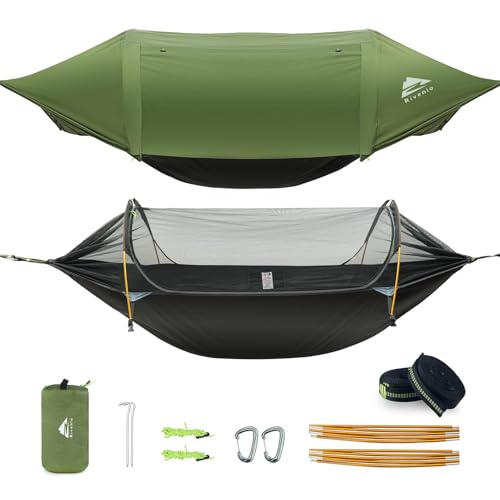
Rivenlo Camping Hammock Tent with Mosquito Net and RainFly

USGI Industries Bivy Tent Self-Deploying Mesh System
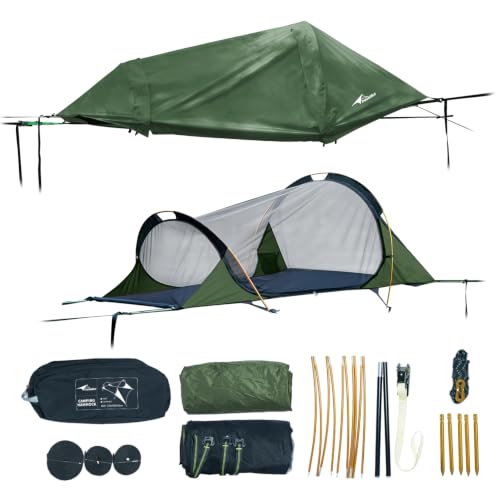
Travel Bird TriHive Flat Lay Hammock Tent with Mosquito Net
More Details On Our Top Picks
Field-ready sleep systems don’t get much more aggressive than this. The MT Military Army Defence 4 and Tropen Patrol mummy combo pairs a Nylon Taslon shell with a G-loft fiber fill, then wraps the whole package in a bivy cover for a layered defense against cold, moisture, and biting insects. Rated down to roughly 0 to -10 degrees Celsius in the manufacturer’s specs, this is the kind of setup you reach for when frost is a real possibility, not a hypothetical.
Compared to the lighter bivy-only options further down this list, this system is built for stationary base use where weight matters less than warmth. Hunters, anglers, and overlanders who camp in mixed conditions will appreciate the side zipper and the compression sack that makes transport manageable.
What Works In Its Favor
- Two-bag modular design lets you add or shed insulation layers as conditions shift
- Nylon Taslon shell resists light rain and blocks mosquitoes from reaching the inner bag
- Cold-rated fill makes it genuinely usable from autumn through early spring in many climates
- Compression sack keeps packed size manageable in a truck, sled, or large pack
Things To Consider
- Bulk and weight make this a poor fit for long-distance backpackers counting every ounce
- Mummy shape and side zipper limit interior space for restless sleepers
Key Specs
Who It Suits Best
Patrol-style campers, hunters, and military simulation enthusiasts who camp in genuinely cold weather and value layered insulation over pack weight.
Where Another Pick Suits Better
Backpackers chasing an ultralight summer load should skip this and reach for the Six Moon Designs Serenity NetTent further down the list.
When you want a shelter that hugs the ground and disappears into the brush, the MT Military Hideaway Bivy Cover delivers a low-profile silhouette that ordinary dome tents can’t match. The single-pole hooped design lifts the mesh just enough off your face to breathe, while the outer shell sheds rain and keeps crawling insects outside. It’s modeled after the U.S. Army modular sleep system, which means the geometry favors real sleeping bags, not pads stacked into a wrap.
Think of this as the bug-protection layer for the cold-weather system reviewed above, but stripped down for shoulder-season solo use. Bushcrafters and tactical-minded campers will appreciate the minimal footprint.
Good Reasons To Consider
- Single-pole hoop creates headroom without bulk, so you can read or shift position
- Waterproof-breathable shell handles surprise showers in shoulder seasons
- Low visual profile suits hunters and field training where blending in matters
- Compatible with existing modular sleep bags for layered cold-weather setups
Worth Noting
- Single pole limits interior width for broad-shouldered sleepers
- Requires a separate sleeping bag or quilt, since the bivy is a cover, not insulation
Made For
Stealth campers and bushcraft practitioners who already own a sleeping system and need a low-profile bug and weather shell to wrap around it.
Look Elsewhere When
Families or anyone wanting to sit upright inside the shelter will find the USGI Industries self-deploying bivy a more spacious alternative further down the list.
AquaQuest engineered this Hideaway Bivy for people who refuse to choose between waterproofing and breathability, which is the usual trade-off that ruins sleep in any shelter. The Olive Drab shell pairs a 70D ripstop nylon face with laminated PU and DWR coatings, then heat-tapes the seams so water has nowhere to sneak in. The manufacturer rates the fabric at 10,000 mm hydrostatic head (a measure of how much water pressure the fabric withstands before leaking) and claims a 10,000 g/m²/24h moisture vapor transmission rate, which is the fancy way of saying your body humidity exits instead of pooling as condensation on the inside.
The mesh bug net keeps mosquitoes, no-see-ums, and ticks out, and the single-pole hoop gives enough lift to keep fabric off your face during rainy nights. This one earns its price tag in places where wet weather is routine, not occasional.
Real-World Strengths
- High hydrostatic-head rating handles sustained rain without soak-through
- Heat-taped seams close the most common leak points in budget shelters
- Improved vapor transmission cuts the clammy feeling that ruins cheap bivys
- Olive Drab color blends into hunting environments and wooded backcountry
Honest Caveats
- Premium spec sheet comes with a premium price that casual backpackers may not justify
- Single-pole design gives limited width for restless sleepers who roll around
Right Fit For
Wet-season hunters and Pacific Northwest backpackers who need a bug-and-rain shelter in a single low-profile package.
Swap It Out When
Dry-summer campers chasing a lighter pack should consider the Six Moon Designs Serenity NetTent instead.
Sometimes you want a real shelter, not a body-hugging bag, and the OneTigris Solo Mesh Tent answers that need with a proper 6.5-foot length and enough standing room to change clothes inside. Built around 70D nylon mesh with a 3000 mm bathtub floor (the raised waterproof edge along the floor’s perimeter that stops ground moisture from creeping in), the design targets humid summer conditions where mosquitoes swarm at dusk and soggy ground waits just below your sleeping pad.
Setup uses triangle straps at the corners and built-in support bars, which most campers find intuitive on the first try. The whole package suits car campers and short-haul backpackers who want a standing-height bug fortress.
Where It Helps
- Standing-height interior beats body-length bivys for comfort on long weekends
- High bathtub floor rating keeps gear dry during heavy overnight downpours
- Full mesh walls maximize cross-ventilation in still, humid air
- Taped seams close common leak points around the floor edges
Points To Keep In Mind
- Larger packed size compared to true bivy sacks, so it’s not for ounce-counters
- Needs flat, debris-cleared ground to seat the bathtub floor properly
Feature Snapshot
Best Suited To
Campers in mosquito-heavy summer country who want a standing-height shelter and don’t mind a slightly larger packed footprint.
Skip It When
Long-distance backpackers need to save weight, and the Six Moon Designs Serenity NetTent further down offers a lighter alternative.
At 11 ounces, the Six Moon Designs Serenity NetTent is the kind of shelter that barely registers on a scale, which is exactly why thru-hikers and section hikers obsess over it. The design is deliberately minimal: a single 45-inch trekking pole (sold separately) holds up the apex, no-see-um mesh wraps the whole interior, and a small bathtub floor keeps ground moisture from creeping in. It pairs naturally with the brand’s Gatewood Cape or Deschutes tarp for rain protection.
This is not a four-season shelter, and Six Moon Designs is upfront about that. It’s a bug pod for fair weather, which is exactly what most long-distance backpackers actually need for three-season routes.
Everyday Advantages
- 11-ounce packed weight disappears inside any thru-hike pack
- No-see-um mesh blocks the tiny biting midges that ordinary mesh lets through
- Small footprint pitches in tight clearings where dome tents won’t fit
- Modular design pairs with a tarp so you can upgrade rain coverage later
Soft Spots
- Requires a separate trekking pole or purchased pole to pitch properly
- Not a standalone rain shelter, so you’ll need a tarp in wet conditions
Quick Facts
Who Should Grab It
Thru-hikers, section hikers, and anyone obsessed with shaving grams who needs a fair-weather bug shelter that pairs with their existing tarp.
Reach For A Different Pick When
You want rain protection built in, and the AquaQuest Hideaway Bivy offers a more weather-ready standalone package.
Pop-up shelters earn their keep when you’re tired, it’s getting dark, and the bugs are already circling. The Portable Camping Tent in Army Green throws open and self-deploys in seconds, then folds back down into the included storage bag once you’ve aired it out. The adjustable frame stretches the dimensions between roughly 70 and 120 cm wide, so you can tune the footprint to your pad or just give yourself extra room to stash a pack inside.
This is more of a backyard and base-camp shelter than a deep-backcountry tool, but for quick overnights, family camping trips, or emergency roadside use, the convenience factor outweighs the bulk.
What Pays Off
- Self-deploying pop-up frame eliminates setup frustration after dark
- Adjustable width fits both minimalist sleepers and gear-heavy campers
- Double-door design simplifies getting in and out without unzipping the whole shelter
- Included storage bag keeps the folded shelter contained in a trunk or closet
Where It Is Less Suited
- Polyester build and pop-up frame add bulk that backpackers will resent
- Best on flat ground, since the rigid frame doesn’t flex with uneven terrain
Perfect Match For
Families, festival campers, and anyone needing a fuss-free bug shelter they can toss in the car and deploy in seconds.
A Better Fit Elsewhere
Backpackers counting ounces will prefer the Six Moon Designs Serenity NetTent earlier in this list.
The Rivenlo hammock tent plays three roles in one package: bare hammock for relaxing in the backyard, suspended bug shelter for warm nights, and a rainfly-equipped sleep system when weather turns. Two foldable aluminum poles hold the mosquito net above your face, while the included rainfly adds weather protection without locking you into a rigid shelter shape. Tree straps and carabiners come in the box, so you can hang it without buying extra rigging.
Versatility like this has a real cost, which is weight and complexity. The Dark Green colorway also blends into forest settings for hammock hunters.
The Good Stuff
- Three-mode design covers relaxation, bug protection, and rainy sleeping in one kit
- Spread-bar pole geometry keeps fabric off your face for cooler sleep
- Tree straps and carabiners included, so the package is ready to hang
- Aluminum poles are lighter than fiberglass alternatives
Things To Weigh
- Hanging it requires two suitable trees spaced correctly apart
- Heavier than a simple bug net for backpackers counting every gram
Who Will Love This
Tree campers, hammock enthusiasts, and casual backpackers who want one piece of gear to flex across multiple use cases.
Consider Something Else When
Ground sleepers without reliable trees nearby should look at the OneTigris Solo Mesh Tent instead.
There’s something undeniably fun about throwing a shelter into the air and watching it snap into shape, which is exactly what the USGI Industries Bivy Tent does. The spring-loaded frame deploys instantly when released, leaving you with a freestanding single-person shelter that just needs staking. Inside, an accessory mesh pouch holds a bottle and small gear, while the wet-ground resistant floor handles damp grass and dewy mornings without soaking through.
It’s not the smallest packed shelter, but the deploy-and-stake simplicity makes it a favorite for emergency kits, scouting trips, and anyone who hates fiddling with poles at the end of a long day.
A Few Strong Suits
- Throw-deploy frame means zero assembly when you’re exhausted or rushed
- Internal mesh pouch keeps a bottle and headlamp off the floor
- Wet-ground floor construction handles dew and damp grass
- Two rainfly attachment loops allow for custom weather coverage
Trade Offs
- Stored size is bulkier than pole-style shelters of similar capacity
- Spring tension requires care during folding to avoid pinched fingers
At A Glance
Built With In Mind
Emergency preppers, scout groups, and casual campers who want the fastest possible setup without sacrificing interior space.
Where Another Pick Suits Better
Backpackers prioritizing packed volume will find the Six Moon Designs Serenity NetTent a lighter carry.
Most camping hammocks bend you into a banana shape that feels cozy for the first night and miserable by the third, which is why the Travel Bird TriHive is built around a true flat-lay geometry. The spreader bars pull the fabric taut across the long axis so you sleep the way you would in a bed, on your back or your side, without the cocoon curl. The 2-in-1 design also drops to the ground as a bivy, which is helpful when no suitable trees are nearby.
The built-in mosquito net keeps biting insects out of the equation, and the convertible design means one shelter covers hammock and ground setups.
The Value In It
- Flat-lay geometry prevents the banana-bend that ruins multi-night hammock sleep
- 2-in-1 design works as a suspended hammock or a ground bivy
- Built-in mosquito net eliminates the need for a separate bug cover
- Spacious interior allows sitting up to read or change clothes
Honest Caveats
- Spreader bars add weight compared to a gathered-end hammock
- Ground mode requires a flat, debris-free site for comfortable setup
Right Fit For
Side-sleepers and campers with back or joint issues who want hammock comfort without the curled-up sleep posture.
Not Your Match When
Traditional gathered-end hammock fans should look at the Rivenlo hammock tent earlier in the list.
Matching Bug Net Bivies To Your Sleep Style
Picking the right bug net bivy starts with three honest questions: where you sleep, how you carry it, and how aggressive the insects actually are. Backpackers chasing every ounce usually land on mesh shelters that pair with a tarp, because layering keeps weight modular. Stationary campers in genuinely buggy territory often want a freestanding or pop-up shelter that stands on its own and lets them sit upright inside.
The next filter is mesh density. Standard mosquito mesh blocks most flying insects but lets tiny biting midges through, which is why some shelters advertise no-see-um netting with smaller holes. If you’re camping near coastal mangroves, mountain trout streams, or northern bogs, the mesh upgrade is worth the trade in airflow. Conversely, dry pine forests with regular mosquitoes handle standard mesh just fine.
Weather matters too, and this is where the category splits. Pure bug shelters rely on a separate tarp for rain, which keeps weight low but adds setup steps. Integrated bivy shells like the AquaQuest Hideaway add weather protection in one package, at the cost of pack weight. Cold-weather sleepers should also confirm that their chosen shelter works over an insulated bag, since narrow mummy geometry in a tight bivy can crush loft and reduce warmth. Finally, think about ground conditions: a flat grassy site suits bathtub floors and pop-up frames, while rocky or sloped ground rewards low-profile pole-hoop designs that flex with uneven terrain.
Key Considerations Across These Picks
Where Shoppers Go Wrong
A common slip is choosing a shelter based on packed weight alone, then discovering the mesh is too coarse for local insects. Another trap is assuming any bug shelter handles rain, when most mesh-only designs need a separate tarp for actual precipitation. Backpackers also sometimes buy a bivy cover expecting it to insulate, only to find it’s just a shell that needs a sleeping bag inside. Confirming the shelter’s role in your sleep system, whether it’s standalone, paired with a tarp, or wrapping a bag, prevents most buyer’s remorse in this category.
What The Higher Tier Buys
Premium bug net bivy pricing pays for measurable engineering upgrades: higher hydrostatic-head waterproof ratings, taped or welded seams, stronger face fabrics like 70D ripstop nylon, and mesh fine enough to block no-see-ums. You also tend to get better hardware, including reinforced zippers, sturdier poles, and accessory loops that hold up over years of use. For weekend campers, the jump may feel steep, but for anyone logging multiple weeks in the backcountry each year, the durability and weather performance usually justify the extra spend over a single stormy season of field use.
Frequently Asked Questions
What exactly is a bug net bivy?
A bug net bivy is a lightweight shelter that combines a mesh insect barrier with a protective floor, sometimes adding a waterproof shell. It wraps your sleeping setup to block mosquitoes, ticks, and no-see-ums while you sleep.
Can a bug net bivy replace a tent?
A pure mesh bug net bivy cannot replace a tent on its own in rain, since the mesh lets water through. Many designs pair with a tarp or include an outer shell for weather protection, which brings the system closer to tent-level coverage.
How do I stop condensation inside a bug net bivy?
Pitch the shelter taut, avoid touching the inner walls with your sleeping bag, and ventilate any rain cover so moisture can escape. In humid conditions, the AquQuest Hideaway Bivy and similar breathable shells handle interior moisture better than basic nylon covers.
Are bug net bivies safe in snake or tick country?
Mesh shelters block flying and crawling insects but won’t stop snakes or rodents from entering. Use a solid floor, seal gaps carefully, and choose sites with low ground cover to reduce unwanted wildlife encounters.
How long do bug net bivies typically last?
With reasonable care, mesh shelters last several seasons of regular use, while premium nylon models with taped seams often hold up longer. UV exposure and abrasion degrade mesh faster than solid fabrics, so storing them out of direct sunlight extends lifespan.
Bottom Line
A bug net bivy earns its place in your pack the first time you sleep through a swarm without a single welt, which is the real test that no spec sheet captures. Match the shelter to your sleep system, your climate, and your tolerance for setup work, and the rest of the choice gets easier. Pick the one that fits how you actually camp, and your nights outdoors get a lot quieter.