
Cold afternoons, snowed-in weekends, or a backyard buried under spring mud tend to send kids straight to the couch. The right indoor inflatable turns that same living room or basement into an energy-burning playground without rattling the walls or dominating the floor plan. This lineup focuses on inflatables that fit through a standard door, inflate fast, and hold up to the kind of repeated jumping that comes with rainy-day boredom. You’ll also find one blower for anyone already running a setup that needs replacement.
The Picks In Brief

Outfunny Inflatable Bounce House, White Indoor Bouncy House for Kids 3-12

Outfunny Inflatable Bounce House for Big Kids 3-12

Blast Zone Magic Castle Inflatable Bounce House with Blower
Outfunny Inflatable Bounce House for Big Kids 3-12

MOUNTO 1.5hp Inflatable Bounce House Blower
Outfunny Indoor Bounce House for Kids 3-8

Bounceland Inflatable Party Castle Bounce House

Outfunny Inflatable Bounce House, White Indoor Bouncy House for Kids 3-8
A Breakdown Of The Leading Choices
The 13.1 by 10.8 foot Outfunny setup balances space and roominess in a way the smaller picks can’t match. A dedicated 8 by 8 bounce zone sits next to a ball pit and a generous slide, giving kids room to rotate between jumping, tossing, and sliding without bumping elbows. The 400 lb total capacity means up to five kids under 99 lb each can share the structure, which fits a typical playdate of neighborhood friends.
Ceiling height matters more than parents realize, and at 6.6 feet tall, this one clears most basement joists and standard eight-foot ceilings with room to spare. Compared to the Bounceland castle reviewed later, the Outfunny feels friendlier for indoor rooms where a 10-foot monster would dominate the space. For a household that hosts rotating guests, the three zones keep small disagreements over whose turn it is to a minimum.
Everyday Perks
- Three zones (bounce, ball pit, slide) keep small crowds engaged without forced turn-taking.
- 400 lb shared capacity handles a playdate of up to five children under 99 lb each.
- Mid-height 6.6 ft profile fits standard 8 ft ceilings without clipping the top.
- White color scheme reads clean in a finished basement or playroom.
- Sliding the blower into the room and inflating takes only a few minutes based on the product design.
Things To Consider
- Total 13.1 by 10.8 ft footprint needs a clear rectangular space, so measure doorways and furniture before setup.
- The blower runs continuously during play, so room acoustics and household noise tolerance matter.
Made For
Households with mixed-age siblings from preschool through tween who host weekly playdates and have a playroom or finished basement to spare.
Look Elsewhere When
Your room runs short on ceiling clearance, in which case the lower-profile Blast Zone Magic Castle is a better fit.
The taller Outfunny sibling trades a little square footage for noticeably more headroom. At 7.5 feet tall and a 13.6 by 11.1 foot base, the structure gives taller kids the freedom to jump without scraping the crown of the bounce area. Inside, the same 8 by 8 foot jumping zone keeps the layout familiar, while the added height makes landings softer for kids growing past the 8-12 range.
You may find the extra foot of ceiling clearance makes this the safer-feeling choice for kids on the older end of the recommended range. Compared to Item 1, the trade is straightforward: give up half a foot in each horizontal direction, gain nearly a full foot of vertical space. For rooms with vaulted ceilings or taller basements, that math lands in favor of this version.
Real Benefits
- 7.5 ft height reduces the top-out feeling for kids approaching the upper age range.
- Same 400 lb shared capacity and three-zone layout for playdate-friendly versatility.
- 8 by 8 ft bounce area stays consistent with the smaller Outfunny for familiar play behavior.
Honest Caveats
- The taller profile rules out rooms with low-hanging beams or standard basement ductwork.
- Slightly larger overall footprint than Item 1, so a tape measure earns its keep before ordering.
Best Suited To
Parents of kids between 8 and 12 who want a structure that won’t feel cramped within a year and who have a room tall enough to handle the 7.5 ft ceiling.
Swap It Out When
Your ceiling sits at a standard 8 ft with low ductwork, in which case the lower-profile Outfunny White Indoor Bouncy House for Kids 3-8 leaves more headroom margin.
The Blast Zone Magic Castle takes a different approach than the Outfunny models by trimming vertical and horizontal size in equal measure. At 8.5 by 11 by 7.4 feet with capacity for three players, the structure feels like the right pick for a basement where every inch counts. The fully enclosed safety netting wraps the entire jumping zone, giving parents a clearer view from any angle.
Puncture-resistant material is the headline durability claim here, which matters once a bounce house starts to see weekly use. Setup follows the usual pattern: unfold, attach the included blower, and the unit rises within seconds. For most basements, the lower height makes the difference between fitting around a hanging light fixture and not.
What Pays Off
- Compact 8.5 by 11 ft footprint fits in tighter basements where larger picks wouldn’t fit.
- Fully enclosed safety netting keeps jumping contained and adds visibility from the side.
- Puncture-resistant material aimed at handling the rough end of indoor play.
- Blower, stakes, and storage straps ship in the box, so there’s no separate parts hunt.
Points To Keep In Mind
- Three-player capacity is the smallest in this roundup, so big groups will rotate.
- No slide or ball pit zones, so the play variety is narrower than the Outfunny picks.
Who It Suits Best
Families with one to three kids who want a small-footprint bouncer for a low-ceiling basement and value a fully enclosed safety net.
A Better Fit Elsewhere
You run a busy household with frequent playdates, in which case the larger Outfunny 3-in-1 Bouncy Castle handles groups much more comfortably.
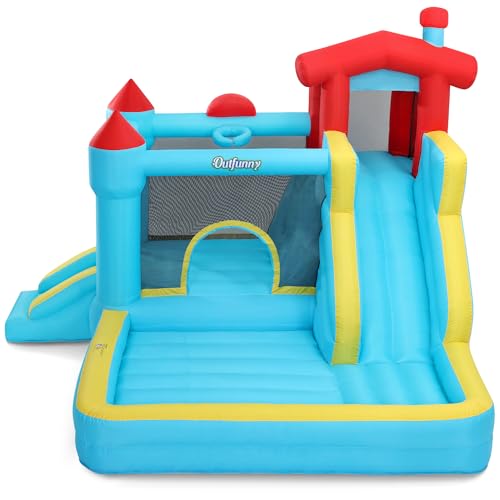
This Outfunny trades the three-zone simplicity of Items 1 and 2 for a full six-in-one layout. A climbing wall, bounce area, ball pit, basketball zone, and two slides of different sizes fill an 11.6 by 11.5 by 8 foot frame. The result reads more like a small inflatable amusement park than a simple jumper, which suits kids who burn through single activities quickly.
Capacity sits at three kids under 99 lb each, lower than the other Outfunny models but reasonable given how much vertical space the slides consume. For most basements, the 8-foot ceiling will be the limiting factor, so measure carefully. Compared to the three-zone Outfunny, the extra zones matter when siblings argue about whose turn it is, since there’s always somewhere else to play.
Useful Strengths
- Six activity zones cover climbing, sliding, jumping, ball play, and basketball in one frame.
- Two slides at different sizes let younger and older siblings each find a comfortable option.
- Near-square 11.6 by 11.5 ft base fits rooms where rectangular layouts leave awkward corners.
Worth Noting
- 8 ft height needs generous vertical clearance, which rules out standard 8 ft basement ceilings.
- Three-kid capacity is lower than the simpler Outfunny models despite the larger base.
- Cleaning the many fabric surfaces inside takes more time than a single-zone bouncer.
Perfect Match For
Active kids who rotate through activities quickly and a household with a tall-ceiling bonus room or two-story play space.
Reach For A Different Pick When
Your room is short on height, in which case the Bounceland Party Castle Bouncer covers similar multi-zone variety with a shorter profile.
The MOUNTO isn’t a bounce house but a 1.5 horsepower replacement blower (a motor that pushes air into the inflatable to keep it firm). Rated for bounce houses, water slides, and obstacle courses, the unit generates enough airflow for most residential inflatables. A roto-molded housing resists dents and rust, which matters once the blower starts spending time near grass, water tables, or a dusty garage corner.
You may find this the right pick if a previous blower failed mid-party and you’d rather replace the motor than the whole unit. The low amp draw helps when the inflatable shares a circuit with other household loads. Pairing it with a sturdy extension cord rated for outdoor or basement use keeps the setup safe.
Good Reasons To Consider
- 1.5 hp output covers most residential bounce houses and obstacle courses.
- Roto-molded housing resists dents and rust for longer garage or basement service life.
- Low amp draw eases sharing a household circuit with other appliances.
Some Limits To Know
- Only useful if you already own an inflatable that needs a replacement motor.
- Not a complete play setup, so first-time shoppers should look at the bounce house options first.
Who Should Grab It
Households replacing a failed blower on an existing bounce house, water slide, or obstacle course.
Not Your Match When
You’re shopping for the inflatable itself, in which case the Outfunny 3-in-1 Bouncy Castle gives you a brand-new play structure instead of just the motor.
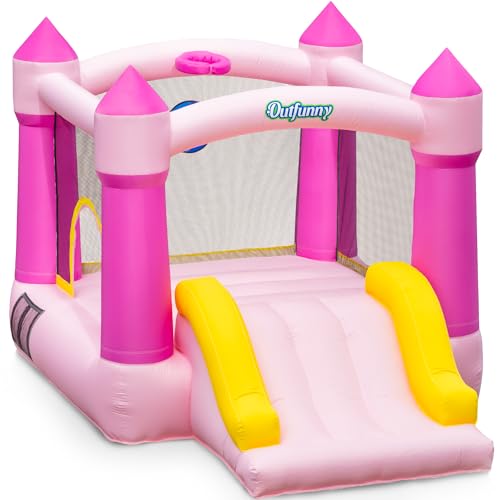
Compact doesn’t mean stripped-down, and this Outfunny proves it. A 6 by 6 foot bounce area sits at the heart of a five-in-one layout that adds slides, climbing, and ball pit play zones around the perimeter. The 300 lb shared capacity fits up to three kids under 99 lb each, which suits siblings and one or two friends.
For most apartments or small bonus rooms, this profile keeps a usable play zone without surrendering the living space. Compared to Item 1, the trade is clear: smaller bounce core, but more activities crammed around it. Storage also benefits, since the deflated unit folds down to something a closet can swallow.
Notable Upsides
- 6 by 6 ft bounce area keeps the footprint manageable for apartments and small bonus rooms.
- Five-in-one activity variety packs climbing and sliding into a tight frame.
- 300 lb capacity handles two to three kids without strain.
- Deflated size fits a standard closet for off-season storage.
Practical Considerations
- Smaller bounce area means bigger kids feel the squeeze faster than on the larger Outfunny models.
- Multiple zones in a tight frame can feel busy during peak playtime.
Right Fit For
Apartment dwellers and parents of younger kids who need a multi-activity structure that disappears into a closet between uses.
Where A Sibling Pick Shines
Your kids trend toward the older end of the age range, in which case the larger Outfunny 3-in-1 Bouncy House gives them more jumping room.
The Bounceland is the largest unit in the roundup at 16 by 13 by 10.3 feet, and the specs reflect party-scale ambition. A 500 lb shared capacity supports up to five kids with a 100 lb per-child ceiling, while a removable sun roof, basketball hoop, and slide give the structure an event feel. The included UL-listed blower (a motor independently tested for safety by Underwriters Laboratories) with a 25-foot cord and GFCI plug (a ground-fault outlet that cuts power if it detects a short) adds a safety-first note for basement outlets near concrete.
You may find the 10.3 ft height rules out any room with a standard ceiling, which makes this a basement-only pick in many homes. Compared to the Outfunny picks, the larger base demands a real dedicated space, not a corner of the family room. For households that host birthdays with rotating groups, the extra capacity pays for itself in fewer meltdowns over whose turn it is.
Where It Excels
- 500 lb capacity handles full birthday party rotations without bottlenecking.
- ASTM-tested construction (safety standards verified by ASTM International) and UL blower listing add consumer-grade safety assurance.
- Removable sun roof and basketball hoop add party-event versatility.
- GFCI plug on the 25 ft cord suits basement outlets near concrete floors.
Minor Gripes
- 10.3 ft height is too tall for standard 8 ft ceilings in most homes.
- Deflated storage requires a sizeable bag and a corner in the basement or garage.
- Blower runs continuously during use, so noise carries through thin basement floors.
Built With In Mind
Families hosting birthday parties or large playgroups who have a tall-ceiling basement or garage to dedicate as a play zone.
Skip It When
You’re working with a standard-ceiling bonus room, in which case the Outfunny 3-in-1 Bouncy House handles smaller groups with much less spatial commitment.
Setup speed is the headline on this Outfunny. A 300W blower fills the structure in roughly 45 seconds, which matters when an eight-year-old is vibrating with impatience at the door. The 10.8 by 9.5 by 5.9 foot frame keeps the unit low enough for finished basements and lower-ceiling bonus rooms, while the 6.5 by 6.5 foot bounce area holds up to three kids under 99 lb each.
Dual-layer 840D PVC fabric (a heavy-duty coated vinyl measured in denier, where higher numbers mean thicker material) reinforces the bounce floor and slide, both of which take the brunt of repeated landings. The package ships with four repair patches, seven ground stakes, a nail hammer, and an oversized storage bag. You may find the included accessory set removes the usual “did we order stakes separately” frustration. The blower runs continuously during use, so leave a clear power outlet within reach.
A Strong Showing
- 45-second inflate time with the included 300W blower gets play started fast.
- 5.9 ft height fits rooms where taller inflatables clip ceiling fixtures.
- 840D reinforced PVC fabric on the floor and slide extends service life under heavy use.
- Repair patches, stakes, hammer, and storage bag all ship in the box.
- White finish with vibrant accents reads bright in any room.
Worth Bearing In Mind
- Lower height caps the upper age range at 8, so older kids feel the squeeze quickly.
- Three-kid capacity is the lowest among the active Outfunny models reviewed here.
- The blower stays on for the entire play session, so plan an outlet and accept the noise.
Whose Shelf It Belongs On
Parents of preschoolers through age 8 who want fast setup, low ceiling clearance, and a tidy accessory bundle in one box.
Consider Something Else When
Your household includes kids older than 8, in which case the larger Outfunny 3-in-1 Bouncy House for Kids 3-12 stretches another year or two of useful play.
What Matters Most Before Choosing Bounce House Indoors
Room Dimensions Come First
Every inflatable on this list quotes a footprint in feet, and that number is the single biggest filter for indoor setups. Measure length, width, and ceiling height before browsing, then add at least two feet of buffer on each side so kids can enter and exit without scraping walls. Doorways matter too, since the deflated unit still has to reach the room. Standard interior doors sit around 30 to 32 inches wide, and most of the Outfunny models deflate to a package that fits through.
Capacity Versus Energy Output
Weight capacity (the maximum total load the structure is rated to hold) splits into two numbers: shared capacity for all kids combined and per-child weight. A 400 lb shared capacity with a 99 lb per-child ceiling fits five small kids but only four tweens. The blower size, measured in watts or horsepower, determines how fast the unit inflates and how firmly it stays pressurized under heavy jumping. For indoor use, a lower-wattage blower keeps the noise and heat output manageable in a closed room.
Material And Durability Signals
Look for reinforced fabric at high-wear points like the bounce floor, slide, and seams. PVC coated in higher denier ratings (a unit measuring thread thickness, where higher means tougher) holds up better to repeated landings than thin nylon. Patching kits ship with most units, and the inclusion of multiple patches signals the manufacturer expects real-world repairs to happen.
Noise, Storage, And Continuous Blowers
The blower runs the entire time kids play, so noise carries through thin basement ceilings to the floor above. Plan placement near an outlet that won’t trip breakers under continuous draw, and remember that deflated storage usually demands a closet or garage corner. Fold dry to prevent mildew, and let the blower cool before packing it away.
Key Considerations Across These Picks
Pitfalls Shoppers Hit
The most common slip is measuring only the bounce area and forgetting the slide, ball pit, and entry ramp that extend past the central platform. Another is underestimating how a continuous blower affects room temperature and noise over an afternoon of play. Finally, parents often skip the per-child weight limit, which feels generous until a 110 lb tween climbs on with two smaller friends and pushes the structure past its safe range.
When Paying More Pays Off
Higher-tier models earn their keep through stronger fabrics, taller ceilings, and tested safety certifications. A unit with ASTM-tested construction and a UL-listed blower pays off in households that run the inflatable weekly rather than twice a year. Larger capacities also reduce the “whose turn is it” friction that comes with frequent playdates, which matters more than any single spec sheet number.
Frequently Asked Questions
Can an indoor bounce house damage my floor?
Most residential inflatables rest on a flat, hard floor without scuffing, but carpet can trap moisture underneath, so a tarp or smooth mat underneath helps. Hardwood and concrete handle the setup fine in most households.
How loud is the blower during play?
Blowers for residential inflatables run in the range of a bathroom fan on high, which fills a basement but stays tolerable on the floor above. Thinner ceilings and open layouts will carry more sound.
Do I need to keep the blower on the entire time kids are playing?
Yes, the blower stays on for the full play session. Turning it off causes the structure to deflate within minutes, which can be unsafe for kids mid-jump.
What age range is safe for indoor inflatable play?
Most models list a 3 to 12 range, though individual weight limits and height clearance narrow that window in practice. Younger kids need supervision regardless, and older or taller kids run out of headroom faster on shorter units.
How do I clean an indoor bounce house?
A damp cloth with mild soap handles most spills, and the material should be fully dry before folding for storage. Avoid harsh chemicals that break down PVC coatings over time.
The Takeaway
The right indoor bounce house depends less on the biggest spec and more on the room you’re putting it in. Measure twice, mind the ceiling, and match capacity to the kids who’ll actually use it. Anything from this list will turn a rainy Tuesday into something the household remembers.