Weekend trips drain your phone faster than you’d expect, especially when navigation, headlamps, and a Bluetooth speaker all compete for the same battery percentage. A reliable charging setup turns a three-day trip into a relaxed one, with enough headroom to handle a slow cook of campsite photos and a rainy afternoon of podcasts. This roundup looks at portable power stations, high-capacity power banks, and solar-equipped packs that fit different camping styles, from car campers running a fan and lights to backpackers who count every gram.
A Closer Look At The Lineup
PickWhy We Picked ItBest ForAction

Premium PickAnker SOLIX C1000 Portable Power Station (1,056Wh)
Alternator charging on the road
Car camping with heavy gear
Travel ReadyAnker SOLIX C200 DC Power Bank Station with 60W Solar Panel (192Wh)
Compact LiFePO4 travel kit
Backpackers and van life
Performance LeaderEF ECOFLOW Solar Generator Delta 3 with 220W Bifacial Panel (1024Wh)
High-output expandable power
Base camp and outages
Value PickLiahomco 70,000mAh Power Bank 30W PD & QC 3.0
High capacity at friendly cost
Multi-day phone top-ups
Non-Slip Grip PickLiahomco 80,000mAh Power Bank 30W PD with LED Display
Extra capacity with grippy shell
Tent or picnic-table charging
Multi-Device PickLiahomco 80,000mAh Power Bank PD & QC 3.0 with LED Display
Five ports for group setups
Group camping and travel
Solar Hybrid PickSOARAISE Solar Power Bank 48,000mAh Wireless with 4 Cables
Built-in cables and wireless top-off
Trail day hikes and festivals
All-In-One Cable PickSOARAISE Solar Power Bank 48,000mAh Wireless Battery Pack
Four built-in cables, no extras
Shared trips with mixed devices
Festival PickSOARAISE Solar Power Bank 48,000mAh with 4 Built-In Cables
Cable clutter stays at home
Multi-day music festivals
Inside Each Recommended Option
Car campers who treat their vehicle like a mini basecamp tend to ask the same question: can the power station top itself up before the next morning coffee? The Anker SOLIX C1000 leans into that workflow with an alternator charger that pulls energy straight from a running engine, an unusual trick in this category that turns driving time into useful charging time. With a 1,056Wh capacity (roughly enough to recharge a phone dozens of times or run a small camp fridge overnight), it sits in the mid-tier of portable stations.
For weekend trips where you want a fan, lights, and a laptop all humming at once, this Anker feels like overkill for backpackers and just right for overlanders and family campers. Compared to the EF ECOFLOW Delta 3 later in this list, the SOLIX C1000 brings the alternator feature to the table, while ECOFLOW leans on raw solar wattage and expandable capacity.
What Works In Its Favor
- ✓Alternator charging turns driving hours into useful top-up time on road trips.
- ✓1,056Wh capacity supports a small camp fridge, lights, and electronics across a long weekend.
- ✓Anker app control (a companion phone app) lets you toggle ports and monitor draw from inside the tent.
- ✓Solid mid-tier output handles common camp appliances without tripping into higher price territory.
Worth Bearing In Mind
- •Heavier than pocket-sized banks, so this one stays in the car or a gear bin rather than a daypack.
- •Alternator charging requires a wired setup and works best for vehicle-based trips.
- •Owners commonly report keeping the unit stored at moderate charge levels to extend LiFePO4 longevity (LiFePO4 is a lithium iron phosphate battery chemistry known for long cycle life and thermal stability).
Key Specs
| | Feature | Specification | Why It Matters |
|---|
| Capacity | 1,056Wh | Enough for a small fridge and lights across a long weekend. |
| Charging Method | Alternator charger plus AC input | Top up the pack from the car while driving between camps. |
| App Control | Anker companion app | Toggle ports and monitor battery draw from your phone. |
| Battery Chemistry | LiFePO4 | Long cycle life and improved thermal stability over standard lithium-ion cells. |
Made For
Overlanders, family campers, and anyone whose campsite revolves around the car rather than a backpack.
Swap It Out When
Backpackers counting every gram should look at the Anker SOLIX C200, which trades capacity for a much smaller carry weight.
The Anker SOLIX C200 DC shrinks the portable power station idea into something closer to a generous paperback, which matters when your hiking pack is already loaded. The 192Wh capacity (enough for several phone charges or a long evening of camera battery work) is paired with a folding 60W solar panel, so the kit handles both daytime top-ups and evening device runs. LiFePO4 chemistry means this one is built to keep cycling long after cheaper cells would have faded.
Travelers bouncing between hostels, trailheads, and rental cars tend to appreciate the included panel. Compared to the larger Anker SOLIX C1000, this C200 trades capacity for a footprint that fits under an airplane seat or inside a van’s overhead shelf.
Everyday Wins
- ✓Compact form factor slips into luggage or daypack without dominating the load.
- ✓Bundled 60W solar panel adds daytime recharge without buying accessories separately.
- ✓LiFePO4 cells extend the usable lifespan compared to standard lithium-ion banks.
- ✓Versatile USB-C and USB-A setup covers phones, tablets, and camera batteries.
Honest Caveats
- •192Wh won’t run a camp fridge overnight, so heavy appliance users need a bigger station.
- •Solar charging speeds drop noticeably on overcast days or under heavy tree cover.
Who It Suits Best
Solo backpackers, digital nomads, and van lifers who want lightweight solar charging on the move.
Consider Something Else When
Group campers running a cooler and lighting should reach for the EF ECOFLOW Delta 3, which delivers higher output and expandability.
Base campers and emergency planners often care less about weight and more about raw output, and the EF ECOFLOW Delta 3 is built for that crowd. With 1,800W of continuous output (1,800W handles most kitchen appliances, including kettles and induction cooktops under that draw), it pushes past the small-electronics tier into actual cooking and heating territory. The 220W bifacial panel captures light on both faces, squeezing more midday energy out of the same footprint than a standard single-face panel.
For families running a base camp or anyone prepping for storm-season outages, the expandability up to 5kWh is the headline feature. Where the Anker SOLIX C1000 leans on alternator charging, this Delta 3 leans on raw solar input and stacking extra battery packs.
The Value In It
- ✓1,800W continuous output runs real appliances, not only small electronics.
- ✓Bifacial panel design pulls energy from reflected light, helping in bright open sites.
- ✓Expandable ecosystem scales capacity up to 5kWh for longer trips or outages.
- ✓Fast AC charging refills the unit in under an hour for last-minute departures.
Trade-Offs To Consider
- •Full kit weight and bulk push this firmly into the vehicle-camping category.
- •Bifacial panels need open placement to capture reflected light, so shaded sites limit the gain.
- •Higher output comes at a higher cost than pocket-sized banks.
Feature Snapshot
| | Feature | Specification | Why It Matters |
|---|
| Capacity | 1,024Wh | Powers a base camp with room to spare across a weekend. |
| Output | 1,800W continuous | Drives kettles, cooktops, and other demanding camp appliances. |
| Solar Panel | 220W bifacial | Captures direct and reflected light for faster midday charging. |
| Expandability | Up to 5kWh | Add extra battery packs for longer trips or whole-room backup. |
Built With In Mind
Base-camp families, tailgate cooks, and homeowners building a backup for short outages.
Reach For A Different Pick When
Solo backpackers who never need to run a kettle will find the Anker SOLIX C200 easier to carry.
Most campers actually only need to keep a phone, a headlamp, and a small action camera alive across a weekend, and a 70,000mAh brick handles that comfortably. The Liahomco 70,000mAh Power Bank supports 30W PD (Power Delivery, a fast-charging standard that negotiates higher wattage over USB-C) and QC 3.0 (Qualcomm Quick Charge, a fast-charging standard common on Android phones), so most modern phones reach a useful top-up in well under an hour. Five output ports let a small group share the bank without taking turns.
Compared to the larger Liahomco 80,000mAh options further down this list, this one shaves a bit of capacity for a friendlier carry weight. If you don’t need solar panels or wireless pads, this is the stripped-down workhorse option.
Key Advantages
- ✓70,000mAh delivers multiple phone charges across a long trip.
- ✓PD and QC 3.0 support means modern phones fast-charge at full speed.
- ✓Five output ports handle small groups sharing one bank.
- ✓LED display gives an honest percentage read so you know when to top up.
Small Caveats
- •Larger milliamp-hour ratings tend to mean a heavier pack in the bag.
- •Not designed for AC appliances, so it won’t replace a real power station.
Whose Shelf It Belongs On
Phone-heavy travelers and weekend campers who want simple, high-capacity charging without solar add-ons.
Not Your Match When
Campers running appliances like kettles or laptops for long sessions should reach for the EF ECOFLOW Delta 3 instead.
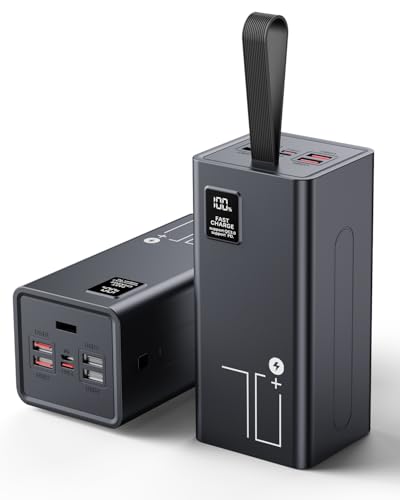
The Liahomco 80,000mAh Power Bank takes the same fast-charging platform as the 70,000mAh sibling and adds a textured shell that doesn’t skate across the picnic table. That non-slip grip is the kind of detail you only appreciate after watching a smooth plastic brick slide off a car hood, and it’s a quietly useful addition for outdoor use. Five output ports and two input ports cover simultaneous charging and refilling from different sources.
Compared to the Liahomco 70,000mAh earlier, this one stretches capacity slightly higher and trades some slimness for stability. For campers who set up a charging hub on a picnic table or inside a tent, the grippy finish earns its place.
What Makes Sense
- ✓80,000mAh capacity gives extra headroom for longer trips or larger devices.
- ✓Non-slip exterior stays put on smooth surfaces like coolers and tailgates.
- ✓30W PD fast-charging keeps phones and tablets refilling quickly.
- ✓Two input ports allow recharging the bank from different sources.
A Few Limitations
- •The textured shell adds a touch of bulk compared to smooth plastic banks.
- •Like the other Liahomco banks, no solar input here, so plan to recharge from a wall or car.
- •Capacity this high typically takes several hours to refill from a standard wall outlet.
Quick Facts
| | Feature | Specification | Why It Matters |
|---|
| Capacity | 80,000mAh | Adds one or two extra phone charges over smaller 70,000mAh packs. |
| Fast Charging | 30W PD USB-C | Modern phones refill quickly without waiting overnight. |
| Outputs | 5 ports, 2 inputs | Charge multiple devices and refill the bank from different sources. |
| Shell | Non-slip textured finish | Stays in place on coolers, tables, and tailgates. |
Right Fit For
Picnic-table campers, van lifers, and anyone who sets up a central charging spot inside a tent.
Skip It When
Backpackers should look at the SOARAISE Solar Power Bank, which adds built-in cables and solar recovery for trail use.
Group camping trips tend to reveal a charging bottleneck fast: four phones, two headlamps, a Bluetooth speaker, and a camera all competing for the same outlet. The Liahomco 80,000mAh Multi-Port Power Bank solves that with five output ports and dual input options, so the group can charge up while the bank itself recharges from either a wall outlet or a car adapter. The 30W PD and QC 3.0 fast-charging standards keep modern phones refilling quickly.
Compared to the similar Liahomco 80,000mAh with non-slip grip, this sibling keeps the same internal capacity but drops the textured shell in favor of a slightly slimmer profile. If carry size matters more than grip, this one nudges ahead.
Where It Delivers
- ✓Five output ports handle a small group charging phones and accessories at once.
- ✓30W PD plus QC 3.0 covers both iPhone and Android fast-charge standards.
- ✓80,000mAh capacity stretches across a long weekend without a refill.
- ✓LED percentage display helps gauge remaining runtime.
Where It May Fall Short
- •Multiple outputs used at once may slow individual charging speeds below the 30W peak.
- •No solar input, so recharge planning still hinges on a wall or car source.
Perfect Match For
Group campers, family road trips, and festival crews who need to charge multiple devices at once.
Look Elsewhere When
Solo trail hikers should consider the SOARAISE Solar Power Bank, which adds wireless and built-in cable convenience.
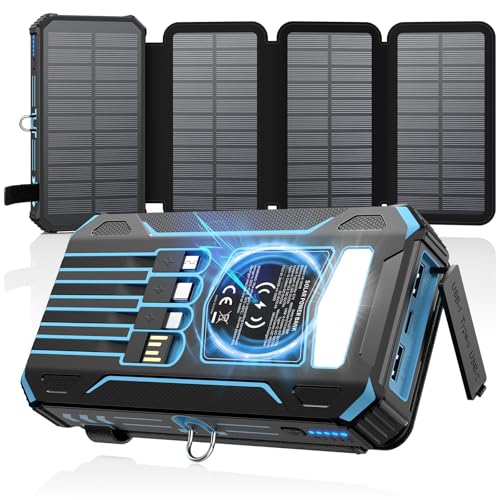
Festival-goers and trail hikers share one annoyance: the cable that always gets left behind. The SOARAISE 48,000mAh Solar Power Bank sidesteps that with four built-in cables tucked into the body, plus a wireless charging pad on top for compatible phones. The integrated solar panels add a recovery option on long, sunny days, although they charge slower than a wall outlet.
For travelers packing light, this hybrid approach removes the need to remember which cable goes with which device. Compared to the larger Liahomco 80,000mAh banks above, this SOARAISE trades raw capacity for built-in convenience and solar backup.
Points In Its Favor
- ✓Four built-in cables cover most phone and tablet connections without packing extras.
- ✓Wireless top-off pad works for compatible phones and earbuds.
- ✓Solar panel array adds a recovery option for sunny, multi-day outings.
- ✓Compact form fits in a daypack pocket more easily than larger bricks.
Less-Strong Areas
- •Solar charging is slower than wall or car input, so treat it as a top-up, not the main refill.
- •48,000mAh is generous but smaller than the Liahomco 80,000mAh options for heavy users.
Best Suited To
Festival campers, day hikers, and weekend travelers who want a single grab-and-go charging brick.
A Better Fit Elsewhere
Long-haul travelers who frequently run laptops or larger devices should look at the EF ECOFLOW Delta 3 for AC-style output.
Shared cabins, hostels, and group camping trips expose a small but real pain: someone always forgets a cable. The SOARAISE 48,000mAh Solar Power Bank, the battery-pack version, doubles down on that problem with four built-in cables, wireless top-off, and integrated solar panels, making it one of the more self-contained options in this list. The 48,000mAh capacity sits in the middle of the pack, generous for personal use and workable for two people sharing.
Compared to its sibling earlier in this list, the battery-pack version leans more toward stationary setups where the solar array can sit in window light, rather than a moving backpack. If your trip involves sunny lounging more than trail miles, this is the SOARAISE to reach for.
What Helps Most
- ✓Four integrated cables handle Lightning, USB-C, and Micro-USB devices.
- ✓Wireless charging pad supports compatible phones and small accessories.
- ✓Solar array recharges in sunny window or picnic-table conditions.
- ✓48,000mAh capacity covers a long weekend of phone and earbud top-offs.
Soft Spots
- •Solar recovery is slow, so most recharging still happens from a wall outlet or laptop.
- •Built-in cables can wear out over years of heavy flexing at the hinge.
Who Should Grab It
Group campers and cabin travelers who need one charging brick that works for nearly every device.
Where Another Pick Suits Better
Solo backpackers should consider the Anker SOLIX C200, which trades built-in cables for a smaller carry weight.
Multi-day music festivals tend to be a stress test for any portable charger: dust, sun, friends borrowing cables, and a tent that’s never quite dark enough to find anything. The SOARAISE 48,000mAh Solar Power Bank with built-in cables handles the chaos by eliminating the cable hunt entirely. The integrated solar panels keep the bank trickling back toward full between sets, although real recovery still needs a wall outlet.
For festival veterans, this SOARAISE is essentially the wireless plus cable version of a setup that used to require a tangle of extras. Compared to the Liahomco 80,000mAh options earlier, this one trades raw capacity for built-in convenience and a wireless pad.
Advantages To Know
- ✓Four built-in cables mean no rummaging through a dark tent for the right cord.
- ✓Wireless top-off is handy for earbuds and compatible phones.
- ✓Solar panel array keeps the bank recovering during sunny festival afternoons.
- ✓Compact shell fits in a hydration-pack pocket or hip belt.
Practical Considerations
- •Solar input is a backup, not a primary recharge method, so plan wall time at some point.
- •48,000mAh may run tight if three friends lean on it for weekend phone top-offs.
- •Owners commonly report keeping the unit out of direct midday heat to preserve battery longevity.
Who Will Love This
Festival campers, beach-weekend regulars, and anyone who hates cable clutter at the campsite.
Not Your Match When
Power-hungry users running laptops should look at the EF ECOFLOW Delta 3 for higher output and AC capability.
Picking The Right Charger For Your Campsite
Match Capacity To Your Trip Length
Capacity drives almost every camping-charging decision, and the rule of thumb holds up well: one phone charge equals roughly 4,000 to 5,000mAh in real-world conditions, with conversion losses eating into the rated number. A 48,000mAh bank gives a solo traveler about a week of phone top-offs, while a 192Wh power station (the Anker SOLIX C200, for instance) handles camera batteries, headlamps, and a small fan for a long weekend. Anything north of 1,000Wh starts to cross into appliance territory, useful for car campers but overkill on a backpacking trip. Pick the smallest bank that comfortably covers your worst-case day, then add a buffer.
Check Output Speed And Ports
Fast-charging standards matter when a dead phone needs to wake up before a navigation call. PD (Power Delivery) and QC 3.0 (Qualcomm Quick Charge) are the two protocols to look for on modern phones, and a 30W port handles most fast-charge claims at full speed. Also count your ports: solo travelers can get by with two outputs, but group camping quickly demands four to five. USB-C inputs are a quiet bonus, since they let the same cable that charges your phone refill the bank.
Decide Between Solar, Alternator, And Wall Charging
Solar panels add recovery on sunny days but charge slowly under cloud cover or tree shade, so they’re best treated as a top-up rather than a primary refill. Alternator chargers (like the one on the Anker SOLIX C1000) turn driving hours into useful top-up time, which is huge for road-trippers. Wall and car outlets remain the most reliable refill sources, and most power banks on this list lean on those exclusively. Match the charging style to your trip, rather than chasing features you won’t use.
Smart Choices Before You Buy
Common Slip Ups In The Camping Charger Category
A frequent mistake is buying the largest capacity available without thinking about weight. A 1,000Wh power station sounds appealing until it sits unused because it never makes it out of the car. Conversely, a slim 48,000mAh bank can run out fast when three phones and a camera all want attention. Honest sizing for your trip length matters more than chasing the biggest number. Another pitfall is ignoring port layout: a bank full of USB-A ports feels dated the moment a USB-C laptop shows up. Plan for the devices you actually carry.
Where Spending A Bit More Pays Off
Higher-tier models earn their price through three upgrades that matter on real trips. First, LiFePO4 battery chemistry (used in the Anker SOLIX models) lasts far more charge cycles than standard lithium-ion, which pays back over years of use. Second, higher continuous output (the 1,800W on the EF ECOFLOW Delta 3) opens up appliances that smaller banks simply cannot run. Third, expandability through extra battery packs lets a base-camp setup scale with your needs, instead of replacing the entire kit when a longer trip arrives.
Frequently Asked Questions
QHow big a power bank do you really need for camping?
For phone, headlamp, and small camera charging across a weekend, 20,000 to 50,000mAh is plenty for solo travelers. Group campers running multiple devices should look at 70,000mAh or higher, or step up to a portable power station if any appliance is involved.
QAre solar power banks actually useful on camping trips?
Solar panels on small power banks are best treated as a top-up rather than a primary refill, since they charge slowly under cloud cover or tree shade. They shine on sunny, multi-day trips where wall outlets are nowhere in sight, but a wall or car outlet always refills faster.
QCan a portable power station run a camp fridge?
Smaller stations in the 200Wh range cannot, while 1,000Wh-plus units with 1,500W to 1,800W output (the EF ECOFLOW Delta 3, for example) typically handle small camp fridges overnight. Always check the fridge’s running wattage before assuming compatibility.
QWhat’s the difference between a power bank and a power station?
A power bank uses USB ports and is sized for phones, tablets, and small electronics, while a portable power station adds AC outlets and higher wattage for kettles, lights, and small appliances. Stations also tend to use LiFePO4 chemistry for longer cycle life.
QIs LiFePO4 worth the extra cost in a power station?
For frequent campers, LiFePO4 cells last several times longer than standard lithium-ion, which pays off over years of trips. Casual users camping once or twice a season may not recoup the premium as quickly.
Closing Remarks
The right camping charger depends less on specs on paper and more on how you actually camp. Backpackers chasing low weight get the most from compact LiFePO4 stations or solar-equipped banks, while car campers running lights and a fridge want the heavier 1,000Wh-plus options. Match the kit to your trip style, and the rest of the gear tends to follow.