
Fall cleanup shouldn’t require a pro crew or a second mortgage. The right affordable leaf blower turns a two-hour rake marathon into a twenty-minute sweep, and you don’t need gas-grade power to handle a typical suburban yard. After sorting through eight corded and cordless options built for homeowners, this list focuses on tools that balance price, airflow, weight, and durability without crossing into premium territory. Every pick below earns its spot through a specific strength: some deliver vacuum-and-mulch versatility, others prioritize battery convenience, and a few simply outperform their price tag.
The Shortlist At A Glance

MZK 3-in-1 Electric Leaf Blower Vacuum Mulcher
3-in-1 Leaf Vacuum Mulcher 450 CFM Blower

Makita XBU02PT 36V Brushless Blower Kit

LAZYBOI 21V Cordless Leaf Blower (Green)

WORX WG547 20V Cordless Leaf Blower
LAZYBOI 21V Cordless Leaf Blower

WORX Nitro WG543 20V Cordless Blower

WORX WG545.1 20V Air Cordless Blower
A Breakdown Of The Leading Choices
Corded tools get a bad reputation for tethering you to an outlet, but the MZK 3-in-1 makes a strong case for staying plugged in. With air volume rated up to 460 CFM (cubic feet per minute, the standard measure of how much air a blower pushes) and wind speed reaching roughly 167 MPH at the nozzle, this unit handles the kind of damp, matted leaves that frustrate smaller cordless models. The tool-free switch between blower, vacuum, and mulcher modes means you clear a path, then sweep up the pile without grabbing a second piece of equipment.
For homeowners with a small yard and a reachable outdoor outlet, the trade-off feels minor. The vacuum side pulls debris into a collection bag and shreds it on the way through, which keeps trash-can trips to a minimum. Compared to the single-purpose cordless picks later in this list, the MZK trades mobility for raw clearing strength and a lower ongoing battery cost.
Notable Upsides
- Three-in-one design replaces a rake, blower, and vacuum with a single corded tool
- 460 CFM airflow and 167 MPH wind speed tackle stubborn leaf mats
- Tool-free mode switching saves time during mid-cleanup changes
- No batteries to charge or replace, so runtime depends on your outlet, not a battery cycle
Worth Noting
- Cord limits reach; an outdoor extension cord becomes essential for larger lots
- Collection bag fills quickly with wet debris, so expect to empty it more than once during heavy sessions
Key Specs
Who It Suits Best
Homeowners with a small yard, a nearby outdoor outlet, and a desire to skip raking entirely benefit most from this tool.
Consider Something Else When
For wide-open lots where cord management becomes a chore, the Makita XBU02PT cordless kit offers untethered freedom.
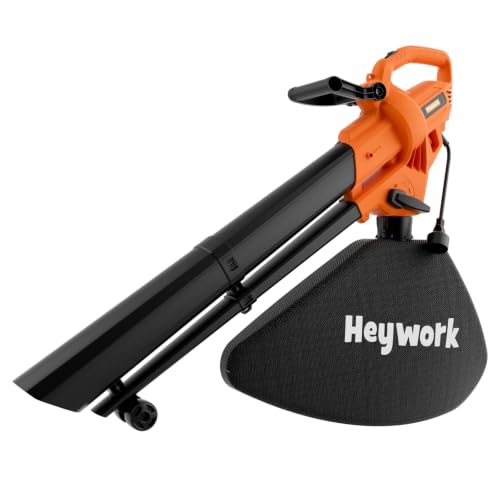
The Heywork 3-in-1 lands in the sweet spot between capability and cost, especially for smaller properties. Its 450 CFM airflow and 158 MPH top speed clear dry leaves and grass clippings without bogging down, and the tool-free mode swap keeps cleanup fluid. Storage stays tidy too, since the unit collapses into a more compact form than bulkier backpack-style alternatives.
Where it earns its “value” badge is in owner fit: apartment patios, townhouse yards, and side-walk strips that don’t justify a premium-tier investment. Compared to the MZK 3-in-1 above, this model trims a few MPH and CFM in exchange for a friendlier price, which most light-duty users won’t notice during a routine sweep.
A Favorable Mix
- Strong 450 CFM output for the price bracket
- Tool-free transitions between blowing, vacuuming, and mulching
- Compact storage footprint suits sheds and garage corners
Things To Consider
- Corded design means planning your outlet access in advance
- Vacuum bag capacity runs smaller than gas units, so plan for frequent emptying on big jobs
Made For
Owners of small to mid-size lawns who want vacuum-and-mulch functionality without committing to a premium price benefit most from this option.
Look Elsewhere When
For cordless convenience on larger properties where extension cords would be impractical, the WORX WG547 brings 20V portability.
The Makita XBU02PT operates on a 36V system built from two stacked 18V LXT batteries, giving it the sustained output that brushless motors (motors with no internal brushes, so they run cooler, quieter, and longer) deliver without the noise and emissions of gas. The kit includes two 5.0Ah batteries, which translates into longer continuous runtime than most cordless competitors at this size. Zero emissions also matter for users in municipalities with idling restrictions.
This kit sits at a higher price tier than the rest of the list, which is exactly why it earns the “premium” badge rather than an “everyday” one. Landscapers and homeowners with acreage get professional-grade airflow without fuel mixing or pull-cord starts. Compared to the corded picks above, the trade-off is purely cost versus runtime freedom.
Everyday Perks
- Dual 18V batteries deliver 36V of cordless output with brushless efficiency
- Zero emissions support cleaner air and quieter neighborhoods
- Compatible with the broader Makita 18V LXT battery platform
- Two 5.0Ah batteries included for extended sessions
Trade Offs
- Higher upfront cost than corded or entry-level cordless picks
- Battery and charger storage take up more shelf space than a single corded tool
Technical Highlights
Right Fit For
Homeowners with larger properties or anyone already invested in the Makita 18V LXT platform gains the most from this kit.
Skip It When
For small patios and quick touch-ups, the LAZYBOI 21V delivers enough airflow at a fraction of the cost.
The green LAZYBOI focuses on the kind of cleanup that doesn’t require a full afternoon: clearing a deck, sweeping a driveway, or blasting dust off patio furniture. The two-speed mode lets you throttle back for light debris and crank up when leaves stack up, and the package ships with two 2.0Ah batteries plus a charger. Hot-swapping mid-session doubles your effective runtime compared to single-battery kits.
The compact build and lighter weight make this one comfortable for users who don’t want forearm fatigue after ten minutes. Compared to the bulkier Makita above, the LAZYBOI trades professional-grade airflow for portability and a much friendlier price. For most patios and small yards, that’s the right swap.
A Few Highlights
- Two-speed control adapts to dust versus heavier leaf piles
- Two 2.0Ah batteries included for uninterrupted sessions
- Lightweight handheld design reduces arm and wrist fatigue
Points To Note
- Lower airflow than premium picks, so wet or compacted leaves may need extra passes
- Plastic housing feels lighter but may not tolerate drops as well as heavier units
Best Suited To
Patio owners, apartment dwellers, and casual homeowners handling light weekly cleanup will find this the most ergonomic match.
A Better Fit Elsewhere
For heavier fall leaf volume on a mid-size yard, the WORX Nitro WG543 delivers stronger airflow in a similar handheld package.
WORX built the WG547 around its Turbine fan technology, which pulls in more air per rotation than conventional impellers (the spinning blades that generate airflow inside a blower). The result is up to 360 CFM through a cordless 20V platform, enough to push a respectable leaf pile across a lawn without dragging out a rake. Two-speed control keeps the lower setting quiet enough for early-morning use in close-quarter neighborhoods.
This model hits the sweet spot for suburban homeowners who want cordless convenience without paying for pro-tier output. Compared to the LAZYBOI 21V above, you get higher CFM and the brand’s established service network, at a modest cost increase. The PowerShare battery platform also means existing WORX 20V tool owners can skip buying a second battery.
Where It Helps
- Turbine fan design boosts airflow up to 360 CFM on a 20V platform
- Two-speed settings balance power with noise control
- Compatible with the WORX 20V PowerShare battery ecosystem
Honest Caveats
- Battery and charger may be sold separately depending on the configuration
- Single-fan design can struggle with very wet, heavy leaves compared to dual-stage units
Who Will Love This
Suburban homeowners with daily or weekly yard maintenance routines get a balance of power and portability that fits naturally into the workload.
Reach For A Different Pick When
For homeowners who frequently tackle wet, matted leaves, the WORX Nitro WG543’s variable nozzle offers better directional control.
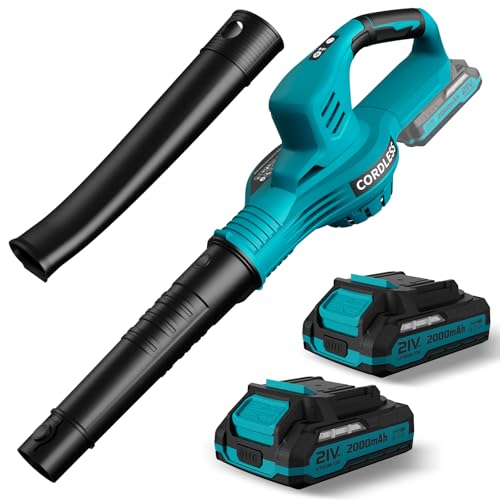
The non-green LAZYBOI is essentially the same handheld platform as its sibling earlier in this list, retuned for first-time owners who want the cordless experience without extras. Two-speed control covers routine sweeping and heavier bursts, and the lightweight shell makes it approachable for anyone who finds larger blowers intimidating.
Where this version stands out is at the entry-level price point for a twin-battery kit. For a homeowner on a tight budget who just needs a working tool, the value math is hard to argue with. Compared to the green LAZYBOI above, you give up the color differentiation but keep the core airflow and battery configuration.
Positive Takeaways
- Entry-level price for a complete two-battery kit
- Two-speed mode handles dust and leaf cleanup with one tool
- Lightweight design welcomes first-time blower owners
Small Caveats
- Lower CFM than mid-tier picks means multiple passes on wet debris
- Plastic construction may scratch or scuff with rough storage handling
Perfect Match For
First-time buyers, gift-givers, and homeowners with small cleanup needs gain the most from this starter configuration.
Not Your Match When
For users who want stronger sustained airflow in a similar cordless shell, the WORX WG547 delivers noticeably more push.
The WG543 Nitro brings variable air control to the cordless 20V category, letting you slide the nozzle out for volume mode or in for focused stream. That mechanical adjustment reaches up to 410 CFM, which positions it above the WG547 sibling in raw clearing power. For stubborn wet leaves and weighty debris, the focused stream makes the difference between a clean sweep and chasing the same pile twice.
Heavy-duty in this context means better-suited for tougher debris rather than pro-grade commercial use. Compared to the LAZYBOI picks above, the WG543 costs more but delivers noticeably stronger airflow and a more refined nozzle system. For mid-size yards where fall cleanup turns into a real chore, that extra muscle earns its place.
What Helps Most
- Variable air-control nozzle adjusts between volume and focused stream
- Up to 410 CFM clears heavier debris in fewer passes
- WORX 20V PowerShare compatibility extends battery investment
Practical Considerations
- Slightly heavier than entry-level cordless units due to larger motor housing
- Battery and charger may be sold separately depending on the configuration
Feature Snapshot
Who Should Grab It
Homeowners dealing with wet leaves, heavier yard debris, or larger mid-size lots benefit most from this model’s airflow and nozzle control.
Where Another Pick Suits Better
For ultra-lightweight patio work, the LAZYBOI 21V handheld is easier to wield for short sessions.
The WG545.1 leans into versatility with nine different attachments that transform the base blower into a vacuum, detail sweeper, inflator, and more. The included PowerShare battery is compatible with the broader WORX 20V, 40V, and 80V tool lineup, which gives existing WORX owners a familiar platform to plug into.
For users who want a single tool that handles cars, pool toys, and tight indoor spaces alongside yard work, this design makes practical sense. Compared to the LAZYBOI handheld picks, the WG545.1 trades raw CFM for attachment variety. The honest read is that this blower shines for detail jobs and narrow spaces rather than open-lawn clearing.
Positive Points
- Nine attachments expand use cases beyond yard cleanup
- PowerShare compatibility spans 20V, 40V, and 80V WORX tools
- Cordless portability reaches tight indoor spots that corded tools can’t
A Few Limitations
- Lower CFM than dedicated yard blowers, so wide-open cleanup takes longer
- Multiple attachments require storage planning to keep the kit organized
Built With In Mind
Homeowners who want one tool for car detailing, workshop cleanup, and light yard work will appreciate the versatility of this kit.
Swap It Out When
For larger yard clearing where raw airflow matters more than attachments, the Makita XBU02PT brings stronger sustained output.
What Matters Most Before Choosing Affordable Leaf Blowers
Air volume and air speed tell you how hard a blower can push debris, but the right balance depends on what you’re clearing. Dry leaves and grass clippings respond well to high CFM (cubic feet per minute, the volume of air moved), while wet or compacted debris needs higher MPH at the nozzle to lift and move. Cordless models with brushless motors run cooler, quieter, and last longer than brushed equivalents, though they typically cost more upfront.
Corded blowers deliver unlimited runtime but tie you to an outlet, which matters for larger lots. Battery platforms vary widely: WORX’s PowerShare system spans 20V, 40V, and 80V tools, while Makita’s LXT platform covers a broader 18V-and-up ecosystem. For homeowners already invested in one brand, staying within that battery family saves the headache of managing separate chargers.
Weight and ergonomics shape daily use just as much as raw power. A heavier unit feels stable for long sessions, while a lightweight handheld keeps fatigue low for quick sweeps. Consider storage too: 3-in-1 blower-vacuum-mulcher combos reduce tool count but add bulk, and units with multiple attachments need a designated bin or shelf.
Vacuum and mulcher functions add versatility but require regular bag emptying and blade cleaning. For most homeowners, a single primary use case (blowing leaves off a lawn, clearing a patio, or detailing a car) should drive the choice more than chasing every available feature.
Key Considerations Across These Picks
Common Shopping Slip Ups
Chasing the highest CFM number often leads shoppers to overpowered tools they rarely use, while underestimating runtime leaves them stranded mid-job with a dead battery. The honest trade-off is matching airflow and battery capacity to your actual yard size. Reading the included-battery details matters too, since some listings ship “tool only” without a pack or charger, which adds cost at checkout.
Where The Extra Money Goes
Premium-tier models like the Makita XBU02PT invest in brushless motor efficiency, higher voltage platforms, and batteries that share across a broader tool ecosystem. The upgrade pays off for daily users and larger properties where runtime and durability compound over months. For occasional seasonal use, mid-tier cordless picks deliver more than enough capability without the premium-tier commitment.
Frequently Asked Questions
How do I choose between corded and cordless affordable leaf blowers?
Corded models offer unlimited runtime within reach of an outlet and typically cost less, while cordless units add mobility and skip extension-cord management. For small yards with accessible outlets, corded often wins on value; for larger or outlet-distant lots, cordless saves frustration.
What does CFM actually measure on a leaf blower?
CFM (cubic feet per minute) measures how much air volume a blower pushes, which determines how fast leaves move across a surface. Higher CFM clears wide areas faster, while higher MPH focuses power on stubborn, wet debris.
Are brushless motors worth the extra cost?
Brushless motors (motors without internal brushes) run cooler, last longer, and use battery power more efficiently than brushed designs. The extra cost makes sense for frequent users, but occasional seasonal cleanup rarely justifies the premium.
How long does a typical cordless leaf blower battery last?
Battery runtime varies widely based on amp-hour (Ah) rating, speed setting, and load. A 2.0Ah pack may run 15 to 25 minutes at high speed, while a 5.0Ah pack can extend that to 45 minutes or more under similar conditions.
Can a leaf blower vacuum and mulch leaves effectively?
Yes, but performance depends on whether leaves are dry or wet, and on bag capacity. Dry leaves mulch down to a small fraction of their original volume, while wet debris fills bags quickly and may clog the impeller without regular cleaning.
Final Verdict
The right affordable leaf blower matches your yard size, outlet access, and tolerance for battery management. Corded 3-in-1 units deliver the most capability per dollar for small lots, while brushless cordless kits pay off for daily users and larger properties. Focus on the use case you’ll actually repeat, and the rest of the spec sheet tends to settle itself.