
Hosting a wedding, graduation, or backyard reunion outdoors throws up the same recurring headache: you need real shelter, but renting a venue feels like overkill for a one-day celebration. A heavy-duty party tent changes that math overnight, giving you a defined space that handles sun, wind, and surprise drizzle without locking you into a hall.
This roundup covers nine standout options across the 20×40 category and its close relatives, from full commercial frames to lighter backyard models. Each entry has been weighed on frame sturdiness, canopy material, sidewall coverage, and how much real-world setup you should expect before the first guest arrives. Whether you’re fitting 50 friends for a buffet or seating 100+ for a ceremony, there’s a match below.
The Lineup, Simplified

Tooluck 20×40 FT Heavy Duty Party Tent
COBIZI 20×30 Outdoor Party Tent
COBIZI 20×20 Outdoor Party Tent

COBIZI 20×40 FT Heavy Duty Party Tent
COBIZI 20×40 Heavy Duty Party Tent

COBIZI 20×40 Party Tent Heavy Duty

Quictent 20×40 West Coast Frame Party Tent
COBIZI 20×20 Heavy Duty Party Tent

COBIZI 20×40 Heavy Duty Party Tent
What Each Pick Brings To The Table
Tooluck’s 20×40 entry targets hosts who want a full enclosed shelter without renting a frame tent. Twelve zippered sidewalls mean you can close off every wall for a plated dinner, then roll panels up for airflow during the dancing portion.
Setup is a two-person job at minimum, and a four-person crew makes the frame work noticeably smoother. The built-in sandbag pockets let you ballast each leg without hauling separate weights, which is a quiet win on a windy afternoon.
Bright Spots
- Twelve zippered sidewalls give full enclosure control for plated dinners or open-air dance floors
- 180G PE canopy material reads as heavier than the budget tents, with UV blocking that holds up across a long afternoon
- Built-in sandbag pockets at each leg cut down on loose gear and speed up teardown
- 800 square feet of covered space seats roughly 80 guests at round tables, fitting most mid-size weddings
- Frame design works on grass, patio, or a gravel drive with proper staking
Points To Note
- Full assembly typically runs two to three hours with a small crew, so plan ahead rather than the morning of
- Canopy should be fully dried before folding to prevent mildew along seams
- Stakes hold well in soil but struggle on hard surfaces without added weight
Whose Backyard It Belongs In
Hosts planning a one- or two-day outdoor wedding with 60 to 90 guests who want a fully enclosed feel.
Skip It When
You only need a 20×20 footprint; the COBIZI 20×20 Heavy Duty Party Tent is a tighter fit for smaller gatherings.
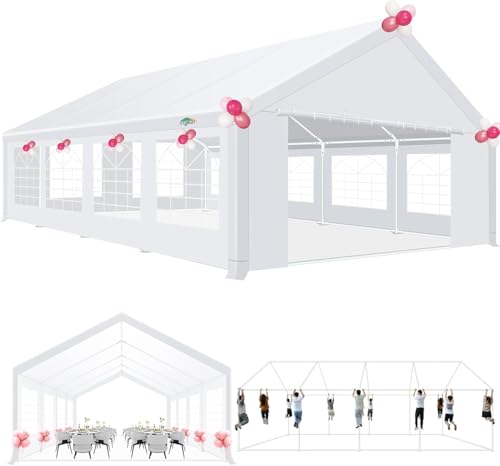
The 20×30 footprint sits in a useful middle ground between the compact 20×20 and the full 20×40 shelters. Twelve church windows let natural light pour in during the day, which matters when your event runs from lunch into golden hour.
Eight sidewalls give you decent enclosure without fully sealing the perimeter, so airflow stays comfortable in warmer months. The white powder-coated frame keeps its finish longer than bare galvanized tubing, which tends to show oxidation after a season outdoors.
A Few Strong Suits
- Mid-size 600-square-foot footprint suits backyard BBQs and graduation parties where 20×40 feels oversized
- Church windows add brightness and a more polished look for daytime photos
- Powder-coated frame resists weathering better than untreated steel in coastal or humid regions
- Built-in sandbag pockets simplify ballast on patio surfaces where stakes won’t bite
Trade Offs To Consider
- Not quite large enough for full seated weddings above 70 guests
- Sidewall count limits full enclosure compared to the 12-wall 20×40 models
- Frame hardware tends to benefit from a quick wipe-down before storage to prevent white-coat spotting
Quick Facts
Best Suited To
Families hosting a graduation party, anniversary, or medium-sized reunion who want a brighter interior than a fully walled tent offers.
Another Choice May Suit
For larger ceremonies with full seating, the Quictent 20×40 West Coast Frame Party Tent offers significantly more open-span space.
A 20×20 tent earns its place when your guest list tops out around 40 to 50 people. The smaller footprint tucks into most suburban lots where a 20×40 would push against fences or property lines.
Ten church windows along the perimeter keep the interior from feeling cave-like, and the white powder-coated frame matches the aesthetic of the larger COBIZI models if you plan to scale up later.
Useful Highlights
- 400 square feet seats roughly 40 guests comfortably for buffet-style dinners
- Six sidewalls offer partial enclosure without committing to a sealed box
- Setup footprint fits lots where a 20×30 or 20×40 simply won’t go
- Frame design reuses similar hardware to other COBIZI models, helpful if you’re upgrading later
Things To Consider
- Tight for seated weddings above 50 guests; standing room only past that
- Same teardown-and-dry storage rules apply, which adds time between events
- Fewer sandbag pockets than the 20×30 and 20×40 versions, so extra ballast may help on hard ground
Made For
Couples throwing a small backyard wedding or families hosting a milestone birthday with under 50 guests.
Swap It Out When
Your guest count trends past 60 or you want full perimeter enclosure; the COBIZI 20×40 FT Heavy Duty Party Tent gives you that headroom.
Compare this to the Tooluck entry above and you find the same bones with COBIZI branding: 800 square feet, twelve sidewalls, sandbag pockets, and the 180G PE canopy that handles UV exposure well across a full afternoon.
The build leans toward a balanced middle ground, with no single feature dominating but everything working in step. For hosts who don’t want to overthink the spec sheet, that consistency is the appeal.
Why It Works Well
- 12 sidewalls zip closed for plated service or open up for casual flow during cocktail hour
- Frame hardware aligns with other COBIZI models, simplifying part replacement
- 800 square feet handles 80-plus seated guests without crowding the dance floor
- 180G PE canopy blocks a strong share of UV rays during midday sun
A Few Limitations
- No center-pole-free design, so sight lines for ceremonies run straight down the middle
- Frame weight and tube count mean a longer first-time assembly than smaller shelters
Feature Snapshot
Who It Suits Best
Hosts running a two-day wedding or a multi-event weekend who want a single shelter that handles both the ceremony and the reception.
Not Your Match When
You need an unobstructed center for a dance floor or head table; the Quictent 20×40 West Coast Frame Party Tent clears that space.
This COBIZI variant doubles down on the window count, sixteen church panels rather than the twelve on most 20×40 models in this list. That extra glazing changes the daytime feel of the space considerably, with sunlight washing across the full interior.
The powder-coated frame is the other talking point. It runs cleaner than standard galvanized tubing, so the photos from your event show a white tent frame rather than a dull silver one, and it holds its finish across seasons.
What Earns Its Place
- Sixteen church windows let in noticeably more daylight than standard 12-window designs
- Powder-coated frame finish photographs cleaner than galvanized steel at ceremonies
- Twelve sidewalls zip closed for dinner service or open up for a dance floor layout
- Frame shares hardware geometry with other COBIZI 20×40 models, easing future upgrades
Worth Bearing In Mind
- More window panels means more individual seams to inspect after windy weather
- Powder coating can chip if poles are dragged across concrete during teardown
- Larger packed footprint than smaller shelters, so plan storage space accordingly
Perfect Match For
Couples prioritizing bright interior photos and a clean white-frame aesthetic for daytime ceremonies.
Look Elsewhere When
You’re hosting in a high-wind coastal area; the Quictent 20×40 West Coast Frame Party Tent uses heavier PVC fabric suited to rougher conditions.
This COBIZI 20×40 lands close to the previous Tooluck and COBIZI entries in spec, with twelve sidewalls and sandbag ballast. The frame feels consistent with the broader 20×40 lineup, which matters when you’re buying replacement parts or expanding your rental inventory later.
Setup time tracks with the other heavy-duty 20×40 models, so budget a real afternoon rather than a quick morning install. The canopy material reads similarly durable for repeated seasonal use.
Notable Gains
- Full perimeter of zippered sidewalls supports seated dinners or open cocktail layouts
- Built-in sandbag pockets at each leg keep gear count low on event day
- Frame geometry aligns with the broader COBIZI 20×40 family
Honest Caveats
- Center poles limit unobstructed sight lines for head tables or dance floors
- Standard PE canopy is lighter than commercial PVC and may need careful drying before storage
- First-time assembly runs long without a small crew
Right Fit For
Commercial hosts running repeat events across a season who want predictable setup behavior.
Consider Something Else When
Your event relies on a fully open center span; the Quictent West Coast Frame design removes that obstacle.
The Quictent steps away from the pole-tent format and uses a West Coast frame, which is a rigid A-frame structure that spans the full width without interior poles. That single design choice changes how the space feels under the canopy.
A 12-foot peak height means headroom stays generous even along the edges, and the 350GSM PVC fabric weighs more than the PE canopies on the other models in this list. PVC handles repeated setup cycles and rougher weather better than thinner PE, though the trade-off is bulkier packed weight.
Where It Helps
- Open-span design removes center poles, so head tables and dance floors fit without layout gymnastics
- 350GSM PVC canopy (PVC, or polyvinyl chloride, is a heavier synthetic fabric common on commercial tents) holds up across multi-day events and rougher weather
- 12-foot peak height keeps air circulating and supports chandelier or floral installations
- CPAI-84 fabric certification (a flammability standard for tent materials) supports use in regulated commercial venues
- Frame design makes repeat assembly faster once the crew learns the layout
Soft Spots
- Heavier packed weight than PE-canopy competitors, so plan transport accordingly
- PVC fabric needs more drying time before folding to prevent mildew at the seams
- Sturdier frame means more parts to track during teardown
Technical Sheet
Who Will Love This
Event rental operators and formal wedding hosts who need an open-span interior for head tables, dance floors, or floral installations.
Where Another Pick Suits Better
Casual backyard BBQs where pole tents are fine; the COBIZI 20×40 Heavy Duty Party Tent is a more forgiving entry point.
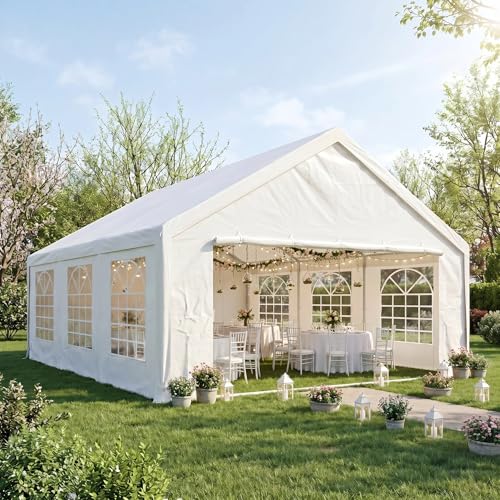
This 20×20 sibling ships with ten church windows and a powder-coated white frame, the same aesthetic language as the larger 20×40 COBIZI models. For hosts with a tighter lot or a smaller guest list, that visual consistency matters when family photos show both shelters side by side.
Six sidewalls give partial enclosure rather than full sealing, so it works well for daytime parties where airflow matters more than weather protection.
Points In Its Favor
- Compact 400-square-foot footprint fits suburban lots where 20×30 won’t fit
- Ten church windows keep the interior bright without full glass walls
- Powder-coated frame finish holds up across multiple seasons
- Reasonable setup time for a small crew on a Saturday morning
Practical Considerations
- Limited to roughly 40 guests seated, or 50 standing
- Six sidewalls won’t fully enclose in heavy weather the way a 12-wall model does
- Canopy should be thoroughly dry before storage to prevent mildew
Key Specs
Built With In Mind
Hosts planning a shower, milestone birthday, or backyard vow renewal with under 50 guests.
Reach For A Different Pick When
You expect a larger turnout or full perimeter enclosure; the COBIZI 20×40 FT Heavy Duty Party Tent handles both.
Closing out the list with another sixteen-window COBIZI 20×40, this variant brings the brightest interior of the lineup together with a powder-coated white frame. For cocktail-style receptions where guests mingle rather than sit, that open, airy feel is the whole point.
Like the other COBIZI heavy-duty models, the sandbag ballast and twelve zippered sidewalls round out a familiar setup. If you’ve used a similar COBIZI tent before, the workflow transfers directly.
What Makes Sense
- Sixteen church windows flood the interior with daylight, ideal for late-afternoon receptions
- Twelve sidewalls zip closed for dinner or open up for a flowing cocktail layout
- Frame hardware matches other COBIZI 20×40 models for easier parts sourcing
- White powder-coated finish photographs cleanly under venue lighting
Details To Watch
- More window panels mean more potential leak points during driving rain
- Standard PE canopy reads lighter than PVC, so drying before storage matters
- Full setup takes a small crew a few hours on grass or patio
Who Should Grab It
Hosts running a cocktail-style reception or daytime event who want maximum natural light inside the canopy.
Skip It When
Your event centers on a dance floor or head table; the Quictent West Coast Frame removes the center pole obstacle.
What Matters Most Before Choosing a 20×40 Party Tent
Frame Style Sets the Tone
Pole tents and West Coast frames look similar from the outside, but the interior experience differs sharply. Pole tents use interior supports, which can interrupt sight lines during a ceremony or force awkward layouts around a dance floor. West Coast frames clear the full span with rigid perimeter supports, giving you an open canvas for seating and entertainment.
For formal weddings, that distinction usually matters. For casual backyard BBQs, a pole tent’s lower cost and simpler parts count often wins.
Canopy Material Decides Longevity
PE (polyethylene) and PVC (polyvinyl chloride) are the two fabrics you’ll see most. PE canopies in the 160G to 180G range handle seasonal backyard use well and stay light to transport. PVC canopies start around 350GSM (grams per square meter, where higher numbers mean thicker fabric) and run heavier, with longer service lives under commercial rental use. For one or two events per year, PE is plenty. For weekly use or rentals, PVC pays off.
Sidewalls and Windows Shape the Feel
A 20×40 with twelve zippered sidewalls and church windows gives you three setups in one: fully enclosed for plated dinner, half-open for buffet service, or fully open for a dance floor. Fewer sidewalls means simpler but less flexible. More church windows mean brighter interiors and better daytime photos, but more seams to maintain.
Real-World Setup Time
Most 20×40 party tents need a two- to four-person crew and two to four hours for first-time assembly. Plan that timeline honestly. Crew size, ground conditions, and weather all matter. On a hard patio, expect slower staking. On grass with a calm morning, you’ll move faster.
Key Considerations Across These Picks
Pitfalls Shoppers Hit
Many first-time tent owners underestimate ground prep and stake length. Soft grass accepts standard stakes easily, but packed soil or gravel needs longer hardware or added weight at each leg. Another common miss is assuming any 20×40 tent fits any 20×40 space. Check fence setbacks, overhead wires, and tree branches before ordering. Finally, drying the canopy fully before storage is the single biggest factor in how long the fabric holds up. Folding a damp canopy leads to mildew at the seams within a season.
Where The Extra Money Goes
Spending up typically buys three things: a West Coast frame that clears the interior, a heavier PVC canopy that handles repeat commercial use, and a powder-coated frame that resists weathering longer than bare galvanized tubing. For a single annual backyard event, those upgrades rarely justify the jump. For rental operators, multiple seasonal events, or formal weddings with open-span layouts, they usually do. The honest read is that the upgrade pays off when your tent sees more than two weekends of use per year or hosts anything beyond casual seating.
Frequently Asked Questions
How many guests fit under a 20×40 party tent?
A 20×40 tent covers 800 square feet. Seated guests at round tables fit roughly 80, while banquet-style layouts with long tables can seat around 100. Cocktail or standing layouts handle 130 or more.
Can a 20×40 tent stay up year-round?
Most heavy-duty 20×40 tents are designed for temporary event use, not permanent installation. Owners commonly report shorter fabric lifespans when tents stay up through winter weather, ice, or heavy snow. Takedown between events extends canopy life considerably.
How long does setup take for a 20×40 tent?
First-time setup with a two-person crew typically runs three to four hours. A four-person crew with experience can finish in two to three hours. Plan your event timing around that window rather than rushing install the morning of.
Are party tents safe in wind?
Most 20×40 party tents handle moderate breezes when properly staked or weighted. Owners commonly report taking tents down or adding extra ballast as wind picks up beyond typical conditions. Check local weather and secure every leg before guests arrive.
Do these tents need a permit?
Permit requirements vary by city and venue. Some jurisdictions require permits for any temporary structure above a certain size, especially for public events. Check with your local municipality and venue before installing.
The Takeaway
A 20×40 party tent pays for itself the first time it replaces a venue rental, and the right model depends almost entirely on guest count, lot size, and how often you’ll set it up. Match the frame style to your layout, the canopy weight to your event frequency, and the sidewall count to your climate, and the rest is timing and a willing crew.