
A tired pump turns pool season into a chore. Cloudy water, slow circulation, and rising energy bills hit hard when the motor wheezes through the summer. Upgrading to a properly sized 2 0 Hp pool pump keeps water moving, cuts chlorine demand, and trims your electric bill on long run cycles. The list below covers above-ground, in-ground, dual-voltage, and variable-speed options so you can match a pump to the shape of your pool, your panel capacity, and the kind of upkeep you actually want to do.
How The Shortlist Stacks Up

Doheny’s 3/4 HP Above Ground Pool Pump

Hayward Super Pump InGround 0.85HP

Aquastrong Riptide 1.5 HP Dual-Speed 220V

VIVOHOME 1.0 HP 5280 GPH 115V Pump

Hayward TriStar VS 1.85 HP Variable Speed
Aquastrong Riptide 2 HP Dual-Speed 220V
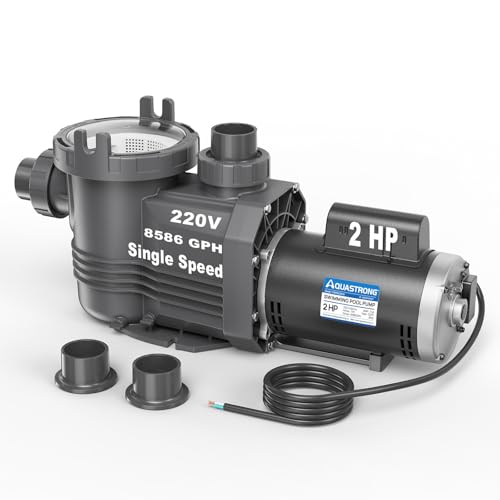
Aquastrong Riptide 2 HP Single-Speed 220V

Aquastrong Riptide 1.5 HP Single-Speed 220V
More On The Choices That Made The List
Smaller above-ground pools don’t need a thundering motor, and that’s where this Doheny’s pump earns its keep. The 3/4 HP rating pairs a stainless steel motor shaft with a reinforced thermoplastic body, so corrosion from constant chlorinated exposure stays manageable over several seasons. For a backyard pool that runs six to eight hours a day, the flow feels steady without the strain of an oversized unit.
Compared with the bigger-ticket options on this list, it’s a sensible starter pump for someone who wants dependable daily circulation without the wiring demands of a 220V setup. You give up some peak flow, but for round pools in the 15 to 21 foot range, the trade reads as fair.
Why It Works Well
- Stainless steel motor shaft resists corrosion and rust in chlorinated water
- Reinforced thermoplastic housing handles sun and chemical exposure year after year
- Lower upfront cost than major-name pumps with similar real-world output
- Compact frame fits tight equipment pads beside small above-ground pools
- Runs on standard household voltage, so no electrical work is needed
Worth Noting
- Flow rate falls short for larger in-ground pools or attached water features
- Single-speed design lacks the daily-cycle flexibility of dual-speed options like the Aquastrong Riptide 1.5 HP Dual-Speed 220V
- Strainer basket requires routine clearing in heavy debris seasons
Whose Backyard It Belongs In
Pool owners with smaller above-ground setups looking for a low-cost replacement that still moves water reliably.
Reach For A Different Pick When
Choose the Hayward Super Pump InGround 0.85HP instead if you run a mid-size in-ground pool and want quieter performance with tool-free basket access.
The Hayward Super Pump sits in that comfortable middle ground where in-ground owners usually land. The 0.85 HP output runs cooler and quieter than older single-speed workhorses, and the swing-away hand knobs on the strainer cover mean you never hunt for a screwdriver at the start of maintenance. Visible debris through the clear basket cover is a small touch that quietly saves time.
Most owners appreciate the heavy-duty motor construction when the pump lives outside through summer storms. The output is well matched to standard residential in-ground systems, and installation feels familiar to anyone who has worked on a Hayward pad before.
Strong Points
- Swing-away hand knobs remove the strainer cover without any tools
- Clear basket lid lets you spot debris buildup before it clogs the impeller
- Heavy-duty motor housing is engineered for cooler, quieter long cycles
- Service-friendly design fits common Hayward replacement parts
Points To Keep In Mind
- Single-speed operation costs more to run than the variable-speed Hayward TriStar VS 1.85 HP over a full season
- Output may feel modest for pools with attached heaters or water features
Feature Snapshot
Who Should Grab It
Homeowners with standard in-ground pools who want a serviceable, time-tested pump without paying for variable-speed electronics.
Look Elsewhere When
Step up to the Hayward TriStar VS 1.85 HP Variable Speed pump if your utility offers rebates and you want programmable efficiency.
The Aquastrong Riptide 1.5 HP dual-speed gives you the rare chance to set a pump and forget it without burning through kilowatt-hours. High speed pushes up to 6,604 GPH for filter runs and vacuuming, while low speed drops to about 3,302 GPH for quiet, energy-sipping daily circulation. A pure copper motor and self-priming housing round out a build that feels more substantial than the price suggests.
Where the Hayward Super Pump InGround 0.85HP runs one speed all day, this Aquastrong lets you tune the cycle to the work. For most pools larger than 15,000 gallons, that flexibility quickly shows up on the utility bill. You do need a 220V line at the pad, which rules out simple plug-in installs.
The Value In It
- Dual-speed motor cuts daily electricity use during long filter cycles
- Pure copper motor winding supports longer run life under heat
- Self-priming design simplifies startup after winterizing or maintenance
- Built-in filter basket catches debris before it hits the impeller
- Compatible with both in-ground and larger above-ground setups
Honest Caveats
- Requires a 220V electrical connection at the equipment pad
- Not as programmable as a true variable-speed pump like the Hayward TriStar VS 1.85 HP
- For most residential in-ground pools this size, the lower speed still moves a respectable volume
Right Fit For
Pool owners with mid-to-large systems who want quieter daily runs without stepping all the way up to variable-speed pricing.
Consider Something Else When
Pick the Aquastrong Riptide 2 HP Dual-Speed 220V if you need higher peak flow for waterfalls, long plumbing runs, or solar heating.
If the idea of calling an electrician makes the whole project stall, the VIVOHOME 1.0 HP sidesteps that headache entirely. It runs on standard 115V household current, so most owners can drop it in place and plug it into an existing outdoor outlet. The 5,280 GPH flow handles mid-size above-ground pools comfortably, and the ETL and DOE certifications confirm it meets baseline safety and efficiency standards.
For a first-time pool owner setting up a backyard system, this is one of the more forgiving installs on the list. You trade off the heavy-duty motor build of the Hayward line and the dual-speed flexibility of the Aquastrong series, but the trade feels reasonable for simpler above-ground setups.
Positive Takeaways
- Plugs into a standard 115V outlet with no electrician visit required
- 5,280 GPH flow covers most above-ground pools up to about 18 feet round
- ETL and DOE certifications confirm safety and energy compliance
- Integrated strainer basket keeps routine maintenance quick
Practical Considerations
- Single-speed operation costs more in electricity than the Aquastrong Riptide 1.5 HP Dual-Speed 220V on long cycles
- Best installed within roughly 10 feet of the pool for proper priming
- Thermoplastic housing is durable but lighter than cast-iron commercial units
Quick Facts
Made For
First-time pool owners and rental-property setups where simple plug-in installation matters more than maximum efficiency.
Swap It Out When
Upgrade to the Doheny’s 3/4 HP Above Ground Pool Pump if your pool is on the smaller side and you want a slightly lower entry price.
Variable-speed pumps used to be a luxury, and the Hayward TriStar VS 1.85 HP is the version that finally feels like the new standard. It replaces pumps up to 1.5 full-rate or 2.0 max-rate HP, with a permanent-magnet, totally enclosed fan-cooled motor that runs at the speeds you program. Long, slow cycles become the default, and the energy savings on a full summer can be substantial.
This is a noticeable step above the Hayward Super Pump InGround 0.85HP in both build and operating cost. For owners planning to stay in the home for several more summers, the efficiency curve tends to pay back the upfront premium over time, especially where local utilities offer rebates.
Features That Help
- Variable-speed programming matches motor output to the actual task
- Permanent-magnet motor delivers strong torque at low RPMs
- Totally enclosed fan-cooled design extends motor life in hot equipment pads
- Replaces most 1.5 to 2.0 HP pumps without plumbing changes
- May qualify for local utility rebates depending on your region
Trade-Offs To Consider
- Higher purchase price than single-speed pumps like the Hayward Super Pump InGround 0.85HP
- Programming interface takes longer to learn than a basic on-off switch
- Requires proper 220V wiring and a compatible controller or timer
Key Attributes
Best Suited To
Energy-conscious in-ground pool owners who plan to optimize run cycles and may benefit from utility rebate programs.
A Better Fit Elsewhere
Choose the Aquastrong Riptide 1.5 HP Dual-Speed 220V if you want lower operating cost than single-speed without the full programming depth of variable-speed.
Large pools, raised plumbing, and water features all push a pump to work harder than mid-size residential units are built for. The Aquastrong Riptide 2 HP dual-speed handles that load with up to 8,586 GPH on high and roughly 4,427 GPH on low. The pure copper motor handles continuous cycling, and the self-priming body makes start-up after a cleanout or off-season much simpler.
Think of this as the workhorse sibling of the 1.5 HP Aquastrong on this list. If your setup includes a raised spa, a long pipe run to an equipment shed, or solar panels that need serious flow to activate, the extra head pressure here earns its keep. For a flat yard with a simple pad, you may be paying for capacity you don’t use.
Notable Upsides
- Up to 8,586 GPH on high speed handles demanding hydraulics
- Low speed around 4,427 GPH keeps daily cycles energy-conscious
- Pure copper motor supports extended run times under heavy load
- Self-priming housing simplifies restart after maintenance
- Integrated filter basket protects the impeller from large debris
Some Limits To Know
- Requires a 220V circuit at the equipment pad
- May over-spec a basic above-ground pool with no extra features
- Higher output means larger strainer basket clearings during leaf season
Feature Card
Who Will Love This
Owners running large pools, raised spas, or setups with long plumbing runs that demand serious head pressure.
Not Your Match When
The Aquastrong Riptide 2 HP Single-Speed 220V makes more sense if you want the same throughput with simpler controls and lower upfront cost.
Sometimes you just want a pump that turns on and pushes water without a menu of speed settings. The single-speed 2 HP Aquastrong Riptide delivers that simplicity, paired with up to 8,586 GPH of flow and the same pure copper motor build as its dual-speed sibling. Setup is straightforward, and there’s no interface to learn beyond a basic timer.
For owners who run their pump on a fixed daily schedule and rarely tweak it, the streamlined approach can make sense. You give up the daily-cycle savings of the dual-speed version, but you gain a simpler ownership story and a slightly lower entry cost.
The Upside
- Up to 8,586 GPH flow covers demanding residential and small commercial setups
- Pure copper motor supports long run times with steady output
- Self-priming housing makes seasonal start-up painless
- Simple controls pair well with standard mechanical timers
Where It May Fall Short
- Single-speed design drives higher daily electricity use than the Aquastrong Riptide 2 HP Dual-Speed 220V
- Requires a 220V connection at the equipment pad
- No low-speed option for quieter evening cycles near outdoor living areas
Perfect Match For
Pool owners who prefer set-and-forget operation and want the throughput of a 2 HP motor without programming complexity.
Where A Sibling Pick Shines
Move up to the Hayward TriStar VS 1.85 HP Variable Speed pump if your goal is energy savings through programmable speed settings.
The 1.5 HP single-speed Aquastrong Riptide sits in a comfortable spot between the entry-level Doheny’s and the high-output 2 HP models above. Up to 6,604 GPH handles most mid-size in-ground and larger above-ground pools, and the pure copper motor is the same component found in the dual-speed version. Self-priming startup and a built-in filter basket round out a familiar ownership experience.
Compared with the VIVOHOME 1.0 HP 5280 GPH 115V pump, this Aquastrong requires a 220V line but moves noticeably more water. For owners with a 220V pad who don’t need the dual-speed control, this is the kind of dependable mid-tier workhorse that quietly does its job all summer.
What It Does Well
- Up to 6,604 GPH flow suits mid-size pools and larger above-ground setups
- Pure copper motor winding supports steady long-cycle operation
- Self-priming design simplifies post-maintenance startup
- Built-in filter basket protects the impeller between cleanings
Things To Weigh
- Single-speed design costs more in electricity than the Aquastrong Riptide 1.5 HP Dual-Speed 220V over time
- Requires a 220V circuit at the equipment pad
- Not the right match for large in-ground pools with attached water features
Built With In Mind
Mid-size pool owners with existing 220V wiring who want copper-motor build quality without dual-speed controls.
Skip It When
The Hayward Super Pump InGround 0.85HP is a better fit for smaller in-ground pools where the quieter tool-free strainer design matters more than peak flow.
What Matters Most Before Choosing 2 0 Hp Pool Pumps
Pool Size And Hydraulic Demand
The right horsepower starts with the volume of water you need to turn over in roughly eight hours. Smaller above-ground pools often run fine on a 3/4 to 1 HP pump, while mid-size in-ground systems usually want 1 to 1.5 HP, and feature-heavy setups with raised spas or solar heating need closer to 2 HP. Over-sizing a pump can push more water than your filter is designed to handle, so matching output to plumbing and filter capacity matters as much as raw GPH numbers.
Voltage And Wiring
115V pumps like the VIVOHOME 1.0 HP plug into standard outdoor outlets with no electrician visit. 220V pumps like the Aquastrong Riptide series and the Hayward TriStar VS require a dedicated circuit, which most existing in-ground pads already have. Confirm your pad’s wiring before settling on a model, since converting a 115V outlet to 220V adds real cost to the project.
Speed Control And Operating Cost
Single-speed pumps run at full output for the entire cycle, which costs more in electricity over a full summer. Dual-speed options like the Aquastrong Riptide 1.5 HP Dual-Speed 220V add a quieter low-speed mode for daily circulation. Variable-speed pumps like the Hayward TriStar VS 1.85 HP let you program custom speeds for heating, filtering, and cleaning tasks, often paying back the price difference through utility savings.
Build Quality And Maintenance
A pure copper motor winding, stainless steel shaft, and reinforced thermoplastic housing all extend service life in chlorinated water. Look for a clear strainer basket cover so you can spot debris buildup at a glance, and confirm that replacement parts like lids and seals are easy to source for the brand you choose.
Key Considerations Across These Picks
Mistakes Worth Dodging
The most common slip-up is buying more pump than the pool actually needs, which wastes electricity and can over-pressurize the filter. Another trap is ignoring voltage requirements and ending up with a 220V unit on a 115V pad, forcing a costly electrical upgrade. Finally, some shoppers skip the strainer basket check and end up with a design that’s awkward to open or prone to leaking around the lid seal.
When Paying More Pays Off
Higher-tier pumps like the Hayward TriStar VS 1.85 HP earn their premium through variable-speed programming, longer motor life, and lower long-term electricity use. If your pool runs eight or more hours a day and you live in a region with high utility rates, the upgrade pays back faster than most owners expect. For smaller above-ground pools with shorter cycles, the simpler mid-tier Aquastrong and Doheny’s options usually deliver better overall value.
Frequently Asked Questions
What pool size needs a 2 0 Hp pool pump?
A 2 HP pump typically fits in-ground pools in the 20,000 to 40,000 gallon range, especially those with raised spas, water features, or long plumbing runs. Smaller above-ground pools usually do fine on 3/4 to 1 HP units.
Can I install a 220V pool pump on a 115V circuit?
No. A 220V pump requires a dedicated dual-pole circuit at the equipment pad, and running it on 115V will cause the motor to stall or fail. Have an electrician verify your panel capacity before choosing a 220V model.
How long should a pool pump run each day?
Most residential pools aim for one full turnover every 24 hours, which usually means six to ten hours of runtime depending on pool size and pump flow rate. Variable-speed pumps can stretch that cycle longer at lower speeds for better efficiency.
Are variable-speed pumps worth the extra cost?
For pools that run long daily cycles, variable-speed pumps often pay back their higher upfront cost through lower electricity bills over several seasons. Smaller pools with short cycles usually don’t recoup the premium as quickly.
How do I know when to replace my pool pump?
Common signs include grinding or humming noises, visible leaks around the seal, the pump losing prime repeatedly, or noticeably weaker flow at the returns. Pumps older than eight to ten years with any of these symptoms are usually worth replacing.
Bottom Line
Matching the right 2 0 Hp pool pump to your pool size, electrical setup, and runtime habits makes the difference between clear water and constant frustration. Small above-ground pools do well with the Doheny’s or VIVOHOME, mid-size in-ground systems lean toward the Hayward Super Pump or Aquastrong 1.5 HP models, and energy-focused owners get the most from the Hayward TriStar VS. Pick the pump that fits your pad, run it on a sensible schedule, and the rest of the season takes care of itself.