
Choosing a tent that comfortably sleeps ten people without turning your campsite into a cluttered mess is trickier than it sounds. Big families, friend groups, and outdoor event hosts often find themselves juggling headcount, weather, setup time, and pack-down logistics on the same weekend. The picks below cover a range of styles, from inflatable canvas glamping shelters to cabin-style family tents, so you can match the shelter to the trip instead of forcing the trip to fit the tent.
A Closer Look At The Lineup

Coody Premium Inflatable Canvas Air Tent

COBIZI 10 Person Camping Tent
KTT Extra Large Family Cabin Tent (A)
KTT Extra Large Family Cabin Tent (Style-B)
KTT Extra Large Cabin Tent 10-12-14 Person

KTT Extra Large Cabin Tent With Bay Windows

KTT Extra Large Tent With Dual Bay Windows

KTT Extra Large Cabin Tent (Style-B V2)
Taking A Closer Look At The Options
The Coody Premium Inflatable Canvas Air Tent is a different animal than the lightweight nylon options you’ll see elsewhere on this list. It uses inflatable air beams to replace traditional poles, which makes the structure rise in a single push instead of threading a maze of fiberglass through sleeves. The canvas body is geared toward extended outdoor living, so families or glamping hosts who treat a campsite like a temporary cabin will appreciate the roomier interior feel.
A built-in stove jack is the headline detail, letting you run a flue pipe from a small wood stove inside the tent for cooler trips. The breathable TC (polyester-cotton) blend is a smart match for that feature, helping manage condensation around a heat source. Owners commonly note the heavier packed weight compared to nylon shelters, so this one fits car camping more than backpacking.
Useful Strengths
- Air-beam frame removes the need to wrestle with rigid poles, which makes setup quicker for groups unfamiliar with tent pitching.
- Stove jack compatibility opens up four-season use for campers who want a heat source inside the shelter.
- Canvas construction tends to feel quieter in wind than flapping nylon and offers better temperature buffering through cool nights.
- Spacious interior footprint allows cots, chairs, and gear to coexist without tripping over sleeping bags.
Trade Offs
- Heavy packed weight makes it impractical for anything beyond car-accessible campsites.
- Canvas requires thorough drying before storage to prevent mildew on the fabric seams.
- Air-beam inflators may need occasional pressure checks during long stays.
Quick Facts
Who Will Love This
Glampers, cold-weather campers, and families who want a tent that feels more like a canvas lodge than a sleeping pod will appreciate the comfort-first approach.
Consider Something Else When
You’d rather skip the heavy packed weight, in which case the COBIZI 10 Person Camping Tent is a lighter, quicker-deploy alternative for festival and beach weekends.
Where the Coody leans into long-stay canvas comfort, the COBIZI 10 Person Camping Tent takes the opposite approach. It is a 190T polyester shelter (polyester fabric measured by thread count, where higher numbers mean denser weave) built around quick-release hardware that gets the frame standing in a fraction of the time traditional poles require. Festival crews, beach weekends, and travelers who arrive after dark will appreciate being able to pitch camp without dragging the process into dinner.
The removable rainfly and PU-coated floor are designed for three-season conditions, meaning everything except deep winter and heavy snow. Two large mesh screen windows give you cross-ventilation when the weather cooperates. Compared to the Coody above, you give up the stove jack and canvas feel, but you gain a much lighter pack size for trips where every trunk inch counts.
Noteworthy Benefits
- Quick-release frame system is built for setup without tools, ideal for groups arriving tired from the road.
- Removable rainfly lets you shed weight in clear weather and maximize airflow.
- Two large mesh windows create cross-breeze potential that helps on warm summer nights.
- PU-coated construction adds a layer of water resistance beyond bare polyester.
Points To Keep In Mind
- Three-season rating means it’s not the right shelter for snow load or extended sub-freezing trips.
- Polyester body handles UV exposure reasonably well but should be dried fully before storage to avoid mildew on the coated seams.
Feature Snapshot
Right Fit For
Festival-goers, beach campers, and families chasing quick weekend trips who want a tent that pitches itself before the cooler runs warm.
A Better Fit Elsewhere
You want stove-heated winter camping, in which case the Coody Premium Inflatable Canvas Air Tent offers a heat-source-ready shelter for cold-weather use.
The KTT Extra Large Family Cabin Tent (A) is where this list pivots from expedition-style shelters to plain family logistics. With an inside dimension around 12.5 by 8.5 feet and a roughly 6.2-foot peak height, it functions like a small cabin: partition curtain in the middle, three doors, and three mesh windows so two families can share the space without bumping into each other at 6 a.m.
Straight-wall construction (vertical side walls instead of the sloped walls found on dome tents) keeps the usable floor area generous, and the mesh door panels let you trade privacy for breeze. Where the COBIZI above is built for speed, this KTT leans into roominess and routine family use. For most backyards and established campgrounds, the size is comfortable without dominating the site.
The Good Stuff
- Internal divider curtain turns one large room into two zones, useful for separating kids from adults or changing areas from sleeping areas.
- Three doors reduce the morning traffic jam when everyone exits at once.
- Straight-wall design preserves standing and sitting headroom along the edges, not just in the center.
Small Caveats
- Heavier packed weight than a quick-pitch shelter, so it’s not ideal for trail-to-trail moves.
- Two-room divider reduces total open space when closed, which may feel tight if a family of eight all wants to share one room.
Whose Shelf It Belongs On
Families with mixed-age kids, or two small families camping together, who want a cabin-style layout that respects everyone’s morning routine.
Reach For A Different Pick When
You need a much larger footprint for reunion-style gatherings, in which case the KTT Extra Large Cabin Tent 10-12-14 Person provides nearly twice the floor area.
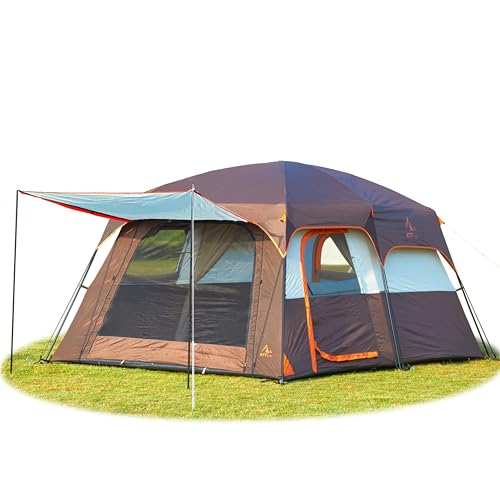
The Style-B variant of the KTT cabin line keeps the same 12.5 by 8.5-foot footprint and straight-wall profile as the previous pick but trims a few features to land in a more accessible price tier. The 8-10 person capacity still accommodates three doors, three mesh windows, and a divider curtain. It’s the practical version of a family cabin tent for shoppers who don’t need extras like extended storage or larger vestibules.
Two top corner hooks and a middle hook per room offer lantern hanging points, and the PE-coated floor (polyethylene coating that resists ground moisture) helps protect against morning dew. Compared to the KTT (A) above, you’re sacrificing some accessories rather than structural quality, which is a fair trade for casual campers.
Useful Highlights
- Lower entry price than other KTT cabin models without sacrificing the straight-wall footprint.
- Mesh windows and PE-coated floor keep condensation and ground moisture manageable in mild conditions.
- Repair patches included in the accessory kit address small field damage without a separate purchase.
Honest Caveats
- Seam sealing at first use is commonly suggested by owners to reach the rated waterproof performance.
- Accessories are minimal, so plan on buying a footprint tarp separately for rocky or rough terrain.
Technical Sheet
Built With In Mind
Budget-conscious families who want cabin-style space and a proven footprint without paying for premium upgrades they won’t use.
Swap It Out When
You want an extra-large cabin for group reunions, in which case the KTT Extra Large Cabin Tent 10-12-14 Person stretches the floor to roughly 16 by 11 feet.
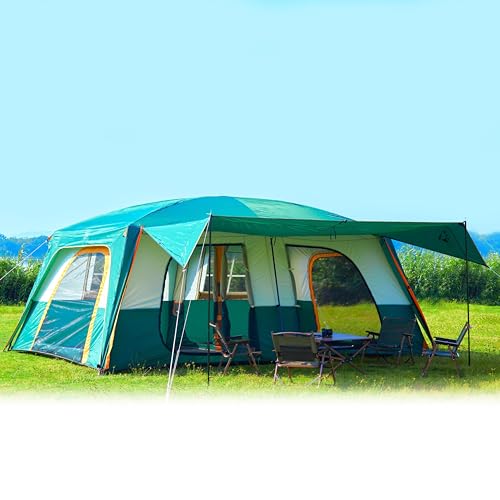
The 16 by 11-foot KTT Extra Large Cabin Tent 10-12-14 Person is the biggest shelter on this list, with a peak height around 7.4 feet that lets most adults stand upright almost everywhere. The straight-wall design is essential at this size because sloped walls would waste usable floor area. Two rooms separated by a curtain, three doors, three windows, plus a large back window give the tent real livability for groups that think of camping as indoor time outside.
Where the smaller KTT cabins serve families of four to six comfortably, this one handles reunion-style trips where cousins, grandparents, and family friends all want a bed under one roof. Eight top corner hooks and a middle hook give plenty of lantern and gear-hanging options. Expect the packed weight and footprint to demand a vehicle with real cargo space.
What It Does Well
- Massive floor area fits four queen air mattresses with room to walk between them.
- 7.4-foot peak height means adults don’t have to crouch while moving around.
- Multiple doors and windows let different zones of the tent ventilate independently.
- Plenty of interior hanging points for lights, fans, and gear organizers.
Possible Compromises
- Requires a large flat site, which can be harder to find on crowded summer weekends.
- Setup involves more poles than smaller tents, so plan extra time at first pitch.
Feature Snapshot
Best Suited To
Multi-family reunions, church retreats, and large friend groups who prioritize shared living space over pack-down simplicity.
Look Elsewhere When
You don’t need 16 feet of width, in which case the KTT Extra Large Family Cabin Tent (A) offers a similar two-room layout in a smaller footprint.
The KTT Extra Large Cabin Tent With Bay Windows lands between the smaller KTT cabins and the 16-foot monster, offering a 14.1 by 10-foot footprint with a 6.58-foot peak height. The defining feature is the pair of bay windows on the side walls, which let you prop the panels outward to create small observation nooks and pull in cross-breezes that typical flat windows don’t deliver.
Three doors, three mesh windows, and the bay configuration make this one of the better-ventilated cabins on the list. The divider curtain splits the space into two rooms for adults-and-kids separation. Compared to the Style-B above, you get those unique bay window openings in exchange for a slightly larger packed size.
Practical Pluses
- Bay windows create usable interior nooks and let breezes reach deeper into the shelter.
- 14.1-foot length fits four queen air mattresses with walking room in between.
- Three doors keep morning and evening traffic flowing without a single bottleneck.
Worth Noting
- Bay window poles add a few extra pieces to the setup, which you may find fiddly on the first pitch.
- Mesh-heavy ventilation means rain enters more easily if you leave bay panels open in a storm.
Who Should Grab It
Warm-weather family campers who want maximum airflow and a fun observation nook for the kids to call their own.
Not Your Match When
You camp in regions with frequent heavy rain, in which case the KTT Extra Large Tent With Dual Bay Windows adds a fuller rainfly for wetter conditions.
The 12-14 person KTT with dual bay windows builds on the previous design by adding a full-coverage rainfly and a second bay window. The 14.1 by 10-foot floor holds four full air mattresses, and the straight-wall profile keeps the perimeter usable rather than sloped. Eight top corner hooks and a middle hook give you enough interior rigging that the whole tent can stay organized even with a dozen sleepers inside.
The full rainfly is the key upgrade over the bay-window model above. Where that tent is optimized for clear, warm conditions, this one extends into shoulder seasons and drizzle-prone regions without leaking at the seams. It’s the right shelter for groups who camp in unpredictable coastal or mountain weather where afternoon showers are the rule rather than the exception.
What Works In Its Favor
- Full rainfly coverage protects the entire tent body during sustained wet weather.
- Dual bay windows offer symmetrical ventilation so neither side of the tent feels stagnant.
- Plenty of interior hanging points keep lights and gear off the floor.
Trade-Offs To Consider
- Larger packed size compared to the bay-window model, which can complicate smaller vehicle loads.
- Two bay windows mean more poles to manage on setup than a single-window cabin tent.
Made For
Large groups camping in regions with frequent rain, where full-coverage weather protection is non-negotiable.
Another Choice May Suit
You’re mostly camping in dry summer conditions, in which case the KTT Extra Large Cabin Tent With Bay Windows offers similar airflow without the full rainfly weight.
Closing out the list is the Style-B V2 KTT cabin tent, a 14 by 10-foot straight-wall shelter with a 6.58-foot peak height and the familiar two-room, three-door, three-window layout. The double-layer rainfly and inner tent construction help the shelter handle light rain and morning dew without dripping through to sleeping bags.
It shares footprint DNA with the bay-window model above but sticks to flat windows, keeping the pole count lower for faster setup. For repeat family campers who pitch the same tent two or three times a season, that simplicity pays off. The 12-person capacity means it can host a typical family plus a few cousins without feeling cramped.
The Helpful Details
- Double-layer construction improves rain resistance compared to single-skin designs.
- Straight walls preserve usable floor space for cots, gear, and luggage.
- Three-door layout simplifies entry and exit for large families.
- 12-person capacity balances family comfort with a manageable packed size.
Where It Is Less Suited
- Flat window design delivers less airflow than the bay-window cabins in the same lineup.
- Repair materials may need to be purchased separately for long-term field maintenance.
Feature Rundown
Perfect Match For
Repeat family campers who want a familiar cabin layout with reliable double-layer rain protection across multiple trips a year.
Where A Sibling Pick Shines
You prioritize ventilation and unique windows, in which case the KTT Extra Large Cabin Tent With Bay Windows provides more airflow options in a similar footprint.
What To Weigh Before Choosing A 10 Person Tent
Capacity Claims Versus Real Sleep Space
Manufacturer headcounts are aspirational figures, often calculated by tight sleeping-bag dimensions rather than air mattress or cot footprints. A tent rated for ten people usually fits eight sleeping adults comfortably with space left over for a duffel bag or two. If your group plans to use air mattresses, subtract roughly two people from the rating to estimate realistic capacity. Family campers often find a “10 person” tent sleeps six people with gear, which is exactly the right size for a family of four plus occasional guests.
Climate And Season Suitability
Three-season shelters like the COBIZI handle rain, wind, and mild temperatures but won’t survive heavy snow loads. Canvas air tents like the Coody extend further into shoulder seasons and can support a wood stove for genuine winter camping. Coastal campers dealing with salt spray and wind need reinforced pole structures, while desert campers prioritize mesh ventilation and reflective rainfly coverage. Match the shelter’s season rating to your typical trip calendar rather than wishful thinking.
Setup Logistics For Groups
Larger tents require more hands and more time, with simple math guiding the choice: count the number of adults who can realistically help at arrival. A quick-release polyester shelter can be pitched by two adults in a few minutes. A 16-foot straight-wall cabin tent realistically needs three to four adults and a longer setup window. Factor in that tired kids and late arrivals rarely help, so a tent pitched in twenty minutes by two people is worth more than one with extra space that takes an hour for a full crew.
Site Selection And Storage Footprint
The biggest tents on this list, especially the 16-foot KTT cabin, demand flat, open campsites that aren’t always available on peak summer weekends. Reserve early or scout smaller alternatives when popular campgrounds book up. Storage is the hidden cost: a 14-foot cabin packed down can fill a large SUV cargo area, while quick-pitch polyester tents fit in a compact trunk. Frequent travelers should measure their vehicle’s cargo space before committing to a family cabin tent.
Smart Considerations Across These Picks
Mistakes Worth Dodging
The most common buying mistake is trusting the printed headcount without thinking about air mattresses, gear, or walking space. Shoppers also tend to overlook mesh ventilation on warm-weather tents, only to discover condensation issues on the first humid night. Finally, ignoring pole and stake quality leads to frustration in windy conditions; heavier-gauge poles and full-coverage rainflies are worth the small premium for anyone camping in unpredictable weather.
Why Top Tier Costs More
Premium cabin tents earn their higher price through stronger Oxford polyester (a heavier, more abrasion-resistant fabric than standard polyester), thicker pole structures, and reinforced seams. The upgrade shows up over time: better materials hold up across multiple seasons instead of failing at the seams after a year of storage and setup cycles. When your group includes kids, pets, or expensive gear, the extra cost buys genuine reliability rather than just a bigger footprint.
Frequently Asked Questions
How big of a tent do I need for 10 people?
Plan on a tent with at least 12 by 10 feet of floor space if everyone will sleep on individual pads. If you’re using air mattresses, give yourself roughly 100 square feet per sleeper so people can move around without climbing over each other. For gatherings where people spend more time inside than outside, err toward the larger end of the size range.
Can 10 person tents handle rain and wind?
Most 10 person tents handle light to moderate rain well, especially those with full-coverage rainflies and PU-coated floors. Heavy wind requires proper staking, guy lines, and site selection behind natural windbreaks. Avoid setting up any large cabin tent on exposed ridgelines where gusts catch the broad side of the shelter.
How long does it take to set up a 10 person tent?
Quick-pitch polyester tents typically take two adults about 15 to 30 minutes from bag to standing. Larger straight-wall cabin tents require 30 to 60 minutes with three or four adults helping. First-time setup always runs longer, so practice in the backyard before relying on a tight arrival schedule at a busy campground.
Are 10 person tents suitable for winter camping?
Only winter-specific or four-season tents handle snow loads and sub-freezing temperatures safely. Canvas air tents with stove jacks extend further into shoulder seasons than polyester shelters. For genuine snow camping, look for reinforced pole geometry and dedicated snow flaps rather than relying on a three-season cabin tent.
How do I maintain a large family tent?
Dry the tent fully before folding for storage to prevent mildew on coated fabrics and mesh panels. Inspect seams once a year and re-seal any areas showing wear with a compatible seam sealer. Store the tent loosely in a breathable bag rather than a tight compression sack so the fabric doesn’t crease permanently over the off-season.
The Takeaway
A reliable 10 person tent comes down to matching headcount, climate, and setup capacity to your group’s habits rather than chasing the biggest footprint. Canvas and cabin options serve extended-stay comfort, quick-pitch polyester shelters serve festival and weekend pace, and bay-window cabins offer a middle ground for warm-weather families. Pick the shelter that fits your usual trip style, and the campsite will feel like an upgrade rather than a compromise.