
Picture a wall at the campsite going blank right after sunset. Phones show menus, lanterns flicker, and the whole group crowds around a six-inch screen. A purpose-built camping projector flips that moment: a 60-to-120-inch image draped across the side of a tent, a tailgate, or a sheet clipped between two trees, with audio loud enough to carry over a crackling fire.
The picks below cover the trade-offs that actually matter outside the living room: battery runtime versus brightness, Bluetooth speaker pairing versus onboard audio, Wi-Fi streaming versus casting from a phone, and the long list of small frustrations when a unit is designed primarily for indoor use. Each entry here was chosen for genuine outdoor value, not spec-sheet theater.
A Fast Comparison Of The Options

Soundcore Nebula P1 Portable Projector with Detachable Speakers

VOPLLS 4600 ANSI Smart 4K Projector with WiFi and Bluetooth

Lisowod Outdoor Projector with WiFi and Bluetooth, 4K Built-In Apps

NEBULA Capsule 3 Portable Projector, Netflix-Certified
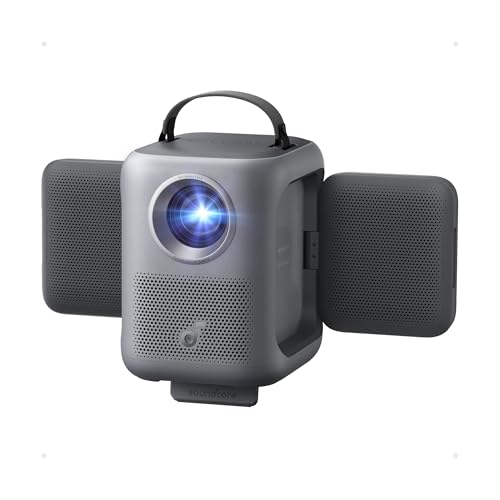
Soundcore Nebula P1i Portable Projector with Flippable Speaker

TOPTRO Portable Smart Projector with Google TV 14.0 and Dolby
More On The Choices That Made The List
The Nebula P1 solves a problem most camping projectors ignore: built-in speakers that point the wrong direction. Its 20-watt stereo pair detaches from the main body, so one module can sit on a picnic table while the other rests near the cooler, with the projector itself perched on a tripod between them. For a campsite spread across ten feet of dirt and folding chairs, that flexibility matters more than a slightly sharper image.
Compared with the smaller Capsule 3 reviewed later, this unit trades ultimate portability for real volume and wider placement. Dolby Audio processing gives dialogue weight outdoors, where wind and crackling wood usually eat midrange, and the wireless link between the speakers stays stable across short distances. For families running a sheet off the back of an SUV, the P1 is the easier night.
Benefits That Matter
- Detachable 20W wireless speakers create true stereo separation across a campsite, not just louder mono.
- Dolby Audio tuning keeps voices intelligible when ambient noise from wind and fire would muddy cheaper drivers.
- Wireless playback up to 20 hours means movie night plus an afternoon of music from a single charge.
- Modular layout lets each speaker move to where the audience actually sits, instead of forcing everyone to crowd the projector.
Things To Consider
- Carrying three pieces (projector plus two speakers) takes more pack space than a single-body unit like the Capsule 3.
- Owners commonly report that pairing the speakers for the first time takes a couple of attempts in cold weather.
Built With In Mind
Families or friend groups who want real stereo spread and don’t mind carrying an extra module or two on a car-camping trip.
A Better Fit Elsewhere
Solo backpackers packing tight should look at the NEBULA Capsule 3 instead, since its all-in-one form saves both space and setup time.
Brightness is the single biggest reason camping nights go wrong, and the VOPLLS unit leans into that harder than anything else here. At 4600 ANSI lumens (a measure of light output, where higher numbers beat ambient light better), it pushes a usable image well past sunset, into the blue-hour window when most battery-powered portables wash out completely. For tailgates and driveway parties that start before full dark, that headroom is the difference between a clear picture and a pale smear.
The trade-off is size and power. This is closer to a small living-room projector that happens to have Wi-Fi and Bluetooth, and at roughly the size of a shoebox, it needs a flat surface and AC power more than a tent stake. For campers with a generator, a power station, or an outlet at the site, it delivers image quality the truly portable picks on this list cannot match.
The Practical Payoff
- 4600 ANSI lumens hold up against dusk light and porch lamps, extending the viewing window well beyond full dark.
- Full 4K input with HDR10+ support pulls detail out of streaming content that 1080P portables simply flatten.
- Built-in Wi-Fi and Bluetooth cut the cable clutter between phone, projector, and an external speaker.
- Auto-focus saves real setup time on uneven ground where the unit shifts after placement.
Honest Caveats
- Battery-free design means a power station, inverter, or AC outlet is mandatory, ruling out backcountry use.
- The larger body is heavier than the capsule-style picks, so backpackers will feel the weight on a hike-in site.
- Lens cleaning on the road gets tricky without a microfiber cloth on hand, since dust settles fast in open environments.
Right Fit For
Car campers, RV travelers, and driveway-party hosts who already have a power source and want image quality closer to a living-room setup.
Skip It When
Backpackers should reach for the NEBULA Capsule 3, which trades peak brightness for true battery-powered portability.
The Lisowod entry sits in the middle of the pack on portability, but jumps ahead on software. With Whale OS 3.0 running on a dedicated LX2 chip, the projector behaves more like a streaming stick bolted to a light engine, which removes the phone-as-remote dance that frustrates outdoor setups. Native 4K support means content scales up cleanly on a sheet or a wall.
Unlike the bright but plug-bound VOPLLS unit, this one carries its own battery-friendly smart platform, so a campsite Wi-Fi hotspot or a phone’s hotspot is enough to start streaming. Setup is the kind of thing most reviewers forget to mention until something breaks: a smart interface that boots into real apps beats wrestling with screen-mirroring lag when the kids are losing patience.
Standout Benefits
- Native app support removes the need to cast from a phone, which often fails on weak campsite connections.
- 4K input keeps detail intact on screens stretching past 100 inches across a tent side or garage door.
- Wi-Fi and Bluetooth are built in, so pairing a portable speaker for louder outdoor audio takes seconds.
- The dedicated smart chip keeps menus responsive where weaker processors tend to stutter under load.
A Few Limitations
- Battery runtime is shorter than dedicated portable units, so a power bank is wise for full-length features.
- The smart OS receives occasional updates that may temporarily change the menu layout after a trip.
Made For
Households that want a true app-first outdoor projector and are willing to bring a small power bank along for longer nights.
Where Another Pick Suits Better
Anyone chasing maximum lumen count for dusk viewing should look at the VOPLLS projector instead, since brightness is its whole point.
The Capsule 3 earns its name from a soda-can footprint that genuinely fits in a jacket pocket or a side pouch of a backpack. That changes who the projector is for: hikers, van-lifers, and anyone carrying gear any distance. Built-in Google TV plus a Netflix license means streaming starts the moment the unit boots, with no side-loading or sideloaded app workarounds.
Resolution lands at 1080P with 200 ANSI lumens, which sounds modest next to the VOPLLS entry reviewed earlier. In practice, that pair makes sense indoors but struggles in any lingering daylight. The honest expectation is dusk-only viewing, after which the image looks clean on screens up to 120 inches.
Notable Upsides
- Pocket-sized body is the lightest option on this list, ideal for hike-in campsites and bikepacking setups.
- Official Netflix certification removes the app-loading headaches that plague uncertified portables.
- Google TV integration brings a familiar interface plus voice search for hands-free control around a campfire.
- Battery-powered playback keeps the unit usable in tents, vehicles, and other spots with no power outlet.
Points To Note
- 200 ANSI lumens forces full-dark viewing; any ambient light washes the picture out quickly.
- Onboard audio is small, so an external Bluetooth speaker is wise for groups larger than two or three people.
Who Should Grab It
Backpackers, tent campers, and van-dwellers who prize pack size over brightness and stream after sunset anyway.
Look Elsewhere When
Hosts running early-evening viewings in open driveways should consider the VOPLLS projector, since it wins outright on light output.
The P1i is the smaller sibling of the Nebula P1 reviewed first, trading the detachable-speaker setup for a single rotating audio module. The speaker pivots 90 degrees side to side and 200 degrees vertically, which sounds gimmicky until it gets used: aim it at the seating area, not at the projection surface, and the audio goes where ears actually are. The 20W (2 x 10W) Dolby Audio configuration holds up well for groups of moderate size.
At 7.3 lb and roughly 183 x 204 x 228 mm, it’s cube-shaped and packable in a way that fits between camp chairs and a cooler. Brightness drops to 380 ANSI lumens, TÜV-certified, while resolution stays at 1080P Full HD. Think of it as the right compromise when detachable audio is too much hassle but built-in mono is too compromised.
Notable Gains
- Rotating speaker module keeps audio pointed at the audience even when the projector faces a wall or screen.
- Compact 7.3 lb cube fits into most camping kits without a dedicated carrying case.
- TÜV-certified 380 ANSI lumens strike a usable balance between brightness and battery life for full-dark viewing.
- 1080P Full HD resolution keeps streamed content looking sharp on screens up to roughly 100 inches.
Soft Spots
- Single-speaker design can’t match the stereo spread of the larger Nebula P1 with its detachable pair.
- DC plug-in power limits placement to within cord reach of an outlet or power station.
Best Suited To
Tent campers and van dwellers with tight floor space who still want directional audio without hauling multiple speaker modules.
Reach For A Different Pick When
Anyone needing true stereo separation across a wide campsite should move up to the original Soundcore Nebula P1, which carries that workload.
The TOPTRO entry closes out the list with the most ambitious smart platform of the group. Running Google TV 14.0 on Android, with 1GB of RAM and 32GB of storage, it offers direct access to 10,000-plus apps including Netflix, YouTube, Prime Video, Disney+, Sling TV, Hulu with Live TV, and YouTube TV, all from the home screen. Voice control through the Google Assistant rounds out a software package the more portable picks can’t match.
Compared with the Lisowod smart projector earlier, this one leans further into the living-room replacement role: short-throw optics (meaning a large image from a short distance), auto focus, keystone correction, and ceiling-mount versatility for both indoor and outdoor use. For users who already live inside the Google TV ecosystem, the experience is consistent from the family room to the campsite.
Where It Delivers
- Google TV 14.0 unlocks a massive native app library without any phone mirroring or streaming-stick workaround.
- Short-throw optics suit tight tent interiors and small van setups where a long throw distance isn’t available.
- Auto focus and keystone correction cut setup time on uneven ground where the unit shifts after placement.
- Voice control through Google Assistant removes the need for a remote when hands are dirty or full.
Practical Considerations
- Battery life is shorter than dedicated portable projectors, so a power station belongs on the gear list for full nights.
- Software updates occasionally require a reboot that can interrupt a viewing in progress.
Who Will Love This
Cord-cutters and app-focused streamers who want the same software experience outdoors that they enjoy in their living room.
Not Your Match When
Backcountry travelers needing compact, battery-first hardware should turn to the NEBULA Capsule 3, which fits in a pocket and runs without AC power.
What Matters Most Before Choosing Projectors For Camping
Brightness is the first filter, and the ANSI lumen rating (a standardized measure of light output, where higher numbers handle ambient light better) deserves more attention than resolution. A 4K image at 200 lumens washes out the moment a lantern or moon hits it, while a 1080P image at 1000-plus lumens stays readable in soft dusk. For trips that start before full dark, prioritize lumen count over pixel count. For late-night viewing only, resolution can lead the conversation.
Battery versus AC power splits the category in two. Pure battery units trade brightness and runtime for packability, and they make sense for backpackers and tent campers who rarely have an outlet. Plug-in models like the VOPLLS unit on this list need either a power station, an inverter, or a campsite electrical hookup, but they reward that constraint with stronger image quality and longer runtime. Match the power source to how the projector actually gets used.
Audio deserves more weight than most lists give it. Outdoor sound disappears fast, and built-in phone-grade speakers underdeliver against wind, conversation, and fire crackle. Detachable speakers, Bluetooth output to a portable speaker, or a flippable speaker module like the one on the Nebula P1i makes a real difference. A common ownership habit worth adopting: bringing a small dedicated Bluetooth speaker as backup, since built-in audio on most camping projectors is the weakest part of the package.
Connectivity rounds out the decision. Wi-Fi and Bluetooth are nearly universal now, but app support varies wildly. Google TV or Whale OS unlocks direct streaming, while units without native apps force casting from a phone that often fails on weak campsite data. For households already paying for streaming subscriptions, native app support removes one more point of friction from a night that should feel easy.
Key Considerations Across These Picks
Where Shoppers Go Wrong
The most common slip-up is buying on resolution alone. A sharp picture at 200 lumens loses to a softer picture at 1000-plus lumens the moment ambient light creeps in. Equally common is overestimating battery life: manufacturers often quote runtime at minimum brightness, and real-world playback at usable brightness typically lands 30 to 40 percent below that number. Plan for the realistic figure, not the marketing ceiling, and bring a power source when the night runs long.
When Paying More Pays Off
Higher-tier models on lists like this one tend to spend the extra budget on three things: brightness, native smart platforms, and better audio. For groups that begin movies around sunset rather than midnight, the lumen jump is the upgrade that pays off most. For app-first households, native Google TV removes a layer of friction that cheaper units paper over. For anyone using the projector as the campsite speaker too, better audio modules justify the price step. The case for spending up is strongest when the projector replaces both a screen and a speaker, not just one of them.
Bottom Line
The right camping projector depends less on specs and more on the night being planned: full-dark tent viewing favors the Capsule 3, dusk driveway movies favor the VOPLLS, and audio-led gatherings favor the Nebula P1. Match the unit to the moment, and the technology fades into the trip. The goal is a screen that simply shows up when the fire gets going, without anyone thinking about lumens or keystone at all.