
A grill and smoker combo earns its keep when weekends start smelling like hardwood and dinner lands on the table without a juggling act. Anyone serious about low-and-slow ribs but still wants Tuesday-night burgers without babysitting coals should pay close attention here. The seven picks below span portable charcoal, classic offset drums, dual-fuel workhorses, and a smart pellet unit, so the right match depends on patience level, yard size, and how often the cooker will actually leave the patio.
A Snapshot Of The Selections

Oklahoma Joe’s Rambler Portable Charcoal Grill 218 sq. in.
Oklahoma Joe’s Bronco Pro Drum Smoker and Grill 366 sq. in.

Oklahoma Joe’s Firecraft Series Open Fire Barrel Grill 480 sq. in.

Oklahoma Joe’s Highland Reverse Flow Offset Smoker 1093 sq. in.

Traeger Woodridge Wood Pellet Grill & Smoker 860 Sq In WiFi
Oklahoma Joe’s Canyon Combo Dual Fuel Smoker and Grill 1031 sq. in.

Oklahoma Joe’s Longhorn Offset Charcoal Smoker and Grill 1060 sq. in.
Meet The Standout Selections
The Rambler is the smallest unit in this roundup and the one most likely to leave the driveway. Sized for tailgates, small patios, or a camping pad, it gives charcoal purists a way to chase real fire flavor without dragging a full-size cooker along. Because the chamber tops out at 218 square inches, it suits two-to-four people more than a block-party crowd.
Compared with the Bronco Pro drum reviewed next, this is a much simpler build. There is no sealed lid designed for overnight cooks, no massive charcoal basket, and no claim of marathon burn time. For anyone wanting fast weeknight grilling rather than overnight pulled pork, that simplicity is the point.
The Upside
- Tabletop-friendly footprint that fits on a tailgate, apartment balcony, or picnic table.
- Real charcoal flavor in a form factor most people can lift with one hand.
- Adjustable charcoal height lets you tame heat for burgers or push it hot for steaks.
- Low learning curve for first-time charcoal owners.
Points To Note
- Limited surface area means cooking for larger groups requires working in batches.
- Ash and grease cleanup on small portable grills tends to be a more frequent task than on larger units.
Right Fit For
Campers, tailgaters, and small-space dwellers who want a charcoal grill that travels.
Reach For A Different Pick When
Long overnight smokes are the goal, where the Oklahoma Joe’s Bronco Pro offers far more cooking space and sealed-drum control.
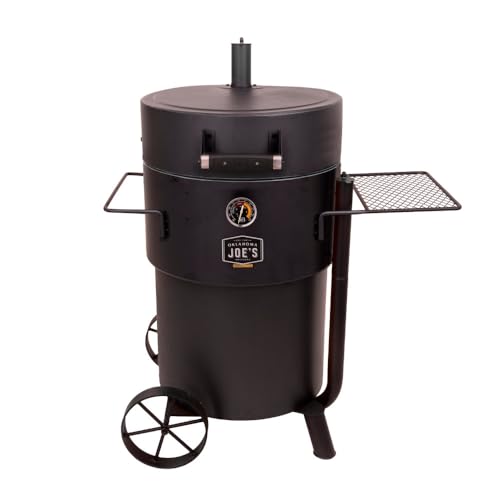
The Bronco Pro takes everything appealing about the portable Rambler and turns up the scale. Built as a vertical drum with a sealed lid, it sits between the small charcoal grill reviewed above and the larger offsets further down this list. The 366-square-in-cooking surface gives room for two pork shoulders, a brisket, or a stack of racks.
The oversize charcoal basket is the headline feature. Owners can load enough fuel for many hours of unattended smoking, which makes it a genuine weekend workhorse rather than something needing babysitting. Its airflow tuning mimics the sealed-drum feel that competition teams favor, all in a backyard-friendly size.
The Good Stuff
- Sealed drum design helps hold steady temperatures for low-and-slow cooks.
- Large charcoal capacity supports long overnight sessions without refueling.
- Vertical format keeps the footprint compact for a 366-square-in-cooker.
- Suitable for both grilling and smoking in one unit.
Small Caveats
- Drum smokers have a learning curve on vent tuning that beginners sometimes underestimate.
- Cleaning ash from a vertical drum requires tipping or vacuuming more carefully than a kettle grill.
Feature Snapshot
Made For
Backyard pitmasters who want long charcoal cooks without investing in a full-size offset rig.
Consider Something Else When
Direct grilling sear marks are a weekly must, in which case the Oklahoma Joe’s Canyon Combo’s propane side offers a faster path.
The Firecraft barrel steps sideways from typical enclosed smokers and gives a backyard fire pit the bonus of being a fully functional grill. With 480 square inches split across two heavy-gauge wire grates, there’s room to feed a dozen people, and the open-fire setup lets you adjust heat by stoking or spreading coals.
Unlike the Bronco Pro, this is not about slow smoking temperatures or sealed airflow. It’s about cooking over visible flame, hosting a fire-pit evening, and getting creative with open-flame techniques. For anyone whose idea of grilling involves roasting vegetables directly on coals, this hits a sweet spot.
A Strong Showing
- 360-degree access to the firebox makes stoking and rearranging food straightforward.
- Multi-use appeal: fire pit, open-flame grill, or a casual cooking station.
- Generous 480-square-in-capacity handles larger gatherings.
- Twist-lock grates allow easy adjustment while cooking.
Honest Caveats
- Open-fire design means less temperature precision than the Highland offset.
- No lid means smoking is not the realistic use case here.
Best Suited To
Outdoor entertainers who want a fire-pit centerpiece that doubles as a grill on weekends.
A Better Fit Elsewhere
Anyone focused on low-and-slow smoking will find the Oklahoma Joe’s Highland reverse flow far better suited to overnight cooks.
The Highland is a full-size offset smoker aimed at people cooking for a crowd and chasing competition-style bark. At 1,093 square inches, it towers over the Bronco Pro drum and accommodates whole briskets, multiple pork butts, or a small hog. Reverse flow, a layout where heat and smoke travel under a baffle before reaching the food, evens out the cooking surface, which means fewer hot spots than a traditional offset.
Removable baffles and an adjustable smokestack let the user flip between reverse-flow mode and standard offset smoking. That flexibility is rare at this size. The trade-off is footprint and weight, so this is a backyard cooker rather than something rolled around the patio.
What Pays Off
- Reverse flow design delivers more even cooking across the large grate.
- Large charcoal basket reduces mid-cook refueling on long burns.
- Adjustable smokestack allows tuning between traditional and reverse-flow modes.
- Heavy-gauge steel construction handles repeated high-heat sessions.
Trade-Offs
- Size demands a permanent spot in the yard and a sturdy pad.
- Offset smokers require vent and fuel management that first-timers often find steep.
Key Product Details
Who It Suits Best
Serious backyard pitmasters running whole-hog cooks and brisket parties.
Look Elsewhere When
Smaller yards or apartment patios rule it out, where the Oklahoma Joe’s Bronco Pro drum offers similar smoke character in a tighter footprint.
The Traeger Woodridge is the only pellet unit in this lineup, and it’s the most hands-off option in the roundup. Wood pellets feed automatically from a hopper into a fire pot, so temperature is set on a controller rather than dialed in by hand. For anyone juggling kids, work, and weekend projects, that automation changes the cooking experience entirely.
WiFi connectivity adds remote monitoring, allowing temperature and cook time checks from a phone. Capacity at 860 square inches is generous, falling between the Highland and the Canyon Combo, and supports ribs, multiple roasts, or a couple of chickens at once. The flavor profile is distinctly wood-fired rather than charcoal, and pellet availability matters more than charcoal supply.
Strong Points
- Automatic pellet feed delivers steady temperatures without constant vent checks.
- WiFi app integration simplifies long, remote cooks.
- Wide 860-square-in-grate handles family-sized meals.
- 6-in-1 versatility covers grilling, smoking, baking, roasting, braising, and BBQ.
Worth Bearing In Mind
- Pellet cookers rely on electronics and need access to power and dry pellet storage.
- Pellet flavor is milder than hardwood offset smoke, which purists may notice.
Whose Shelf It Belongs On
Tech-forward home cooks who want wood-fired flavor with minimal in-person cook management.
Swap It Out When
Charcoal purists chasing deep, traditional smoke flavor should consider the Oklahoma Joe’s Highland reverse flow instead.
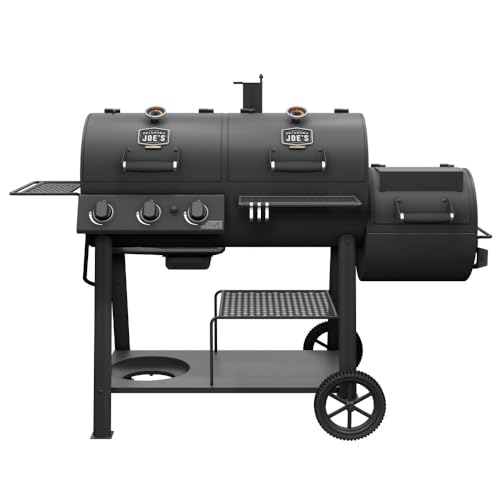
The Canyon Combo blends two worlds by pairing a charcoal and wood-burning smoker on the left with a three-burner propane grill on the right. The propane side hits 36,000 BTU and lights fast for weeknight burgers or weeknight seared chicken, while the charcoal side handles low-and-slow when there’s time to commit.
At 1,031 square inches total, including a 750-square-in-primary chamber, the Canyon sits in the same capacity tier as the Highland. The dual-fuel approach is the real draw. One rig handles brisket overnight and hot dogs the next afternoon, which suits households that don’t want separate equipment.
A Few Highlights
- Dual-fuel design combines charcoal smoking with propane grilling in one frame.
- Three-burner propane side delivers fast preheat for weeknight meals.
- Primary 750-square-inch chamber supports multiple large cuts.
- Single footprint replaces the need for a separate smoker and grill.
Practical Considerations
- Propane tank is sold separately and adds to overall setup cost.
- Large combined frame requires a permanent patio location.
Feature Rundown
Built With In Mind
Busy households that want charcoal smoke and propane speed from a single backyard rig.
Where A Sibling Pick Shines
Purists who only want charcoal and wood flavor will prefer the Oklahoma Joe’s Highland reverse flow for its focused offset design.
The Longhorn rounds out the roundup as a traditional offset smoker, which is a layout where the firebox sits beside the main cook chamber and heat travels across the food before exiting the stack. With 1,060 square inches split between primary and secondary chambers, it offers nearly the same capacity as the Highland but in a simpler, more familiar design.
For first-time offset owners, the Longhorn is often the friendliest entry point. It skips the reverse-flow baffle system but still gives the indirect-heat setup that defines authentic offset smoking. Owners get the full bark-and-smoke-ring experience without the larger price and footprint of higher-tier models.
What Makes Sense
- Classic offset layout teaches the fundamentals of indirect-heat smoking.
- Combined 1,060-square-in-cooking area handles family-sized cooks.
- Hardwood splits and chunks deliver traditional smoke character.
- Lower price tier among full-size offset options.
A Few Limitations
- Heat management requires more attention than reverse flow designs.
- Standard offset layout can produce hot spots near the firebox end.
Quick Facts
Who Will Love This
First-time offset owners ready to learn traditional smoking techniques without overspending.
Not Your Match When
Even heat across the entire grate is the priority, where the Oklahoma Joe’s Highland reverse flow baffle system outperforms a standard offset.
What To Weigh Before Choosing Pellet Grill And Smoker Comboes
Fuel Type And Flavor Profile
Charcoal and hardwood deliver the deepest, traditional smoke flavor but demand hands-on vent management. Pellets feed automatically and run through a controller for set-and-forget cooking, though the smoke character is generally milder. Propane, when present, is the fastest path to weeknight grilling but adds little smoke on its own.
Cooking Capacity Versus Footprint
A 218-square-inch portable grill feeds two-to-four people; a 1,000-plus-square-in-offset feeds a dozen or more. Larger chambers cook more food per session but require a permanent patio spot, a sturdy pad, and the room to safely open lids and access fireboxes.
Heat Control And Learning Curve
Drum smokers and reverse-flow offsets smooth out temperature swings. Standard offsets require more active fuel and vent management. Pellet grilles handle temperature automatically through a controller. Newcomers usually adapt fastest to pellet grilles or drum designs.
Build Materials And Durability
Heavy-gauge steel, welded seams, and reinforced handles extend service life. Light-gauge metal can warp over years of high-heat sessions. Coated finishes resist rust better but can scratch with rough cleaning.
Key Considerations Across These Picks
Pitfalls Shoppers Hit
Buying a giant offset for a small patio leaves no room to maneuver, while buying a portable grill for family parties means cooking in endless batches. Fuel cost matters too: charcoal and hardwood split costs accumulate faster than propane or pellets in some markets. Many first-timers also skip a cover, which shortens the life of any outdoor cooker.
Where The Extra Money Goes
Higher-tier models invest in thicker steel, sealed lids, larger fuel capacity, and smarter airflow. The payoff shows up in longer service life, fewer hot spots, and the ability to leave a cook unattended for hours. For occasional weekend cooks, a mid-tier offset is enough; for weekly use, the upgrade tends to pay back through durability and reduced babysitting.
Closing Thoughts
The right cooker matches the cook, not the catalog. Someone running weekday family dinners will lean toward the Canyon Combo or the Traeger Woodridge for speed and convenience. A weekend hobbyist chasing competition-style bark belongs in the Highland or the Longhorn, while tailgaters and small-space owners will find the Rambler hard to beat. Match capacity to the crowd, fuel to the patience level, and the rest of the roundup falls into place.