
A two-burner camp kitchen in a car trunk is overkill for a hiker who just wants hot coffee at sunrise. The right compact camping stove fits your pack, your fuel, and the way you actually cook outdoors, whether that means boiling water fast for freeze-dried dinners or simmering a real sauce over a weekend basecamp.
The seven picks below span ultralight backpacking systems, wind-defying canister stoves, and a wood-burning option that doesn’t need gas at all. Each one earns its place for a specific kind of outdoor cook, so the shortlist should narrow your search instead of widening it.
A Quick View Of The Lineup

Jetboil Flash Portable Fast Boil Stove with Cooking Cup

Jetboil Stash Ultralight Backpacking Stove System

Jetboil MightyMo Ultralight Camping and Backpacking Stove

Petromax Rocket Compact Outdoor Stove with Cast Iron Surface

Jetboil HalfGen Basecamp Cooking System
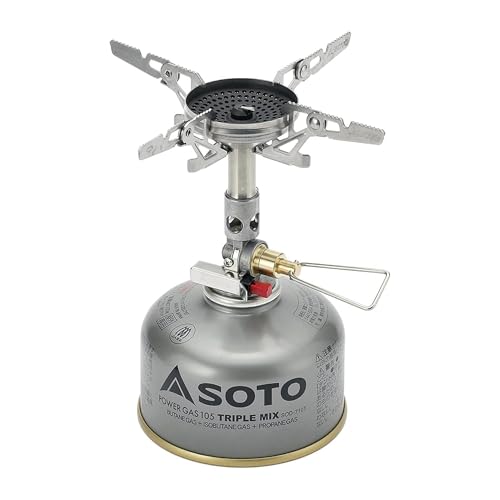
SOTO WindMaster Backpacking Stove with 4Flex

Jetboil Flash 1.0L Fast Boil Stove, Ocean Topo
A Deeper Look At The Lineup
The Jetboil Flash is the system most backpackers recognize on sight: a 1.0-liter FluxRing pot (a finned aluminum cup that wicks heat from the burner directly into the water) bolted to a burner base, an insulating cozy wrapped around the pot, and a single control knob up top. You twist it half a turn, the flame catches automatically, and roughly two minutes later you’ve got a rolling boil for two cups of coffee or a dehydrated dinner.
Compared to the Stash that comes later in this list, the Flash trades a few ounces for a more rugged feel and a clearer status reading. The color-changing heat indicator on the cozy tells you when water hits a useful temperature, which matters when you’re half-asleep at 5 a.m. in cold weather and don’t want to lift the lid to check.
What Stands Out
- One-step push-button ignition eliminates the need for a lighter on cold or wet mornings.
- The FluxRing pot pairs with the burner so heat moves into the water instead of escaping sideways, which shortens boil times and stretches a canister.
- The integrated cozy doubles as a handle, so pouring hot water into a freeze-dried bag feels steady, not precarious.
- Stacks into a single short cylinder, easy to slide into a pack’s side pocket or strap to a lid.
Trade Offs
- The cozy and plastic base need a few minutes to cool before packing, so post-dinner cleanup isn’t instant.
- It’s a closed system designed around the included pot, which limits your cookware choices for real meals.
- Fuel canisters are sold separately, so factor that into your first trip’s packing list.
Key Specs
Who It Suits Best
Three-season backpackers who mostly boil water for coffee, tea, and freeze-dried meals, and who want a stove that’s hard to misuse after a long trail day.
Look Elsewhere When
Cooks planning actual simmered meals should consider the Jetboil MightyMo, whose open platform handles a real skillet.
The Stash trims weight by separating the parts. Instead of one welded unit, you get a standalone titanium burner, a 0.8-liter FluxRing pot, and a stabilizer that nests inside. Owners commonly report the whole kit at roughly 7 ounces, which puts it in serious ultralight territory without crossing into fragile.
That weight savings pays off on long-distance routes where every gram matters more than a slightly faster boil. In everyday car camping, the Flash above feels sturdier; on a five-day section hike, the Stash earns its place.
Where It Delivers
- Titanium burner holds up to repeated pack-and-unpack cycles without much fuss.
- The 0.8-liter pot is a sweet spot for one person who drinks a lot of tea or splits a dehydrated dinner.
- Parts nest together so the kit takes up roughly the footprint of a Nalgene bottle.
- Still uses Jetboil’s FluxRing design, so boil times stay short relative to a generic canister stove.
Honest Caveats
- Without the Flash’s built-in igniter, you’ll want to pack a separate lighter or firesteel.
- The thinner titanium burner dissipates heat slightly faster than the Flash’s aluminum setup, so on windy ridges a windscreen helps.
- The smaller pot means real cooking for two requires a different vessel entirely.
Right Fit For
Solo thru-hikers and fast-packers who count ounces and drink plenty of hot water on the trail.
Consider Something Else When
Two-person trips that need larger meals should look at the Jetboil HalfGen, which scales up without going full basecamp.
The MightyMo is Jetboil’s answer to people who got tired of boiling water and started wanting a real skillet. The burner sits on a low, open platform instead of locking under a FluxRing pot, so a small pan or a titanium mug both fit comfortably. A four-turn regulator dial lets you walk the flame from a whisper to a rolling boil without the on-off-on-off dance of a basic valve.
It’s also notably efficient. The claimed three-minute boil time uses roughly half the fuel of a traditional upright canister stove, which adds up on week-long trips where resupply isn’t an option.
Everyday Perks
- The four-turn regulator gives finer simmer control than the single-knob Flash, so sauces don’t scorch.
- Open platform accepts your own pot or pan, useful for frying an egg or rehydrating something thicker than a freezer-bag meal.
- Lower fuel usage means fewer canisters shipped into remote resupply points.
- Light enough for backpacking despite the added versatility.
Worth Bearing In Mind
- The wider flame footprint wants a real windscreen in breezy campsites; otherwise heat loss drags boil times.
- No built-in igniter, so a separate fire-starter belongs in your kit.
- The regulator’s fine threads feel great in clean weather, but grit can make them stiff until cleaned.
Best Suited To
Camp cooks who treat dinner as part of the experience, want sautéed vegetables or a real sauce, and still care about pack weight.
Skip It When
Boil-only minimalists will leave features unused; the Jetboil Flash handles that workload with less fuss.
The Petromax Rocket is the odd one out in this list, and that’s the point. It’s a small cast-iron stove with a chimney that creates a strong updraft, so twigs, pine cones, and small branches become your fuel. No gas canisters to pack, no empty canisters to pack out, and a hot cooking surface that holds temperature well enough for a slow-cooked breakfast.
It weighs about 14 pounds and measures roughly 13 by 10 by 12 inches, so it’s firmly in car-camping and backyard territory. Anyone hoping to backpack into a high lake with this on their back should look at the SOTO or Stash instead.
The Value In It
- Burns whatever biomass is at hand, useful where canister fuel is hard to find or pricey.
- Cast iron cooking surface distributes heat evenly and seasons with use, similar to a cast-iron skillet.
- Sturdy build handles years of repeated trips without much complaint from owners.
- The chimney effect produces a clean, hot flame that minimizes smoke and residue.
Practical Considerations
- At roughly 14 pounds, it’s not a backpacker’s tool; think picnic-table or tailgate.
- Wet or snowy conditions make finding dry tinder a real chore.
- Fire restrictions in dry regions can rule out wood-burning stoves entirely.
- Cast iron needs a dry storage spot to avoid rust between trips.
Who Should Grab It
Backyard cooks and car campers who want the ritual of a real fire without hauling firewood the way a campfire requires.
Not Your Match When
Backpackers who need to cover miles each day will find the SOTO WindMaster a far better weight-to-function trade.
The HalfGen is the family-sized cousin of the Jetboil lineup. A 10,000 BTU output boils water in roughly three minutes and melts snow fast enough to matter on a winter car-camping trip. It also links to other Jetboil stoves via the JetLink cable, so two systems can share one fuel source and act like a two-burner camp range.
Where the Flash and Stash are personal gear, the HalfGen is something you set on a picnic table at a developed campground and forget about. For backpackers it’s overkill; for car campers feeding a small group, it’s quietly capable.
What Makes Sense
- The 10,000 BTU output handles bigger pots, dutch ovens, and serious meal prep.
- JetLink compatibility turns two units into a real cooking range at basecamp.
- Same regulator style as the MightyMo, so simmer control stays precise even at high output.
- Useful for melting snow into drinking water in winter conditions.
Things To Weigh Up
- Heavier and bulkier than the rest of this list, so it only fits car trips, not pack trips.
- Fuel use scales with that output; you’ll chew through canisters faster than a smaller system.
Feature Snapshot
Whose Shelf It Belongs On
Family car campers and basecamp cooks who feed a small group and want a single burner with enough output for real cooking.
A Better Fit Elsewhere
Solo backpackers who want more output than a personal system should jump to the Jetboil MightyMo instead, which keeps weight reasonable.
The WindMaster earned its name honestly. A concave burner head and a raised pot support sit inside a flame ring that blocks crosswinds from stealing your heat. The included 4Flex pot support folds flat but extends to four positions, so a tiny mug, a wider pan, or a tall pot all sit steady.
Unlike the Jetboil systems above, this is a standalone stove only, so you bring your own pot. For backpackers who already own a titanium mug or a small pot, that’s actually a feature, not a drawback.
Strengths Worth Knowing
- Wind performance is the standout trait; the burner stays lit and hot where generic stoves gutter out.
- The 4Flex support adapts to four pot sizes, useful when your cookware changes by trip.
- Regulator is compatible with standard butane, isobutane, and propane mixes (100% propane excluded).
- Folds flat and weighs only a few ounces, so it slips into a cook kit easily.
Things To Consider
- Fuel canister sold separately, and you’ll want to keep its plastic cap on between trips to protect the valve.
- Sandy or gritty ground can clog the burner; the brand recommends keeping the base off bare dirt.
- Boil times are slower than a Jetboil’s because there’s no integrated FluxRing heat exchange.
Who Will Love This
Alpine campers, exposed-ridge hikers, and anyone cooking in places where wind shuts down ordinary canister stoves.
Reach For A Different Pick When
Boil-and-go minimalists will find the Jetboil Stash faster for pure water-boiling duty.
This is the same proven Flash system reviewed first in this list, just wearing a different colorway. Jetboil’s refreshed ignition system still spins a half turn, clicks, and lights on the first try, no matches needed. The FluxRing pot still pulls heat into the water fast enough that two cups of coffee is a wait measured in minutes, not a coffee-break podcast.
The Ocean Topo color is a real differentiator if you care about gear that doesn’t look identical to everyone else’s. Functionally, you get the same cooking performance and the same 1.0-liter capacity as the standard Flash.
Features That Help
- Updated ignition feels more like turning on a home stove than lighting a camp burner.
- Thermochromatic indicator on the cozy signals when water is ready, useful in cold mornings.
- Pairs with most Jetboil accessories, including the coffee press and hanging kit.
- Distinctive colorway helps you spot your stove in a shared gear tent or rental pile.
Room For Improvement
- Color variant typically costs a little more than the standard Flash without adding performance.
- Still a closed system, so swapping in your own pot means buying an adapter.
Quick Facts
Perfect Match For
Weekend backpackers who want the same reliable Flash performance with a slightly more personal look on the trail.
Swap It Out When
Cooks who want a more versatile platform should pick the Jetboil MightyMo for skillet-friendly cooking.
Choosing The Right Compact Stove For Your Style Of Camping
Weight Versus Capability
Backpackers should treat every ounce as a vote. Systems under 10 ounces, like the Stash or WindMaster, vanish in your pack but trade some cooking versatility. Heavier basecamp rigs like the HalfGen or Petromax Rocket deliver real cooking power but only make sense when a car is doing the hauling.
Fuel Type And Availability
Canister stoves (Jetboil, SOTO) use screw-on isobutane or propane mixes that are easy to find at outdoor shops but heavy to ship internationally. Wood-burning stoves like the Petromax Rocket sidestep fuel logistics entirely, but tie you to dry biomass and clear fire regulations. Match the fuel type to the kind of trips you take.
Wind And Altitude Exposure
Alpine ridges, exposed campsites, and shoulder-season trips punish weak flames. The SOTO WindMaster’s flame ring and the Jetboil systems’ integrated FluxRing heat exchangers both protect the flame in ways a generic upright stove can’t. If you camp where wind is normal rather than exceptional, the trade-off favors lighter systems.
Real Cooking Versus Boil-Only
Coffee, tea, and freeze-dried dinners work fine on any closed system. Actual cooking, sautéed vegetables, simmered sauces, seared fish, asks for an open platform with a fine regulator, which is exactly what the MightyMo delivers.
Key Considerations Across These Picks
Where Shoppers Go Wrong
Picking a stove purely on boil-time claims is a common trap. Real-world boil times vary with altitude, wind, water temperature, and canister age, so a system that wins on paper can lose in your usual campsite. Another mistake is ignoring fuel logistics: a stove that needs a specific canister type isn’t much use on a trip where resupply is unreliable.
Why Top Tier Costs More
Premium systems earn their price through better regulators, integrated igniters, and heat exchangers that recover more energy from the same canister. Over a season, fuel savings and reliability can close the gap between a basic stove and a refined one, especially on long trips where convenience adds up.
Frequently Asked Questions
What Is A FluxRing?
A FluxRing is a finned aluminum or titanium band integrated into a pot’s base. The fins sit directly above the burner flame and pull heat sideways into the water, which speeds boiling and reduces wasted fuel compared to a flat-bottomed pot.
Can I Use These Stoves Indoors Or In A Tent?
Most canister and wood-burning stoves should only be used outdoors or in well-ventilated shelters. Burning fuel in an enclosed space produces carbon monoxide, which is dangerous regardless of how well the stove is vented.
Do I Need To Buy Fuel Separately?
For every canister stove on this list, yes. The stoves ship without a fuel canister, so a compatible isobutane or propane-mix canister is an additional purchase.
How Do I Store A Canister Stove Between Trips?
Keep the stove clean and dry, store it loose (not compressed inside a hot garage), and leave the fuel canister’s plastic cap in place. Most owners find a simple mesh bag keeps dust and debris off the burner between trips.
Are Wood-Burning Stoves Allowed Everywhere?
No. Many national forests, state parks, and dry-season regions restrict open flames and wood-burning stoves during fire bans. Always check local fire regulations before packing a wood-burning stove.
Final Take
The best compact camping stove is the one that matches your trips: ultralight systems for long trails, regulated open burners for real cooking, and wood-fired rigs for car camping where fuel logistics are a pain. Pick by use case first, weight second, and the right system usually reveals itself.