
Whole-home backup and serious job-site demand push wattage into the 18,000 range, but a true 18kW unit is heavy, loud, and built like a tank. Most shoppers land on the Westinghouse WGen14500DFc for its raw output and dual-fuel flexibility, while inverter picks like the Generac GP3300i serve a totally different role: quiet, clean power for tools and sensitive electronics. This list compares ten generators worth your attention, mixing heavy-duty workhorses with portable inverter units, so the right match for your setup becomes obvious fast.
The Shortlist At A Glance

ALL-Power 3300W Peak Power Quiet Inverter Generator, 19.5kg Portable

Generac 3,300 Watt Gas Powered Portable Inverter Generator, USB Charging

Generac 12,500 Starting Watt Tri-Fuel Portable Generator, Electric Start

Honda EB2200i 2200 Watt 120V Super Quiet Inverter Generator (EB2200ITAN)

Honda EB5000 5000 Watt 120/240V Quiet Generator (EB5000XK3AN)

Pulsar 2,300W Portable Gas-Powered Quiet Inverter Generator, G2319N

Generac 2,500 Watt Gas Powered Portable Inverter Generator, Outdoor Use

Champion Power Equipment 9000-Watt Electric Start Home Backup Open Frame Inverter
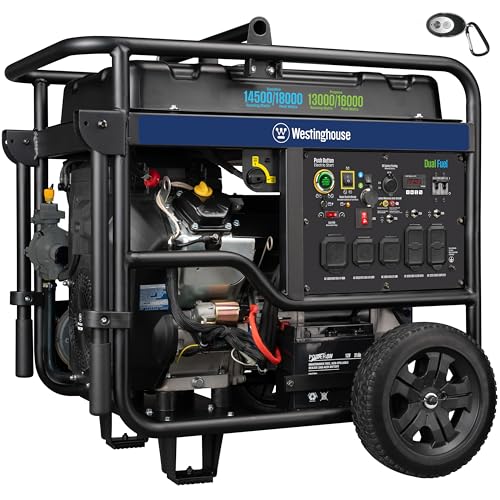
Westinghouse 18000 Peak Watt Dual Fuel Home Backup Portable Generator

Westinghouse 4650 Peak Watt Dual Fuel Portable Generator, RV Ready 30A
A Breakdown Of The Leading Choices
Trade crews who drag gear up truck beds all day feel the weight difference between a 19.5kg inverter and a 25kg+ rival pretty quickly. ALL-Power rates this unit at 3000W running with a 3300W peak, which covers drills, circular saws, and air compressors without breaking a sweat. The 67.6 dB noise floor makes it easier to work near homes, outdoor events, or small business setups where loud exhaust draws complaints.
An inverter means clean sine wave output, so laptops, charge controllers, and small electronics run safely alongside power tools. For most mobile crews, that versatility across jobs in one day is the real selling point.
A Strong Showing
- 3000W rated / 3300W peak handles job-site tools and 2-3 office setups at once
- 19.5kg frame is meaningfully lighter than comparable 3000W units
- 67.6 dB operation suits residential and event settings
- Inverter output keeps sensitive electronics safe on shared circuits
- Compact footprint loads into a work truck without rearranging the bed
Honest Caveats
- Runs on gasoline only, so storing fuel for long jobs becomes a logistics task
- No electric start; pull-cord ignition can be a grind in cold weather
- Smaller service network than the bigger-name brands if parts are needed
Who It Suits Best
Mobile trade crews, small business owners, and contractors who need clean power without lugging a heavy frame across job sites.
Skip It When
The Generac GP3300i suits homeowners wanting USB charging and tailgate-friendly operation more than a pure trade crew.
The Generac GP3300i sits in the sweet spot for tailgates, RV pads, and home backup where noise matters as much as wattage. At roughly 59.5 pounds, it’s still liftable by one person and stores easily in a garage corner. Compared with the ALL-Power above, this unit leans more toward recreation and emergency backup than heavy contractor use, and the USB ports make phone and tablet charging straightforward during a long outage.
Generac rates the GP3300i at 2,500 running watts with a 3,300W peak, which handles a fridge (around 700W running) plus lights, a TV, and a couple of charging cables at the same time. Inverter output means laptops and modern appliances stay happy too.
What It Does Well
- 2,500 running watts handle a fridge and small electronics together
- Built-in USB ports skip the wall adapter on phones and tablets
- Inverter-grade clean power for sensitive devices
- Single-person portable at under 60 pounds
Things To Consider
- 2,500 running watts won’t run a central AC or large well pump
- Pull-start only, which can be tough in freezing weather
Made For
Tailgaters, campers, and homeowners who want quiet backup for essentials during shorter outages.
Look Elsewhere When
The Honda EB2200i fits better when absolute quiet and Honda-grade refinement matter more than peak wattage.
Storm season has a way of emptying gas station pumps, which is exactly the scenario a tri-fuel generator is built for. The Generac GP9500E runs on gasoline, propane, or natural gas, so the fuel source can shift based on what’s available. Electric start removes the pull-cord scramble during a stressful power loss.
With 12,500 starting watts, this model steps up from the GP3300i and reaches well into whole-home backup territory. Owners commonly route it through a transfer switch to power furnaces, well pumps, and kitchen circuits at the same time.
Strong Points
- Three fuel options remove single-fuel dependency during shortages
- Electric start cuts ignition steps during stressful outages
- 12,500W starting watts cover furnaces, pumps, and large appliances
- Transfer-switch ready for permanent home installation
Points To Keep In Mind
- Heavy open-frame body; plan for wheeled placement, not lifting
- Natural gas hookup requires a professional line install
- Noticeably louder than compact inverter units
Right Fit For
Homeowners in storm-prone regions who want fuel flexibility and the wattage to run more than essentials.
Consider Something Else When
The Westinghouse WGen14500DFc fits shoppers who want maximum wattage and dual-fuel simplicity over tri-fuel capability.
Honda’s industrial-series EB2200i earns its reputation the same way Honda engines always have: it just runs, and quietly. Operating between 48 and 57 dB(A), it’s quieter than a normal conversation, so neighbors on a job site or in a campground won’t complain. The 120V industrial-grade inverter output also stays clean enough for computers and modern tool chargers.
At 2,200 watts, the EB2200i sits below the GP3300i on raw power, but trades that for Honda build quality and noise discipline. Trade workers who run diagnostic laptops on-site tend to gravitate here.
A Few Highlights
- 48-57 dB(A) operation keeps job-site and neighborhood noise low
- Honda industrial-series engine with a long service reputation
- Stable inverter output for laptops and sensitive diagnostic tools
- Compact frame fits in tight truck beds and storage corners
Trade Offs
- 2,200W limits you to smaller tools and lighter backup loads
- Honda build quality commands a higher price tier
- No electric start, just recoil ignition
Best Suited To
Field technicians, residential contractors, and quiet-campground users who prioritize refinement over raw wattage.
A Better Fit Elsewhere
The ALL-Power 3300W Peak Power Quiet Inverter is the right call for crews needing higher wattage and still-lighter-than-average weight.
The Honda EB5000 hits the contractor middle ground: 5,000 running watts with a 7,000W surge for ten seconds to start motors up to 3 horsepower. iAVR, which stands for Intelligent Automatic Voltage Regulation, keeps voltage steady as loads change, so power tools and equipment with sensitive electronics stay protected. The 120/240V output unlocks heavier 240V equipment like table saws and small welders.
At 63-65 dB(A), it’s quieter than most open-frame units in this wattage class, which helps on residential job sites. Compared with the EB2200i, this is the version a contractor reaches for when tools get bigger and outlets need 240V.
Real-World Strengths
- 7,000W surge handles 3hp motor starts without dropping tools
- iAVR keeps voltage steady for electronics alongside power tools
- 120/240V outlets unlock heavier stationary equipment
- 63-65 dB(A) is quiet for an industrial open-frame unit
Small Caveats
- Recoil start only; bring gloves for cold-weather pulls
- Heavier than the EB2200i and needs wheeled handling
Who Should Grab It
Contractors and serious DIYers running table saws, compressors, or small welders who need a 120/240V source.
Reach For A Different Pick When
The Generac GP3300i suits homeowners whose priority is quiet backup for a fridge and electronics, not contractor-grade voltage.
The Pulsar G2319N is the kind of generator that makes a first-time buy feel reasonable. At 2,300 peak watts and 1,800 running watts, it handles a campsite or a small backup setup without dominating the budget. Parallel capability means two units can be linked together to roughly double output, which is a clever escape hatch when a single inverter isn’t quite enough.
A 1.18-gallon tank delivers around 4.8 hours at half load, so a typical evening cookout or short outage gets covered. The direct-connect USB port charges phones without burning an outlet.
Features That Help
- Parallel-ready for doubling output by linking a second unit
- USB port charges phones without using a 120V outlet
- 4.8-hour runtime at half load covers most evening use cases
- Light enough to toss in a trunk or small storage bin
Worth Noting
- 1,800 running watts won’t power much beyond lights and small appliances
- Smaller fuel tank means more frequent refills on long days
Perfect Match For
Casual campers and tailgaters on a tight budget who want inverter-grade clean power for phones and small devices.
Where Another Pick Suits Better
The Generac GP2500i serves the same use case with a slightly higher 2,500W starting capacity for similar money.
The Generac GP2500i sits one step below the GP3300i but keeps the same quiet-inverter personality. With 2,200 running watts and a 2,500W peak, it covers a fridge (around 700W running) plus a few lights and charging cables without strain. The 46.6-pound frame is light enough for most adults to carry a short distance without dragging it.
For campers and homeowners, the GP2500i fills the “just enough” role nicely. Compared with the Pulsar above, you trade a parallel port for a slightly higher starting wattage and Generac’s broader service network.
Positive Takeaways
- 2,200 running watts handle fridge, lights, and phone charging together
- 46.6-pound frame is manageable for one person to carry
- Inverter output keeps modern electronics safe
- Generac’s service footprint simplifies parts and support over smaller brands
Minor Gripes
- No parallel capability like the Pulsar G2319N
- Pull-start only, no electric ignition option
Whose Shelf It Belongs On
Homeowners and outdoor enthusiasts who want reliable, quiet backup for essentials without the larger GP3300i footprint.
Not Your Match When
The Pulsar G2319N is the better choice when parallel capability and a USB port matter more than peak wattage.
Champion built this open-frame inverter to split the difference between quiet inverter units and raw traditional generators. At 9,000 watts, it covers most home-backup circuits alongside heavy tools, and CO Shield adds a layer of carbon monoxide sensing for indoor-adjacent placement. Electric start removes the cold-morning pull-cord routine.
Open-frame inverter design is a smart middle ground: more efficient than a conventional generator, far quieter than a traditional 9,000W unit. Owners commonly describe the noise level as closer to a window AC than a contractor-grade open frame.
Good Reasons To Consider
- 9,000 watts covers most home backup circuits and power tools at once
- CO Shield adds automatic carbon monoxide shutoff protection
- Electric start simplifies cold-weather or emergency ignition
- Open-frame inverter design balances noise and efficiency
Where It May Fall Short
- Open-frame body is heavier and bulkier than fully enclosed inverters
- Higher fuel consumption than the smaller inverter units on this list
Built With In Mind
Homeowners and contractors needing 9,000 watts without the noise penalty of a traditional open-frame generator.
Swap It Out When
The Westinghouse WGen14500DFc is the better match for shoppers needing full 18kW output for whole-home backup.
The Westinghouse WGen14500DFc is the closest match on this list to a true 18,000W class generator, with 18,000 peak watts and 14,500 running watts on gasoline. A 713cc V-Twin engine with a cast iron sleeve drives the output, and dual-fuel capability lets you switch between gas and propane on the fly. The 10.5-gallon tank delivers around 16 hours at 25% load, which covers overnight outages without a midnight refuel.
Remote electric start and transfer-switch readiness turn this from a portable generator into a near-permanent backup solution. The built-in CO sensor adds a safety layer when the unit runs near a home.
Positive Points
- 18,000 peak watts and 14,500 running watts approach full-house capacity
- Dual-fuel flexibility between gasoline and propane
- 10.5-gallon tank delivers up to 16 hours at 25% load
- Remote electric start and transfer-switch ready for permanent installs
- Cast iron engine sleeve supports long service life
Practical Considerations
- Heavy open-frame unit; permanent placement is often the realistic option
- Higher fuel draw than smaller inverter picks on this list
- Noticeably louder than compact inverter generators
Who Will Love This
Homeowners with transfer-switch setups who need whole-house coverage during multi-day outages or storm seasons.
Where A Sibling Pick Shines
The Generac GP9500E Tri-Fuel fits shoppers who prefer tri-fuel flexibility over raw wattage maximum.
The Westinghouse WGen3600DF pulls double duty for RV travelers and homeowners who want a smaller backup. At 4,650 peak watts (3,600 on gasoline, 3,240 on propane), it powers most 30A RV hookups plus a few essentials at home. A TT-30R outlet makes plugging into a camper straightforward without adapter juggling.
Remote electric start with auto choke is genuinely convenient for early-morning departures. The 212cc Westinghouse engine with a cast iron sleeve is built for the long-haul use RV owners put these units through, and never-flat polyurethane tires keep the rolling smooth.
The Upside
- RV-ready TT-30R outlet plugs straight into most campers
- Dual-fuel design runs on gasoline or propane
- Remote start with auto choke simplifies cold mornings
- Never-flat polyurethane tires handle rough campground roads
- 4-gallon tank with fuel gauge for clear runtime planning
Possible Compromises
- 3,600 running watts (gasoline) won’t power central AC in larger homes
- 68 dBA noise level is louder than fully enclosed inverter units
The Right Fit
RV travelers and homeowners wanting a smaller dual-fuel unit for travel, tailgating, or basic home backup.
Consider Something Else When
The Champion 9000W Open Frame Inverter fits homeowners needing much higher wattage for full-house backup use.
What To Weigh Before Choosing A High-Wattage Generator
Pick by use case first, raw wattage second. A contractor running a table saw has different needs than an RV traveler or a homeowner in a storm region. Matching the generator to the job keeps weight, noise, and fuel costs in proportion.
Matching Wattage To Real Loads
Add up the running watts of everything you plan to power at the same time, then add a 20% buffer for motor startup surges. A fridge (700W), furnace blower (600W), and a few lights (200W) total around 1,500W, but a fridge alone can spike to 2,200W on startup. Inverter generators (units that produce clean, stable AC output safe for electronics) like the Honda EB2200i or Generac GP2500i handle these smaller loads well, while the Westinghouse WGen14500DFc covers whole-house demands.
Fuel Type And Availability
Gasoline generators are universal, but fuel storage and pump access become issues during long outages. Propane stores indefinitely and burns cleaner, which makes dual-fuel units like the Generac GP9500E and Westinghouse WGen3600DF attractive for storm-prone regions. Tri-fuel units add natural gas as a third option for homes with existing gas lines.
Noise, Weight, And Runtime
Open-frame units deliver more watts per dollar but run louder and weigh more. Inverter generators sacrifice raw output for quiet operation and lighter frames. A 10.5-gallon tank on the Westinghouse WGen14500DFc delivers around 16 hours at 25% load, while a 1.18-gallon Pulsar G2319N runs roughly 4.8 hours at half load. Match runtime expectations to your outage patterns.
Outlet Configuration And Safety Features
240V outlets unlock heavier stationary equipment like well pumps and table saws. A TT-30R outlet is essential for RV travel. CO sensors (carbon monoxide detectors that automatically shut down the generator) on newer units like the Westinghouse WGen14500DFc and Champion 9000W add a safety layer for residential placement.
Key Considerations Across These Picks
Wrong Turns To Avoid
A common trap is buying maximum wattage when you really need portability, or grabbing a quiet inverter when you actually need to run a 240V well pump. Check the outlet panel before checkout. Another mistake is underestimating runtime needs; a generator that runs 4 hours per tank forces midnight refuels during long outages. Match tank size to expected outage length.
When Paying More Pays Off
The price gap between a basic 2,300W inverter and the Westinghouse WGen14500DFc buys you two things that matter in a real outage: enough wattage to run major appliances, and a 10.5-gallon tank for overnight operation. Premium picks like the Honda EB2200i and EB5000 cost more up front, but the Honda industrial-grade engine reputation and iAVR voltage stability reduce long-term headaches for contractors and frequent users.
Frequently Asked Questions
What can a true 18,000-watt generator actually power?
An 18,000W peak generator like the Westinghouse WGen14500DFc covers most household circuits simultaneously, including central AC, well pumps, electric ranges, and dryers. Running watts (the continuous output after startup surges settle) sit lower than peak, so plan your loads accordingly.
Are inverter generators better than open-frame units?
Inverter generators produce cleaner, more stable power for sensitive electronics and run quieter, but they typically cost more per watt. Open-frame units deliver higher output for the same money but are louder and less efficient. Match the type to your use case rather than chasing one spec.
How long can a portable generator run continuously?
Runtime depends on tank size and load. The Westinghouse WGen14500DFc runs up to 16 hours at 25% load on its 10.5-gallon tank, while smaller inverter units like the Pulsar G2319N run roughly 4.8 hours at half load. For multi-day outages, larger tanks and dual-fuel options reduce refuel frequency.
Can you run a portable generator in the rain?
Most portable generators should not run in direct rain without a cover or shelter, since water intrusion can damage electrical components and create shock hazards. Generator tents and weatherproof enclosures exist specifically for this purpose. Always check the manufacturer guidance for your specific unit.
Is a transfer switch necessary for home backup?
A transfer switch (a panel that safely disconnects your home from the utility grid before connecting to generator power) is strongly recommended for any generator connected to home wiring. It prevents backfeeding into utility lines, which can endanger line workers, and it lets you power hardwired circuits safely without illegal jumper cords.
Final Verdict
The right generator depends less on maximum wattage and more on the loads you actually run. RV travelers and campers get the most from portable dual-fuel or inverter units like the Westinghouse WGen3600DF and Honda EB2200i. Homeowners planning serious storm backup should weigh the Westinghouse WGen14500DFc, the closest match to true 18kW output on this list. Trade crews benefit most from lighter high-output inverters like the ALL-Power 3300W or the contractor-grade Honda EB5000. Match the tool to the job, and the rest of the decision follows naturally.